

In The Media
David Rothkopf
{
  "authors": [
    "David Rothkopf"
  ],
  "type": "legacyinthemedia",
  "centerAffiliationAll": "",
  "centers": [
    "Carnegie Endowment for International Peace",
    "Malcolm H. Kerr Carnegie Middle East Center"
  ],
  "collections": [
    "Iranian Proliferation"
  ],
  "englishNewsletterAll": "",
  "nonEnglishNewsletterAll": "",
  "primaryCenter": "Carnegie Endowment for International Peace",
  "programAffiliation": "",
  "programs": [],
  "projects": [],
  "regions": [
    "United States",
    "Middle East",
    "Iran"
  ],
  "topics": [
    "Political Reform",
    "Foreign Policy",
    "Nuclear Policy",
    "Arms Control"
  ]
}
Source: Getty
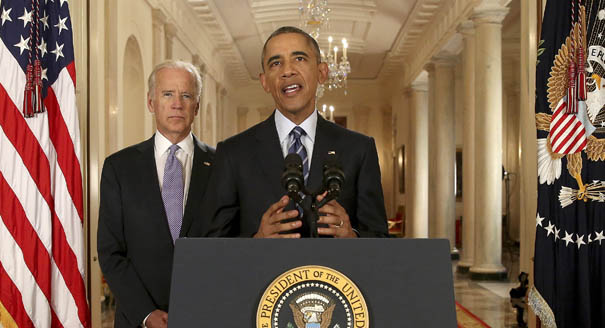
This podcast examines the key parts of the Iran deal and President Barack Obama’s foreign policy strategy in the Middle East.
Source: Foreign Policy
On the the heels of the advancement of the Iran deal, FP Group CEO and Editor David Rothkopf sits down at the Editor’s Roundtable (The E.R.) with Foreign Policy columnists Rosa Brooks and Kori Schake, and historian and FP contributor Robert Kagan. The conversation breaks down the key parts of the Iran deal and President Barack Obama’s foreign policy strategy in the Middle East. What are U.S. interests in the region? What’s ahead in terms of the Iran deal and how it will affect surrounding countries? This episode of The E.R. explores these pressing issues that are rocking today’s news headlines and political conversations.
Rosa Brooks teaches international law, national security, and constitutional law at Georgetown University. Follow her on Twitter: @brooks_rosa.
Kori Schake is a research fellow at the Hoover Institution where she focuses on military history. She is a former foreign policy adviser to Sen. John McCain. Follow her on Twitter: @KoriSchake.
David Rothkopf is the CEO and editor of FP Group. Follow him on Twitter: @djrothkopf.
Former Visiting Scholar
David Rothkopf was a visiting scholar at the Carnegie Endowment as well as the former CEO and editor in chief of the FP Group.
Recent Work
David Rothkopf
David Rothkopf
Carnegie does not take institutional positions on public policy issues; the views represented herein are those of the author(s) and do not necessarily reflect the views of Carnegie, its staff, or its trustees.

Cargo traffic through Russia’s Northern Sea Route has increased because of the disruption caused by the conflict in the Middle East, the Ukraine war, and U.S.-China tensions.

Mikhail Korostikov

Sergei Kiriyenko used Russia’s parliamentary vote to further hone his strategy of corporate mobilization that is designed to maximize votes for United Russia.

Andrey Pertsev

Trump has promised Belarus a massive potash deal. But Minsk is seeking something greater: restored Western transit and greater room for maneuver from Russia.

Balázs Jarábik

The European far right might fail to steer EU policy in the direction Russia wants, but they will create enough chaos inside Europe to benefit the Kremlin.

Dimitar Bechev

Minsk clearly expected the dialogue with Washington to yield more results, in particular the lifting of EU sanctions and permission to export potash.

Artyom Shraibman