

Paper
James M. Acton, Ankit Panda
{
  "authors": [
    "James M. Acton"
  ],
  "type": "other",
  "centerAffiliationAll": "dc",
  "centers": [
    "Carnegie Endowment for International Peace"
  ],
  "collections": [
    "Hypersonic Weapons"
  ],
  "englishNewsletterAll": "ctw",
  "nonEnglishNewsletterAll": "",
  "primaryCenter": "Carnegie Endowment for International Peace",
  "programAffiliation": "NPP",
  "programs": [
    "Nuclear Policy"
  ],
  "projects": [],
  "regions": [],
  "topics": [
    "Security",
    "Military",
    "Nuclear Policy"
  ]
}
Source: Getty
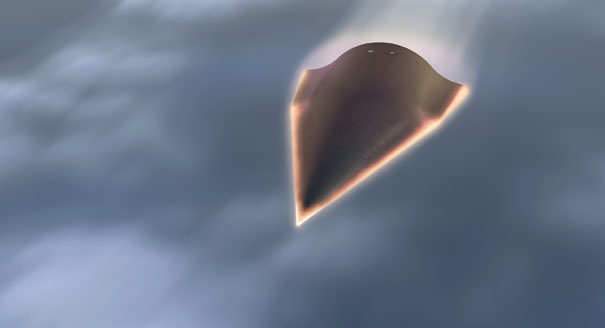
How do boost-glide weapons work? How effective will they be from a military standpoint?
Source: Science & Global Security
The United States, Russia and China are developing hypersonic boost-glide vehicles. A simple model of their trajectory is developed by assuming that the vehicle does not oscillate during the transition to equilibrium gliding. This model is used to analyze U.S. Department of Defense data on test flights for the Hypersonic Technology Vehicle-2. This glider's lift-to-drag ratio—a key performance parameter—is estimated to be 2.6. The model is also used to calculate the tactical warning time that a boost-glide attack would afford an adversary. Other aspects of boost-glide weapons’ military effectiveness are explored. Approximate calculations suggest that, compared to existing non-nuclear weapons, boost-glide weapons could penetrate more deeply but would be less effective at destroying silos. The distance at which a boost-glide weapon armed with a particle dispersion warhead could destroy a mobile missile is also calculated; it is expected to be significantly larger than for an explosive warhead....
This article was originally published in Science & Global Security. A supplement to the article can be found here.

Jessica T. Mathews Chair, Co-director, Nuclear Policy Program
Acton holds the Jessica T. Mathews Chair and is co-director of the Nuclear Policy Program at the Carnegie Endowment for International Peace.
Recent Work

James M. Acton, Ankit Panda
James M. Acton
Carnegie does not take institutional positions on public policy issues; the views represented herein are those of the author(s) and do not necessarily reflect the views of Carnegie, its staff, or its trustees.

Russian strikes are weakening the economy sustaining Ukraine’s war effort. Closing the growing funding gap will require more European support and politically contentious reforms in Kyiv.

Balázs Jarábik

The European far right might fail to steer EU policy in the direction Russia wants, but they will create enough chaos inside Europe to benefit the Kremlin.

Dimitar Bechev

With the growth in points of friction between the great powers, organizations like the SCO will continue to play a role in the strategic adaptation of the smaller powers caught between them.

Temur Umarov

Two divergent trends—Putin’s hardline vision of how to prosecute the war in Ukraine, and a growing desire for change in Russia—could tear the regime apart.

Tatiana Stanovaya

Andrey Melnichenko’s essay offers no answer to the fundamental question of how, under any kind of negotiated settlement, Europe can protect itself from the Russian ressentiment that is inevitable in all scenarios except for an outright victory for Putin.

Leonid Bershidsky