

Commentary
Maksim Samorukov
{
  "authors": [
    "Maksim Samorukov"
  ],
  "type": "commentary",
  "centerAffiliationAll": "",
  "centers": [
    "Carnegie Endowment for International Peace",
    "Carnegie Russia Eurasia Center"
  ],
  "collections": [],
  "englishNewsletterAll": "",
  "nonEnglishNewsletterAll": "",
  "primaryCenter": "Carnegie Endowment for International Peace",
  "programAffiliation": "",
  "programs": [],
  "projects": [
    "Eurasia in Transition"
  ],
  "regions": [
    "Russia",
    "Eastern Europe",
    "Belarus"
  ],
  "topics": [
    "Political Reform",
    "Foreign Policy"
  ]
}
Source: Getty
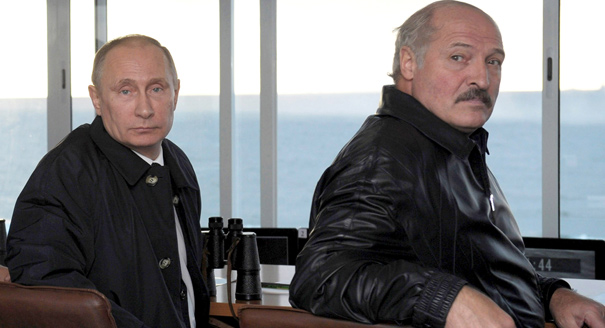
Recently re-elected Belarusian President Alexander Lukashenko is making maneuvers to get closer to the West and distance himself from Russia. But Moscow is not worried: it knows that his fundamental values differentiate him from Western countries.
At first glance there is nothing new about the fifth election of Alexander Lukashenko as president of Belarus on October 11. His return to power by an overwhelming margin, and with no credible opposition, looks the same as all his other victories since 1994. But there is one key difference. Lukashenko, once Moscow's closest ally, has abandoned all talk of integration with Russia.
In this election campaign Lukashenko prioritized improving relations with the European Union and even the United States, while Russia (without being openly named) was presented a threat for Belarusian sovereignty. The overall message was that to protect the nation from the external threat required the exceptional skills and experience of a statesman which only Lukashenko could provide.
Two years ago, when Ukraine's President Viktor Yanukovych tried to pull the same stunt and make a populist U-turn towards the West, there were sleepless nights in the Kremlin. Moscow did everything it could to stop Yanukovych.
That is not happening with Lukashenko. The Kremlin seems to be undisturbed when Belarus hosts a delegation from NATO, negotiates with the IMF, or seeks a new agreement with the European Union within the framework of the Eastern Partnership program.
It is as though the Russian leadership is not noticing Lukashenko’s about-face. But of course that is not the case. Moscow understands full well that, when it comes to rulers like Lukashenko, foreign policy is not important. Domestic policy takes priority--and that still gives the Russian leadership no grounds for concern.
Latterly, Lukashenko has scored some impressive successes on the Western front. The IMF is negotiating a new 3.5 billion dollar loan for Belarus. The EU is easing sanctions and working on a new cooperation agreement. In September, the US State Department’s Under Secretary of State Patrick Kennedy visited Minsk and discussed the possibility of restoring ambassadors, a step that might then lead to the reversal of US sanctions.
In the mean time, Minsk’s relations with Moscow are deteriorating. Lukashenko traded in his old campaign slogan of “For a Strong, Prosperous Belarus” in favor of “For the Future of an Independent Belarus,” suggesting that a fight to maintain the country's independence takes priority over even strength and prosperity.
Who exactly is threatening Belarussian independence? Voters are provided with plenty of clues. It is not NATO, whose delegation visited Belarus in April. However, the setting up of a Russian air-base, something that has been negotiated for two years, is abruptly rejected by Lukashenko.
When it comes to Ukraine, Lukashenko prefers to remain neutral. He continues to supply Ukraine with military hardware. The Belarussian leader didn’t find time to attend the Victory Day festivities in Moscow on May 9, but somehow his foreign minister did make room in his calendar for a meeting with the new governor of Odessa governor (and bête noire of Russia) Mikheil Saakashvili.
Moscow has been extremely tolerant of all these maneuvers. Russia's state-controlled television channels are not leveling corruption allegations against Lukashenko and Russia is not threatening Belarus with higher gas prices or oil duties. On the contrary: in August Belarus received a new 760 million dollar loan from Russia.
There is nothing new in Moscow’s hands-off policy towards Lukashenko. It is reminiscent of the treatment of certain east European states in the Soviet era and of the Romania of Nicolae Ceaușescu in particular.
Ceaușescu excelled at appearing to break the rules. He was friendly with Mao's China, criticized Moscow’s military intervention in Czechoslovakia in 1968 and even joined the IMF—all without precipitating a break with the Soviet Union. Czechoslovakia’s Alexander Dubček, on the other hand, tried to tread carefully in foreign policy while instituting liberal domestic reforms--but was brutally deposed by Moscow in 1968.
Deep down, the Kremlin understands that values do play a significant role in the West’s foreign policy decisions. That means that Lukashenko's rapprochement with the West will never be serious as long as his autocratic domestic regime remains in place. And as Lukashenko will not allow any domestic change, there is no reason for Moscow to worry.
On that front, little has indeed changed. The EU has welcomed the release of Belarus's six remaining political prisoners. But everyone understands that this is a well-choreographed two-step process in which political opponents are imprisoned precisely so as to be amnestied. This does not constitute a real political liberalization.
Lukashenko's weakest point is the economy. Belarus' GDP is forecast to contract by 3.5-4 percent in 2015 for the first time since the mid-1990s. Russia has already cut energy subsidies for Belarus in recent years. Moreover, the two main markets which account for more than half of Belarusian export—Russia and Ukraine--are in deep crisis. Russian loans are not enough, which is why Belarus is turning to the IMF, and Lukashenko is making some gestures about austerity.
And yet Lukashenko can feel relatively secure for one reason: Ukraine. Brainwashed by Russian state-controlled television channels, Belarusians have been so demoralized by the way Ukraine's Maidan turned out that they have no intention of following suit. That is why Lukashenko could be elected on a platform of “independence,” not “prosperity.”
However, if the paralyzing effect of the Ukrainian crisis begins to wear off and even the smallest threat to Lukashenko’s personal power emerges in Belarus, we can be sure that he will immediately put an end to all liberal experiments and tighten the screws once again. In 2010, as soon as several thousand protesters took to the streets, the kid gloves came off and there were mass arrests. That led to Western sanctions, isolation--and complete dependence on Moscow. Which is why the Kremlin has nothing to fear about Lukashenko's Belarus.
Fellow, Carnegie Russia Eurasia Center
Samorukov is a fellow at the Carnegie Russia Eurasia Center.
Recent Work
Maksim Samorukov
Maksim Samorukov
Carnegie does not take institutional positions on public policy issues; the views represented herein are those of the author(s) and do not necessarily reflect the views of Carnegie, its staff, or its trustees.

Russian strikes are weakening the economy sustaining Ukraine’s war effort. Closing the growing funding gap will require more European support and politically contentious reforms in Kyiv.

Balázs Jarábik

Ex-president Gurbanguly Berdimuhamedov remains interested in politics, but his son Serdar, Turkmenistan’s current president, is becoming increasingly independent and willing to break with his father’s legacy. If their covert rivalry goes too far, both risk losing power.

Galiya Ibragimova

Despite a new textbook, an influx of Russian teachers and managers, and an end to the teaching of Ukrainian, the Kremlin is unlikely to have “reprogrammed” locals.

Konstantin Skorkin

For every ruble allocated to social policy, health, and education in 2027, double that amount is earmarked for the army, the police, and the security services.

Alexandra Prokopenko

Cargo traffic through Russia’s Northern Sea Route has increased because of the disruption caused by the conflict in the Middle East, the Ukraine war, and U.S.-China tensions.

Mikhail Korostikov