

Article
C. Raja Mohan, Darshana M. Baruah
{
  "authors": [
    "C. Raja Mohan"
  ],
  "type": "legacyinthemedia",
  "centerAffiliationAll": "dc",
  "centers": [
    "Carnegie Endowment for International Peace",
    "Carnegie India"
  ],
  "collections": [],
  "englishNewsletterAll": "ctw",
  "nonEnglishNewsletterAll": "",
  "primaryCenter": "Carnegie India",
  "programAffiliation": "SAP",
  "programs": [
    "South Asia"
  ],
  "projects": [],
  "regions": [
    "South Asia",
    "Pakistan",
    "India"
  ],
  "topics": [
    "Foreign Policy",
    "Security"
  ]
}
Source: Getty
After the Bangkok breakthrough, Delhi has now established a direct line of communication with Pakistan’s army chief.
Source: Indian Express
After much trial and error, Prime Minister Narendra Modi appears to have found an appropriate framework for engaging Pakistan. New Delhi’s challenge now is to hold its nerve, amid the reflexive criticism at home of the government’s Pakistan policy, and make something of the political space that Modi and his advisors have been bold enough to generate in Paris and Bangkok.
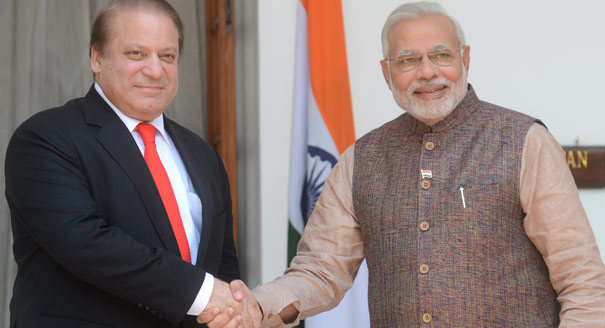
If Modi’s 160-second meeting with Pakistan PM Nawaz Sharif, on the margins of the Paris conference on climate change last week, had set the stage for the Bangkok breakthrough, equally significant has been the apparent establishment of a long overdue line of communication with the other Sharif — Raheel — who is Pakistan’s all-powerful army chief.
The appointment of Lieutenant General Nasir Khan Janjua, days after his retirement in October this year, as the new national security advisor in place of veteran civilian leader Sartaj Aziz underlined General Raheel Sharif’s quest for total dominance over Pakistan’s foreign and national security policies. It also opened the door for Delhi to directly connect with the army leadership in Rawalpindi.The accident-prone nature of the India-Pakistan dialogue tells us that the space created in Bangkok over the weekend might not last too long. No round of bilateral talks in the last quarter century could be sustained beyond a brief period. For, the political cycles across the border are rarely in alignment.
The diplomatic trick, then, lies in seizing the moment and moving decisively on a range of issues in the run-up to Modi’s planned visit to Islamabad to attend the South Asian Summit in mid-2016. Fortunately for the Modi government, much ground had already been covered during the tenure of former PM Manmohan Singh.
From normalisation of trade relations to the demilitarisation of the Siachen Glacier, and from building pipelines across the Radcliffe Line in the Punjab to defining a framework for the resolution of the question of Jammu and Kashmir, many potential agreements are on the shelf waiting to be dusted up. Generating forward movement is the only way to prevent a slide back in the next few months.
A sustained dialogue, in turn, has occurred only when India could directly engage Pakistan’s military leadership. One such period began in late-2003, when then PM Atal Bihari Vajpayee and his advisors established a channel of quiet negotiation with General Pervez Musharraf. This resulted in the institution of a ceasefire all across the International Border, the Line of Control in Kashmir and the Siachen Glacier, and the negotiation of an agreed framework for talks with Pakistan covering all subjects of mutual interest, including terrorism, Kashmir and economic cooperation.
Manmohan Singh ran with the baton passed by Vajpayee and presided over an expansive period of engagement that came to a close in early 2007, when Musharraf’s power began to ebb. The election of a civilian government led by Asif Ali Zardari in 2008 and the more complex internal dynamic of civil-military relations saw an extended period of uncertainty. The ambivalence of General Ashfaq Kayani, who succeeded Musharraf as army chief, the terror attack on Mumbai at the end of 2008, and the steady erosion of Zardari’s authority undermined Singh’s effort to revive the peace process.
Although Modi and Nawaz Sharif seemed eager to make a fresh beginning, Delhi’s attempt at rewriting the terms of engagement with Pakistan ran into the Pakistan army’s resistance. The lack of effective contact between Delhi and Rawalpindi added to the complications.
The appointment of Janjua and the contacts between him and National Security Advisor Ajit Doval over the last few weeks may have begun to change that. The presence of the two foreign secretaries at the Bangkok talks suggests greater coherence across the two establishments as they prepare to negotiate on substance. The inclusion of Asif Ibrahim, the PM’s special envoy on counter-terrorism and former director of the Intelligence Bureau, in the Indian delegation to the Bangkok talks raises hopes for much-needed exchanges between the security agencies.
At Bangkok, the two sides have also got past the problem of “sequencing” in the talks — what comes first, terrorism or Kashmir — that has hobbled recent efforts. They have now returned to the tried-and-tested formula of “simultaneous” talks on all issues of concern, which include terrorism for India and Kashmir for Pakistan.
This does not mean that Doval and Janjua have found a way to crack the problems of cross-border terrorism, 26/11 trials and Kashmir. Building trust through sustained engagement and concluding agreements on economic cooperation, however, could provide a more favourable context to address the difficult issues of terror and Kashmir.
It’s now up to External Affairs Minister Sushma Swaraj, who heads to Islamabad this week to attend an international conference, to articulate Delhi’s new political will for a mutually beneficial engagement with Pakistan.
This article was originally published in the Indian Express.
Former Nonresident Senior Fellow, Carnegie India
A leading analyst of India’s foreign policy, Mohan is also an expert on South Asian security, great-power relations in Asia, and arms control.
Recent Work

C. Raja Mohan, Darshana M. Baruah


Alexander Gabuev, Paul Haenle, C. Raja Mohan, …
Carnegie does not take institutional positions on public policy issues; the views represented herein are those of the author(s) and do not necessarily reflect the views of Carnegie, its staff, or its trustees.

With the growth in points of friction between the great powers, organizations like the SCO will continue to play a role in the strategic adaptation of the smaller powers caught between them.

Temur Umarov

When faced with fuel shortages in the past, Central Asian governments could always count on additional supplies from Moscow. That safety net no longer exists.

Galiya Ibragimova

Two divergent trends—Putin’s hardline vision of how to prosecute the war in Ukraine, and a growing desire for change in Russia—could tear the regime apart.

Tatiana Stanovaya
Andrey Melnichenko’s essay offers no answer to the fundamental question of how, under any kind of negotiated settlement, Europe can protect itself from the Russian ressentiment that is inevitable in all scenarios except for an outright victory for Putin.

Leonid Bershidsky

Despite unhappiness on the ground, Moscow is determined to use both carrot and stick to ensure there is record support for United Russia in occupied Ukraine.

Konstantin Skorkin