
Kazakhstan’s new constitution is an embodiment of the ruling elite’s fears and a self-serving attempt to preserve the status quo while they still can.
Serik Beysembaev
{
"authors": [
"Marc Lynch",
"Michael Wahid Wahid Hanna",
"Thanassis Cambanis"
],
"type": "legacyinthemedia",
"centerAffiliationAll": "dc",
"centers": [
"Carnegie Endowment for International Peace",
"Malcolm H. Kerr Carnegie Middle East Center"
],
"collections": [
"Arab Awakening"
],
"englishNewsletterAll": "menaTransitions",
"nonEnglishNewsletterAll": "",
"primaryCenter": "Carnegie Endowment for International Peace",
"programAffiliation": "MEP",
"programs": [
"Middle East"
],
"projects": [],
"regions": [
"Middle East",
"North Africa",
"Egypt"
],
"topics": [
"Political Reform",
"Democracy",
"Security"
]
}Source: Getty
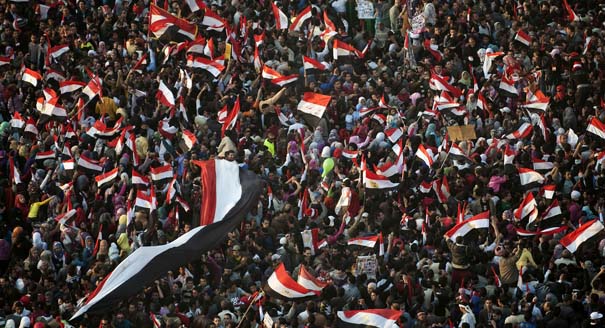
As the anniversary of Egypt’s January 25th revolution approaches, the direction of the country remains uncertain.
Source: Project on Middle East Political Science
Five years after Egypt’s revolution, the country faces challenges on numerous fronts. Looking back at developments since the onset of the Arab Spring and forward toward the country’s future, Marc Lynch discusses Egypt’s state of affairs Michael Wahid Hanna and Thanassis Cambanis.
This podcast originally appeared that the Project on Middle East Political Science.
Former Nonresident Senior Fellow, Middle East Program
Marc Lynch was a nonresident senior fellow in Carnegie’s Middle East Program where his work focuses on the politics of the Arab world.
Michael Wahid Wahid Hanna
Michael Wahid Hanna is a senior fellow at The Century Foundation and a nonresident senior fellow at the Reiss Center on Law and Security at New York University School of Law.
Thanassis Cambanis
is a senior fellow at The Century Foundation.
Carnegie does not take institutional positions on public policy issues; the views represented herein are those of the author(s) and do not necessarily reflect the views of Carnegie, its staff, or its trustees.
Kazakhstan’s new constitution is an embodiment of the ruling elite’s fears and a self-serving attempt to preserve the status quo while they still can.
Serik Beysembaev
The current U.S. indifference to human rights means Astana no longer has any incentive to refuse extradition requests from its authoritarian neighbors—including Russia.
Temur Umarov
Most of Moscow’s military resources are tied up in Ukraine, while Beijing’s foreign policy prioritizes economic ties and avoids direct conflict.
Alexander Gabuev, Temur Umarov
Arms supplies from Russia to Iran will not only continue, but could grow significantly if Russia gets the opportunity.
Nikita Smagin
The use of technology to mobilize Russians to vote—a system tied to the relative material well-being of the electorate, its high dependence on the state, and a far-reaching system of digital control—is breaking down.
Andrey Pertsev








