

Q&A
Matt Ferchen
{
  "authors": [
    "Matt Ferchen"
  ],
  "type": "legacyinthemedia",
  "centerAffiliationAll": "",
  "centers": [
    "Carnegie Endowment for International Peace",
    "Carnegie China"
  ],
  "collections": [
    "China and the Developing World"
  ],
  "englishNewsletterAll": "",
  "nonEnglishNewsletterAll": "",
  "primaryCenter": "Carnegie China",
  "programAffiliation": "",
  "programs": [],
  "projects": [],
  "regions": [],
  "topics": [
    "Economy"
  ]
}
Source: Getty
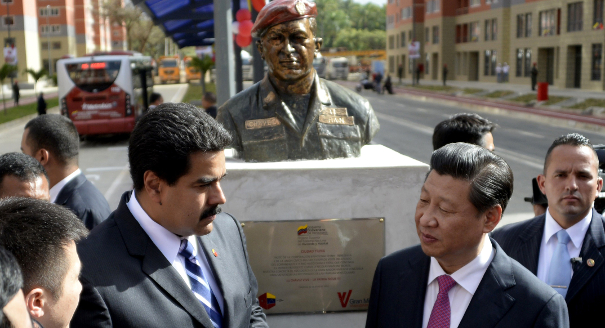
China’s economic relationship with oil-rich Venezuela has always been risky, but it has recently become more instable, given low oil prices and the Latin American country’s domestic politics.
Source: Latin America Advisor
Inter-American Dialogue: Over the past 10 years, China has loaned some $70.2 billion to Latin America for its energy sector alone, according to data from the Inter-American Dialogue’s China-Latin America Finance Database. How will Latin America’s energy sector be affected as China’s economic outlook and investment strategies evolve? How are low global oil prices changing China’s engagement with the energy sector in Latin America and the Caribbean? Is China responding to concerns about the environmental and social implications of the methods it uses when investing in the region’s energy sector? Will there be local unrest and pushback from the advances?
Matt Ferchen: When looking at the China-Latin America energy relationship over the last decade and into the near future, one country stands out: Venezuela. No Latin American country has established a bigger, or more problematic, energy relationship with China than Venezuela. And in turn, China’s engagement with Venezuela stands out for its sheer scale, riskiness, and now, instability.
In theory - and maybe at the beginning it approached this ideal - the relationship should have been simple and mutually beneficial: China needed oil and was willing to pay for a long-term energy partnership with Venezuela. And in turn, Venezuela sought to expand its oil export markets as well as to attract new sources of foreign energy investment; China fit the bill. What has gone wrong? Even before the dramatic drop in oil prices began in the middle of 2014, Venezuelan leaders’ politicization of the country’s oil resources and of PDVSA itself limited the expansion of oil flows to China. With the drop in oil prices contributing to the country’s steep descent into economic and political crisis, Venezuela is in an increasingly poor position to be the energy partner China had hoped it would be.
Yet China has not been blameless, its banks and oil companies misunderstood and miscalculated the direction and instability of Venezuelan politics and economic management, and so failed to anticipate the inevitable and harmful effects on Venezuelan oil management and output. Going forward, the immediate future for China-Venezuela oil ties rests on whether China is willing and able to work with Venezuela and possibly other countries and institutions to help put Venezuela and its oil industry on a more sustainable path.

Former Nonresident Scholar, Carnegie-Tsinghua Center for Global Policy
Ferchen specializes in China’s political-economic relations with emerging economies. At the Carnegie–Tsinghua Center for Global Policy, he ran a program on China’s economic and political relations with the developing world, including Latin America.
Recent Work
Matt Ferchen
Matt Ferchen, Anarkalee Perera
Carnegie does not take institutional positions on public policy issues; the views represented herein are those of the author(s) and do not necessarily reflect the views of Carnegie, its staff, or its trustees.

A much-discussed disagreement over internet restrictions in Russia was never an existential threat for Putin: It was about elite groups protecting their interests.

Alexandra Prokopenko

The demands of the Kremlin’s war in Ukraine, demographic problems, and public hostility toward Central Asians mean Russia does not have enough workers.
Salavat Abylkalikov
Minsk’s faith in the future of its larger neighbor’s economy is fading as Belarusian firms in Russia see record losses.

Olga Loiko

The cost of air defense has become an unregistered tax on revenue for businesses. While military rents are consolidated in the federal budget, the costs of defense are being spread across the balance sheets of companies and regional governments.
Alexandra Prokopenko
Powerful lobbyists and inertia led to Russia’s coal-mining sector missing an excellent opportunity to solve its structural problems.
Alexey Gusev