

Commentary
Nathalie Tocci, Jan Techau
{
  "authors": [
    "Jan Techau"
  ],
  "type": "legacyinthemedia",
  "centerAffiliationAll": "dc",
  "centers": [
    "Carnegie Endowment for International Peace",
    "Carnegie Europe"
  ],
  "collections": [
    "EU Integration and Enlargement",
    "Brexit and UK Politics"
  ],
  "englishNewsletterAll": "ctw",
  "nonEnglishNewsletterAll": "",
  "primaryCenter": "Carnegie Europe",
  "programAffiliation": "EP",
  "programs": [
    "Europe"
  ],
  "projects": [],
  "regions": [
    "Europe",
    "Western Europe",
    "United Kingdom",
    "Iran"
  ],
  "topics": [
    "EU"
  ]
}
Source: Getty
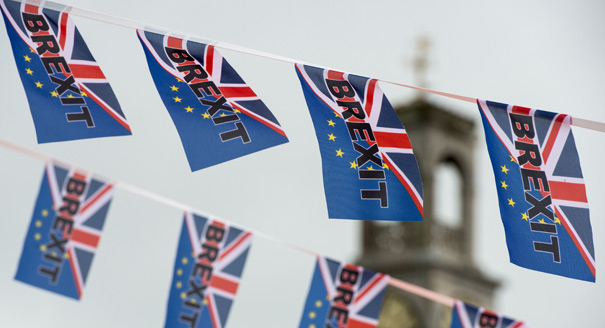
Will the decision to leave the EU hurt Britain more than Brussels?
Source: Euronews
Euronews spoke to Carnegie Europe Director Jan Techau to get his take on how the EU will handle the split with the UK.
Jan Techau: Of course the psychological impact couldn’t be overestimated. It’s a massive blow. The symbolic and political value of this vote we will only find out over the next few days and weeks you know how massive of a shock it is. It’s my guess it’s the biggest blow imaginable. I think it’s a bigger blow even than the height of the Euro crisis when we all thought that was the worst that we’ve seen. So that’s the one thing. On the other hand of course there are parts of the European integration process that direly need more Europe for example the Eurozone, where we need more political integration if we want to keep the currency afloat. So more Europe is not out of the window there. If it is out of the window in the Eurozone we will probably lose the currency. So you know there are very specific policy fields that will require perhaps more integration. I think you are right to say that perhaps this all across the board more integration move, this feeling that we should really work closer together, the ever closer union idea, that’s kind of finally out of the window. It’s been dead for a while, actually the air was out of that balloon a long time ago in Brussels but now that’s the final nail in the coffin.James Franey: And this couldn’t have come at a worse time because there are so many existential crisis that the EU has been facing over the past few years, you mentioned already the Eurozone crisis, but also the refugee crisis, I’m just wondering which way now for the EU, what steps have to be taken?
Jan Techau: Nobody knows how to handle this kind of situation, procedure needs to be implemented from scratch to have an orderly process for a country to leave, Apart from the negotiations, there are legal issues of course, that need to be taken. There’s the question of how Britain plays it, and triggers the process and when, and then there is the question how the rest of the bunch, the 27 react to it. It’s that they have to really walk a very fine line. On the one hand it’s understandable and i think to a certain extent unavoidable that the other 27 want to make it very costly. They want to set a precedent that this is not easily done and that no-one gets the idea in their heads that you can basically get out on the cheap. On the other hand if they go too harsh, if the price tag that they put to it is too high then that could have an adverse effect in that it is mobilising the already, very vibrant anti-Europe skeptic scene. They need to navigate this very carefully to find a middle way and that will require unbelievable skill and statecraft and patience and so it’s a new level of crisis management that nobody has ever tried in this town before.
James Franey: What do you think could be the final divorce settlement for Britain because if you talk to business leaders in the UK, they mention how the single market access is very important. Perversely we’ve just had a vote in Britain based on the issue of EU migration. Do you think that the Norway model could be the path that the next British Prime Minister will have to take?
Jan Techau: I think this is probably desirable from some of the British protagonists’ perspective, but I don’t think that you can replicate a Norwegian or a Swiss model very easily. First of all, these countries were never in, and so their special status has grown organically over many years and many decades, and in a way that is more a kind of natural arrangement that they have. They also had plenty of time to swallow their huge price tag, you know both politically and fiscally, that they have to accept for being part of the Eurosphere while not being a part of the decision making process. That is quite costly and not very attractive. In the British case, all of this needs to be negotiated within a few years, no organic growth, no step by step approach. Something new has to be invented. I think that’s going to be a lot more painful. I don’t think it’s really the model that Britain wants and we will soon find out that in the end Britain has lost a lot more than the EU. At the moment it looks like the EU is the damaged part here, I think as time progresses we will find out that the price on Britain of this decision is much higher than it is on the EU. Britain has a lot more to lose than Brussels does.

Director, Europe Team, Eurasia Group
Techau is director with Eurasia Group's Europe team, covering Germany and European security from Berlin. Previously, he was director of Carnegie Europe.
Recent Work

Nathalie Tocci, Jan Techau
Jan Techau
Carnegie does not take institutional positions on public policy issues; the views represented herein are those of the author(s) and do not necessarily reflect the views of Carnegie, its staff, or its trustees.

The European far right might fail to steer EU policy in the direction Russia wants, but they will create enough chaos inside Europe to benefit the Kremlin.

Dimitar Bechev

If the Russian-speaking community in Latvia cannot articulate their interests without being seen as disloyal, they could end up embracing a pro-Kremlin agenda.

Sergejs Potapkins
Andrey Melnichenko’s essay offers no answer to the fundamental question of how, under any kind of negotiated settlement, Europe can protect itself from the Russian ressentiment that is inevitable in all scenarios except for an outright victory for Putin.

Leonid Bershidsky
Whether PAS can refocus on the unfinished business of state-building may ultimately prove more consequential for Moldova’s European future than the pace of its accession negotiations.

Balázs Jarábik

Ongoing uncertainty in the Middle East allows Moscow to both increase its influence in Tehran and continue to enjoy the financial windfall of higher oil prices.

Nikita Smagin