

Q&A
- +1
Sheena Chestnut Greitens, Oriana Skylar Mastro, Yukon Huang, …
{
  "authors": [
    "Yukon Huang"
  ],
  "type": "legacyinthemedia",
  "centerAffiliationAll": "dc",
  "centers": [
    "Carnegie Endowment for International Peace",
    "Carnegie China"
  ],
  "collections": [],
  "englishNewsletterAll": "asia",
  "nonEnglishNewsletterAll": "",
  "primaryCenter": "Carnegie China",
  "programAffiliation": "AP",
  "programs": [
    "Asia"
  ],
  "projects": [],
  "regions": [
    "North America",
    "United States",
    "East Asia",
    "China"
  ],
  "topics": [
    "Political Reform",
    "Economy",
    "Trade"
  ]
}
Source: Getty
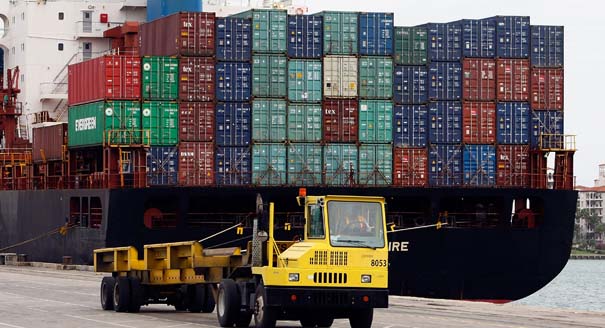
Accusing China of causing America’s trade deficits is politically expedient yet inaccurate. America’s deficits emerged long before the beginning of China’s large surpluses.
Source: China-US Focus
President-elect Donald Trump has capitalized on the fact that complaints about unfair competition are politically popular, with China often being the convenient target. Ask the average person in Detroit or even Washington, and he will likely say that China’s manipulation of its currency is one of the causes for America’s trade deficit and job losses. However, economic principles tell us that the current account balance of each country is determined within its own borders, not by its trading partners, and that employment gains or losses are rarely a trade issue.
The confusion comes from having China as the final assembly point and the shipping to the United States of parts produced by other Asian countries. This makes it difficult to determine which country is really responsible for the bulk of the value of finished products that end up in America.
China’s foreign investment-led industrialization process created the capacity for it to become globally competitive, while membership in the WTO provided it access to Western markets. This led to a dramatic increase in China’s account surpluses by the time of the global recession, while the U.S. and the EU were offset in part with deficits with the rest of the world. The size of its trade surpluses with the U.S. has led to China to being blamed for lost jobs, unfair competition, and low wage growth, although much of the surplus represents an “accounting” shift among countries in the Asian region.
Nonetheless, the fact that China accounts for the largest share of America’s trade deficit provides credibility for the storyline that Beijing has kept the renminbi undervalued for competitive reasons. However, there is no direct link between the emergence of America’s huge trade deficits and China’s trade surpluses. Moreover, there is little evidence that an undervalued renminbi played a major role in driving China’s trade surpluses over the past decade.

The fact that the U.S. and China’s trade balances are not directly linked is clearly illustrated by the historical numbers using shares of global GDP as the reference (see Figure 1). America’s trade problems became significant around the late 1990s when its current account deficit, as a share of global GDP, increased sharply and only began to moderate around 2007. But China’s account surpluses did not become significant until around 2004-05. As China’s surpluses increased, the U.S. deficit actually started to moderate. How could China be responsible for America’s trade deficits, when in fact America’s huge deficits emerged long before China even became a major export power?
A trade deficit is often the result of excessive government deficits and/or households consuming beyond their means—both of which have characterized the American economy over the past two decades. In such circumstances, a large trade deficit is inevitable. The countries that show up as being the source of the offsetting trade surpluses are incidental.
America’s bilateral trade deficits were concentrated among the more developed East Asian economies in the 1990s, most notably Japan, South Korea, and Taiwan. But this shifted to the Chinese mainland after it became the center of the regional production line with its accession to the WTO in 2001. Figure 2 indicates that U.S. manufactured imports from East Asia have decreased from about 45 percent of total U.S. manufactured imports in 1990 to about 20 percent in 2014. However, this a reflection of China gradually capturing an increasing share of the last stop in the global assembly chain. Thus, the appearance that U.S. trade deficits are linked with China’s surpluses is misleading. It is really about deficits with East Asia where many of the higher-value components are being produced.

The other major source of tension is the perception that China’s export strength is due to its exchange rate being deliberately undervalued. China exchange rate was fixed at 8.27 to the dollar from 1994 to 2005. For much of this period, the renminbi was widely seen as over-valued, not under-valued.
What eventually helped China to generate significant trade surpluses came from being able to access Western markets more easily after joining the WTO. Membership provided incentives to ramp up productivity-enhancing infrastructure investments that caused labor productivity to soar. Structural shifts, not an undervalued exchange rate, were the major factors driving China’s export capabilities.
Even if China’s exchange rate becomes less of a concern, emotions in the United States and Europe are likely to remain strong, thanks to the perception that manufacturing jobs have been lost to developing countries like China and that the incomes of the middle class have suffered from globalization. This has derailed any prospects of ratifying the U.S. led Trans Pacific Partnership (TTP).
The decline in manufacturing jobs in the United States is not strictly a China issue. The share of manufacturing workers in the United States has been declining for quite some time with the total number of manufacturing jobs peaking in 1979. China’s trade with the United States did not take off until the early 2000s, well after the U.S. job decline began.
The loss of American manufacturing jobs, however, has been driven by forces largely beyond the control of any leader or country. Technological advances, shifting industrial expertise around the world, and the availability of low-cost labor, if not in China then elsewhere in countries like India, Mexico, and Vietnam, have made the decline in manufacturing jobs inevitable in the United States. The process can be moderated but trying to stop it with trade barriers or restrictions on migration will ultimately prove to be ineffective with the costs showing up in reduced growth and welfare for all countries. Nor would higher tariffs bring many of these jobs back.
What made the process seem like a China issue is the speed and size of the loss in jobs that began as China became the center of the East Asian production network. With the recent decline in East Asia’s trade surpluses, the pattern of job loss has changed. Contrary to today’s popular perceptions, manufacturing jobs have actually been increasing of late in the United States. America’s exports to China are also becoming a major source of U.S. job generation with the Department of Commerce estimating that some 350,000 new jobs were created for this purpose during 2009-14. In contrast, the manufacturing labor force in China has been declining as workers’ salaries are now twice that of Vietnam and four times that of Bangladesh.
Yet, the reality is that the “hollowing” out of the middle class in the United States and Europe has given rise to frustrations that can no longer be placated by simply appealing to the supposed virtues of globalization. There are uncompensated losers in the process. As many have noted, political systems need to find ways to address local interests without giving up the benefits that globalization can bring. Countries like China need to play a role in the process by being more sensitive to the external consequences that their own structural shifts have created in the West and among other developing economies.

Senior Fellow, Asia Program
Huang is a senior fellow in the Carnegie Asia Program where his research focuses on China’s economy and its regional and global impact.
Recent Work


Sheena Chestnut Greitens, Oriana Skylar Mastro, Yukon Huang, …


Yukon Huang, Isaac B. Kardon, Matt Sheehan
Carnegie does not take institutional positions on public policy issues; the views represented herein are those of the author(s) and do not necessarily reflect the views of Carnegie, its staff, or its trustees.

Putin’s conservative staffing policies and search for ever greater control have cemented parliament’s transformation into a bureaucratic appendage of the executive branch.

Andrey Pertsev

Without a ceasefire with Ukraine on attacking each other’s energy infrastructure—to which the Kremlin is unlikely to agree—the diesel agreement between Putin and Trump is largely for show, rather than representing a genuine increase in the volumes of Russian diesel on the global market.

Sergey Vakulenko

Russian strikes are weakening the economy sustaining Ukraine’s war effort. Closing the growing funding gap will require more European support and politically contentious reforms in Kyiv.

Balázs Jarábik

Ex-president Gurbanguly Berdimuhamedov remains interested in politics, but his son Serdar, Turkmenistan’s current president, is becoming increasingly independent and willing to break with his father’s legacy. If their covert rivalry goes too far, both risk losing power.

Galiya Ibragimova

For every ruble allocated to social policy, health, and education in 2027, double that amount is earmarked for the army, the police, and the security services.

Alexandra Prokopenko