

Commentary
Sarah Chayes
{
  "authors": [
    "Sarah Chayes"
  ],
  "type": "legacyinthemedia",
  "centerAffiliationAll": "dc",
  "centers": [
    "Carnegie Endowment for International Peace"
  ],
  "collections": [
    "Democracy and Governance"
  ],
  "englishNewsletterAll": "democracy",
  "nonEnglishNewsletterAll": "",
  "primaryCenter": "Carnegie Endowment for International Peace",
  "programAffiliation": "DCG",
  "programs": [
    "Democracy, Conflict, and Governance"
  ],
  "projects": [],
  "regions": [
    "North America",
    "United States"
  ],
  "topics": [
    "Political Reform",
    "Democracy"
  ]
}
Source: Getty
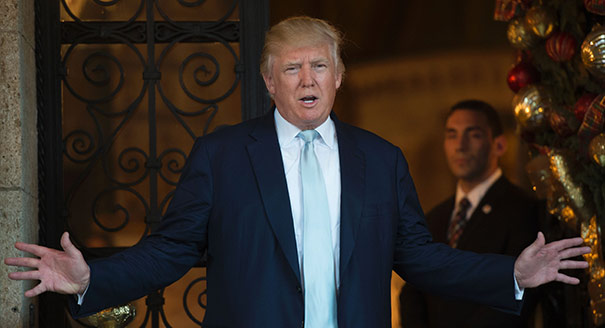
The Trump Organization’s continued business dealings with foreign governments, both at home and abroad, challenge the core principles of U.S. democracy.
Source: Los Angeles Times
Imagine President Trump was a peanut farmer who removed himself from his business and from decisions affecting the price of peanuts. Or make him a one-time haberdasher like Harry Truman. Americans could be proud of such a businessman president, injecting real-world considerations into the bubble of Washington decision-making.
The luxury hospitality business our president is keeping a grip on is of a quite different variety. In a case opening Oct. 18 in federal district court in New York, judges will be asked whether the Trump Organization’s operations, turned over to the president’s children but not entirely removed from his purview, counter a fundamental American principle: Public officials should be swayed only by the interests of the citizens they hold office to serve.
That principle is enshrined in the Constitution’s emoluments clause. Sometimes dismissed as an obscure provision, this ban on federal officials receiving any item of value from foreign governments (unless Congress expressly approves) is anything but. Violating it invites divided loyalties and influence-peddling at home and abroad — precisely what the founders set out to banish. As numerous social science studies have demonstrated, gifts or favors, even innocent ones, bring a sense of reciprocal obligation.
Every federal employee is familiar with the emoluments clause, which applies to anyone holding an “Office of Profit or Trust” in federal government. I will never forget, when I worked for then-Chairman of the Joint Chiefs of Staff Mike Mullen, opening an elegant box to eye a Rolex watch the government of Kuwait had given each member of Mullen’s traveling party — and then replacing it on the stack inside the airplane door. Unless I wanted to buy it at market value, that Rolex was property of the United States of America.
Investigative reporters have been detailing the profits Trump properties are reaping, as foreign officials are inclined to book rooms and hold events there. Trump has promised to turn over any foreign payments to the U.S. Treasury. No transfers have yet been publicly recorded.
This is hardly the first presidential run-in with the emoluments clause. Opinions are divided over President Reagan’s California state pension. Obama’s Nobel Peace Prize and the King Abdul Aziz Order of Merit he (and other U.S. presidents) accepted from Saudi Arabia were also debated. The Clintons sparked a furor by taking furnishings and other presents when they moved out of the White House. I have found no reporting that the haul included foreign gifts, which would have been unquestionably illegal. Foreign donations made to the Clinton Foundation while Hillary was secretary of State, although technically legal, were more problematic in principle.
Far from avoiding such gray areas, Trump has waded in deep.
For technical legal reasons, the complaint in Citizens for Responsibility and Ethics in Washington (CREW) vs. Donald J. Trump emphasizes foreign officials’ use of Trump properties in the United States. But the overseas dimension to Trump’s profiteering aggravates its dangers.
The Trump Organization is in business with several notoriously corrupt countries, including Panama, the Philippines and Indonesia. I have spent much of the past decade studying how countries like these work. Corruption, I’ve discovered, is not just a collection of isolated venalities but the operating system of sophisticated networks that deftly capture choice revenue streams. Favors bind the players together: Impunity for crimes is swapped for a cut of the take; shares in companies whose profits are inflated by beneficial legislation are payment for the corrupt laws. And luxury real estate is one of the industries that crops up again and again in these dealings.
In Indonesia, the Trump Organization is partnering with a billionaire politician on two resort developments, one of which will encroach on a national park on Java. The Lido project has benefited from the waiver of Indonesian environmental regulations designed to protect the irreplaceable tropical rain forest it uses as a marketing draw. A new government-funded highway will connect the resort to Jakarta — which will also invariably affect the rain forest.
In the Philippines, Trump’s business partner is also President Roderigo Duterte’s trade envoy in Washington, an official agent of the government.
In Panama, despite lawsuits over mismanagement that have reduced its role in the Trump Ocean Club International Hotel and Tower, the Trump Organization has drawn millions in fees in recent years from the development. A local lawyer told me the Panamanian government is paying to repair the sewage system that serves the Trump Ocean Club.
If the Trump Organization’s receipt of government largesse, and profits based on it, is allowed, not only could presidential decision-making be subject to foreign influence, the practices may come to seem normal at home as well as “over there,” fundamentally denaturing our democracy.
Americans may also be physically endangered. Corruption is hardly a victimless crime. It enrages people. In less than a decade, indignation at kleptocratic rule has swelled the ranks of groups battling the governments of Philippines and Indonesia, and militant groups elsewhere, such as Nigeria’s Boko Haram and Islamic State. Where the U.S. is perceived as enabling abuses, Americans have come under attack. Corruption has sparked revolutions across the Arab world and in Ukraine, and mass protests from Brazil to South Korea.
Americans are in step with this global zeitgeist. Trump, with his cries of “drain the swamp,” rode voters’ indignation at politicians’ self-dealing to the White House. Now he is betraying his electorate. He is just like other American elites: tone-deaf to citizens’ disgust at rigged systems.
The administration hopes to get CREW vs. Trump dismissed Wednesday. The judges should let it go forward, so Americans can take stock of the real threat that corruption poses to our national interest.
This article was originally published in the Los Angeles Times.
Former Senior Fellow, Democracy, Conflict, and Governance Program
Sarah Chayes is internationally recognized for her innovative thinking on corruption and its implications. Her work explores how severe corruption can help prompt such crises as terrorism, revolutions and their violent aftermaths, and environmental degradation.
Recent Work
Sarah Chayes
Carnegie does not take institutional positions on public policy issues; the views represented herein are those of the author(s) and do not necessarily reflect the views of Carnegie, its staff, or its trustees.

Minsk clearly expected the dialogue with Washington to yield more results, in particular the lifting of EU sanctions and permission to export potash.

Artyom Shraibman

If the Russian-speaking community in Latvia cannot articulate their interests without being seen as disloyal, they could end up embracing a pro-Kremlin agenda.

Sergejs Potapkins

Russia’s ruling party would have benefited from Putin appearing as its distant patron, but as an active frontman imposing his views on the public, he has done nothing but harm both the party’s election campaign and the ruling system overall.

Andrey Pertsev

In the tenth year of his presidency, President Mirziyoyev’s system is becoming even more personalized than that of his predecessor Karimov.

Galiya Ibragimova

The greater threat to Zelensky comes not from Fedorov alone, but from the convergence between the former defense minister’s political campaign and the anti-corruption investigations moving ever closer to the presidential administration.

Balázs Jarábik