

Commentary
Tatiana Stanovaya
{
  "authors": [
    "Tatiana Stanovaya"
  ],
  "type": "commentary",
  "centerAffiliationAll": "",
  "centers": [
    "Carnegie Endowment for International Peace",
    "Carnegie Russia Eurasia Center"
  ],
  "collections": [
    "Inside Russia"
  ],
  "englishNewsletterAll": "",
  "nonEnglishNewsletterAll": "",
  "primaryCenter": "Carnegie Endowment for International Peace",
  "programAffiliation": "",
  "programs": [],
  "projects": [],
  "regions": [],
  "topics": [
    "Economy"
  ]
}
Source: Getty
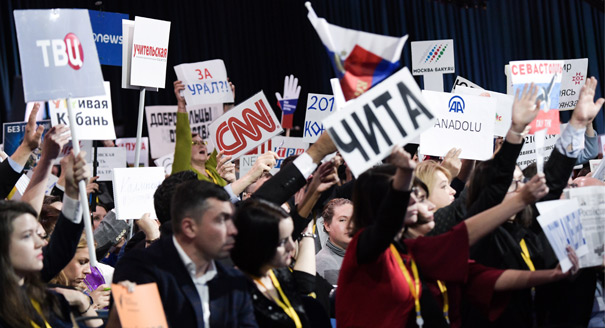
Vladimir Putin is sending out signals about how he sees his fourth presidential term. Domestic initiatives are not a presidential priority and will be dealt with at the technocratic level. In the political sphere, the real threat to Putin’s power comes from the moderate opposition. Above all, there is to be no more democratic window dressing. Preparations are well under way for a new act.
President Vladimir Putin is sending signals that his fourth term will be governed by an entirely new set of rules.
No one doubts that Putin will be reelected on March 18. Without an amendment to the constitution, the coming six-year term will be Putin’s last in office. Yet serious questions persist about his agenda and the direction of the state. A series of comments made by Putin at his Kremlin press conference on December 14 provided clues.
The press conference was not a campaign event. Putin’s responses reveal much about how he will conduct his fourth term—and fundamental changes in his conceptions about politics and governance. His role and political identity are inextricably linked to those of his regime, and are transforming along with it to a more advanced phase.
Throughout his tenure, Putin came to be seen as a hands-on leader with strong authoritarian tendencies, a command of public policy, and an ability to transcend partisanship by acting as an arbiter among his managers. Now, almost none of those qualities remain.
Putin has finally transferred the task of domestic governance to a lower, technical level. His absence of leadership in domestic politics has created a power vacuum, allowing independent domestic initiatives to emerge.
Policymaking by Russia’s Central Bank is one example. The bank’s relative autonomy is a stark rebuttal to Putin’s former system of consolidated control.
For the first time in recent memory, there is a clear demarcation between Putin and his governing circle, which includes both technocrats and liberal reformers like Alexei Kudrin and German Gref. Such initiatives as raising the retirement age, tax reform, and changes to monetary policy have been launched at lower government levels. Having been entrusted with new responsibility, Putin will now hold his managers accountable for positive results.
Putin’s press conference remarks reveal the distance he sees between himself and his managers. In emphasizing the decentralized nature of his government, he absolves himself of culpability for the policies of those under him—yet can claim the credit when their policies succeed. The president has in many ways become a symbolic leader, magnanimous in his role at the head of government while taking increasingly less responsibility for the governing itself.
Vladimir Putin’s new modus operandi is one of supervision from a distance. It is a policy of noninterference and excessive caution. He fears taking sides and creating imbalance among his ranks. On matters with serious implications for the state and his own rule—from the Ulyukayev case to corruption in the Investigative Committee—Putin has remained passive and unassertive. Getting involved would force a difficult decision: to start over or conduct a personnel shake-up, which would be expensive and disruptive. Instead, he has settled on making decisions only when the outcomes bear no political cost.
This represents a stark turn from the Putin of the 2000s, whose personalized regime was ruled with a strict and steady hand. Anyone who attempted to exercise power at lower levels in his vertical regime could be punished. This model has all but collapsed, leading to an emboldened domestic elite that, for now at least, supports their president.
The most significant news to come from the press conference was that Vladimir Putin will run for reelection as an independent candidate. Putin’s independent candidacy is not intended as a ploy to grant him greater electoral influence and status as a political referee. That is unnecessary, given his broad support. It has an entirely different purpose: the depoliticization of Putin. He is ceding his role as political leader, as the distinction between United Russia and the Communist Party or Liberal Democrats has blurred. Now, his main goal is to overcome the non-systemic opposition.
After eighteen years of Putin’s rule, Kremlin-sanctioned political opposition—what we might call the systemic opposition—has ceased to play any meaningful role. It has been subsumed within Putin’s authority. Two important conclusions follow from this. First, if there is no systemic opposition, then there is no party of power, hence Putin’s decision not to run on the United Russia ticket. The ruling party has become just another mechanism in support of the ruling regime.
Moreover, when the line between the ruling party and the systemic opposition is erased, the only opposition remaining is the organic opposition movement, which falls outside the president’s control and thus represents a threat to his power. Year after year, any real opposition has been aggressively repressed. Putin’s concept of political competition extends only to those who do not criticize the Kremlin.
Without speculating on his own political future, Putin conveyed several messages at his Kremlin press conference. For one, domestic initiatives are not a presidential priority, and will be dealt with at the technocratic level. In the political sphere, the real threat to Putin’s power comes from the non-systemic opposition, as the Kremlin-sanctioned political opposition has lost relevance in the current system. Above all, the press conference made abundantly clear that Putin is done with feigning democracy in Russia. The electoral system has been stripped of any democratic window dressing and preparation is well under way for a new act.

Senior Fellow, Carnegie Russia Eurasia Center
Tatiana Stanovaya is a senior fellow at the Carnegie Russia Eurasia Center.
Recent Work
Tatiana Stanovaya
Tatiana Stanovaya
Carnegie does not take institutional positions on public policy issues; the views represented herein are those of the author(s) and do not necessarily reflect the views of Carnegie, its staff, or its trustees.

A much-discussed disagreement over internet restrictions in Russia was never an existential threat for Putin: It was about elite groups protecting their interests.

Alexandra Prokopenko
The demands of the Kremlin’s war in Ukraine, demographic problems, and public hostility toward Central Asians mean Russia does not have enough workers.
Salavat Abylkalikov
Minsk’s faith in the future of its larger neighbor’s economy is fading as Belarusian firms in Russia see record losses.
Olga Loiko
The cost of air defense has become an unregistered tax on revenue for businesses. While military rents are consolidated in the federal budget, the costs of defense are being spread across the balance sheets of companies and regional governments.
Alexandra Prokopenko
Powerful lobbyists and inertia led to Russia’s coal-mining sector missing an excellent opportunity to solve its structural problems.
Alexey Gusev