

Article
Garima Mohan
{
  "authors": [
    "Garima Mohan"
  ],
  "type": "other",
  "centerAffiliationAll": "",
  "centers": [
    "Carnegie Endowment for International Peace",
    "Carnegie India"
  ],
  "collections": [],
  "englishNewsletterAll": "",
  "nonEnglishNewsletterAll": "",
  "primaryCenter": "Carnegie India",
  "programAffiliation": "",
  "programs": [],
  "projects": [],
  "regions": [
    "Europe"
  ],
  "topics": [
    "Foreign Policy"
  ]
}
Source: Getty
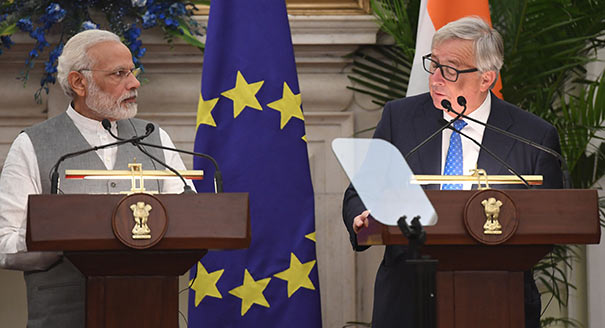
The European Union wants to partner with key players in Asia on shaping the rules around connectivity, and provide a comprehensive response to the Belt and Road Initiative challenge.
Source: German Marshall Fund of the United States
Europe’s initial enthusiasm about the Belt and Road Initiative (BRI) is tempering. BRI is undermining the EU’s internal cohesion, has the potential to impact European security, and is creating stiff competition for European companies on trade, investments, and market access in Europe and Asia. European policymakers are also beginning to realize the impact of BRI beyond the European continent — notably on the power balance and stability in Asia. Asian markets are important export destinations for Europe, and a majority of its sea-borne trade transits through the Indo-Pacific.
Europe, therefore, has a clear interest in maintaining a rules-based order and unhindered trade flows in the Indian and Pacific Oceans. Even though Europe is still grappling with the new “Indo-Pacific” framing, its interests converge with the Quad countries. Member states like France and Britain have already begun to reassess their security role in the Indo-Pacific. And the EU wants to partner with key players in Asia on shaping the rules around connectivity, and provide a comprehensive response to the BRI challenge.
This article was originally published by the German Marshall Fund of the United States.
Former Nonresident Fellow, Carnegie India
Garima Mohan was a nonresident fellow at Carnegie India. Her research focuses on the foreign and security policies of rising powers, particularly that of India, and on Europe-India relations.
Recent Work
Garima Mohan
Carnegie does not take institutional positions on public policy issues; the views represented herein are those of the author(s) and do not necessarily reflect the views of Carnegie, its staff, or its trustees.

With the growth in points of friction between the great powers, organizations like the SCO will continue to play a role in the strategic adaptation of the smaller powers caught between them.

Temur Umarov

When faced with fuel shortages in the past, Central Asian governments could always count on additional supplies from Moscow. That safety net no longer exists.

Galiya Ibragimova

Andrey Melnichenko’s essay offers no answer to the fundamental question of how, under any kind of negotiated settlement, Europe can protect itself from the Russian ressentiment that is inevitable in all scenarios except for an outright victory for Putin.

Leonid Bershidsky
Despite unhappiness on the ground, Moscow is determined to use both carrot and stick to ensure there is record support for United Russia in occupied Ukraine.

Konstantin Skorkin

Whether PAS can refocus on the unfinished business of state-building may ultimately prove more consequential for Moldova’s European future than the pace of its accession negotiations.

Balázs Jarábik