

Commentary
Peter Kellner
{
  "authors": [
    "Peter Kellner"
  ],
  "type": "legacyinthemedia",
  "centerAffiliationAll": "dc",
  "centers": [
    "Carnegie Endowment for International Peace",
    "Carnegie Europe"
  ],
  "collections": [
    "Brexit and UK Politics"
  ],
  "englishNewsletterAll": "ctw",
  "nonEnglishNewsletterAll": "",
  "primaryCenter": "Carnegie Europe",
  "programAffiliation": "EP",
  "programs": [
    "Europe"
  ],
  "projects": [],
  "regions": [
    "Europe",
    "Western Europe",
    "United Kingdom",
    "Iran"
  ],
  "topics": [
    "EU"
  ]
}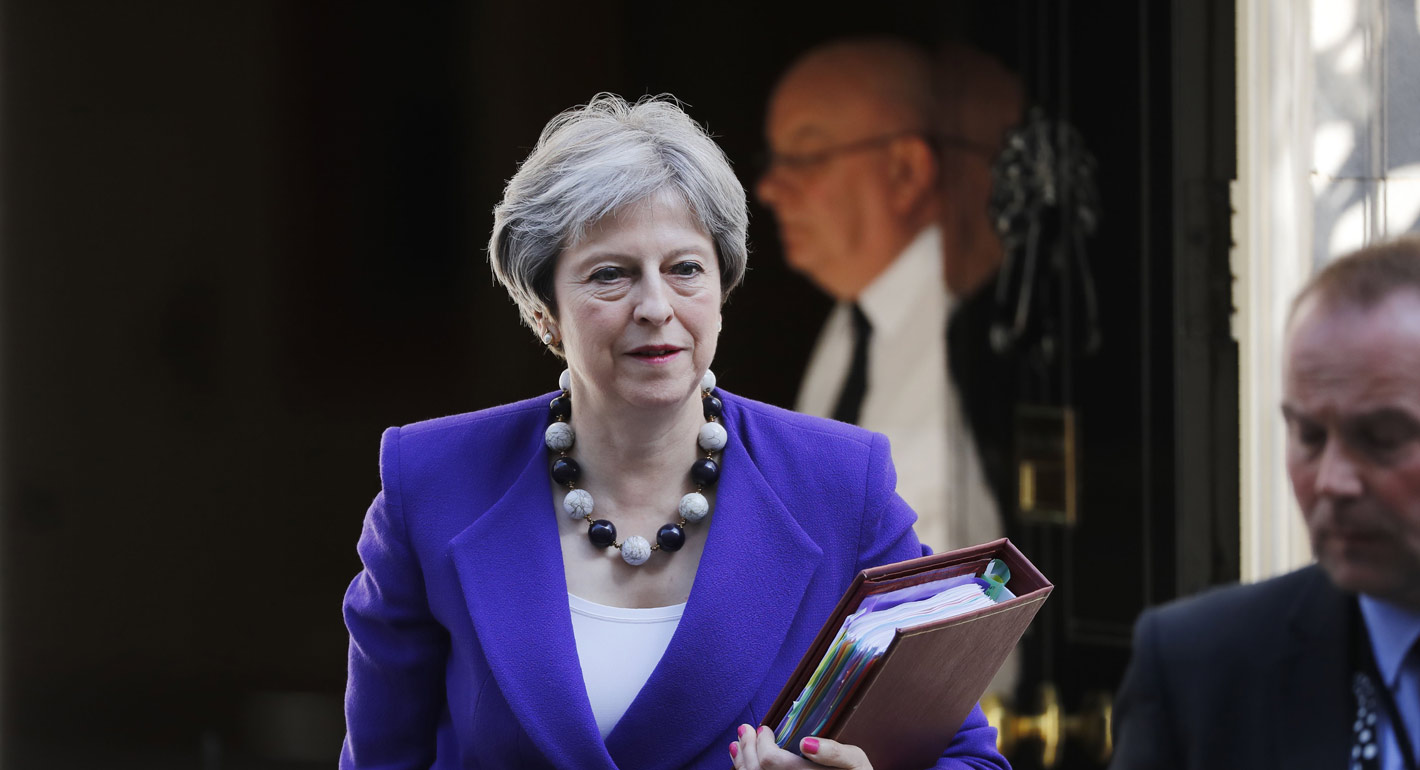
Source: Getty
The United Kingdom looks certain to remain in the EU at least into the summer of 2019—and, very possibly, indefinitely.
Faced with almost certain rejection, U.K. Prime Minister Theresa May delayed a parliamentary vote on Monday on her plans for leaving the EU. To win over MPs, she is now seeking to amend the deal, in particular the complex arrangements concerning the future of the border between the U.K. and Ireland — the only land border between the U.K. and the rest of the EU.
The big picture: EU leaders have made clear that the 585-page withdrawal agreement cannot be changed. All May can expect is a side letter containing a legally meaningless “clarification,” which will satisfy very few, if any, MPs in London. Whenever she calls the vote, she is likely to face a heavy parliamentary defeat.
Background: The U.K. Parliament voted to leave the EU on March 29, 2019. Without a deal, the prospects for the U.K.’s — and, to some extent, the EU’s — economy will darken. The government’s own projection is that a “no deal” Brexit could provoke an economic slump of 10%.
What's next: The pressure to prevent a “no deal” Brexit will be intense. There are several possible paths:
The bottom line: None of the three options can realistically be concluded by March 29. The U.K. looks certain to remain in the EU at least into the summer — and, very possibly, indefinitely.

Former Nonresident Scholar, Carnegie Europe
Kellner was a nonresident scholar at Carnegie Europe, where his research focused on Brexit, populism, and electoral democracy.
Recent Work
Peter Kellner
Peter Kellner
Carnegie does not take institutional positions on public policy issues; the views represented herein are those of the author(s) and do not necessarily reflect the views of Carnegie, its staff, or its trustees.

Andrey Melnichenko’s essay offers no answer to the fundamental question of how, under any kind of negotiated settlement, Europe can protect itself from the Russian ressentiment that is inevitable in all scenarios except for an outright victory for Putin.

Leonid Bershidsky

Whether PAS can refocus on the unfinished business of state-building may ultimately prove more consequential for Moldova’s European future than the pace of its accession negotiations.

Balázs Jarábik
Ongoing uncertainty in the Middle East allows Moscow to both increase its influence in Tehran and continue to enjoy the financial windfall of higher oil prices.

Nikita Smagin

Azerbaijan’s relations with the EU appear to be going from strength to strength after several years in the deep freeze following the military escalation in Karabakh in 2023 and Azerbaijan’s bitter fallout with France and several other EU member states.

Shujaat Ahmadzada
For the Middle Corridor to fulfill its promises, one of these routes must become scalable. At present, neither is.

Friedrich Conradi