

Commentary
Peter Kellner
{
  "authors": [
    "Peter Kellner"
  ],
  "type": "commentary",
  "blog": "Strategic Europe",
  "centerAffiliationAll": "",
  "centers": [
    "Carnegie Endowment for International Peace",
    "Carnegie Europe"
  ],
  "englishNewsletterAll": "",
  "nonEnglishNewsletterAll": "",
  "primaryCenter": "Carnegie Europe",
  "programAffiliation": "",
  "programs": [],
  "projects": [],
  "regions": [
    "United Kingdom",
    "Europe"
  ],
  "topics": [
    "Political Reform",
    "Foreign Policy"
  ]
}
Source: Getty
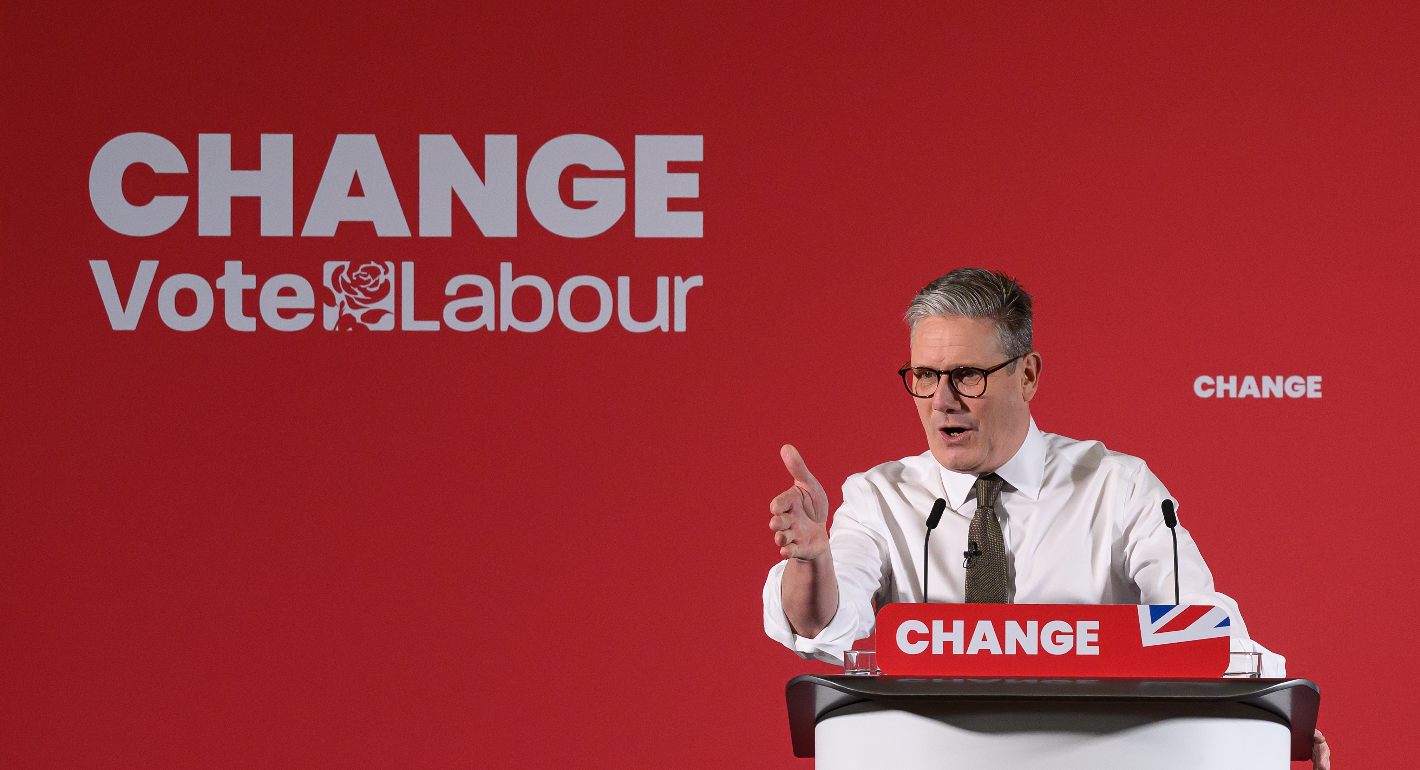
Britain’s Labour party looks set to win July’s general election. In recalibrating the country’s foreign policy, Keir Starmer’s government intends to work more closely with the EU while tackling global challenges.
Unless something extraordinary happens, fourteen years of Conservative rule in Britain will come to an end on July 4. As with most elections in most democracies, domestic issues—above all the economy—will matter more to voters than foreign affairs. However, eight years after the United Kingdom voted to leave the EU, two years after Russia invade Ukraine, and eight months after the war in Gaza erupted, it’s more relevant than usual to ask: would a Labour government seek to change Britain’s place in Europe and the world?
The short answer is yes, to an extent—but not nearly as much as if Labour had won either of the last two elections, in 2017 or 2019. Then, the party was led by Jeremy Corbyn, a lifelong opponent of NATO in general and nuclear weapons in particular. He is also a fierce critic of Israel and has faced accusations of anti-Semitism. If Labour wins this time, Keir Starmer, the new prime minister, will strike out in a very different direction. He has ruthlessly reclaimed control of the party from its left wing. He has rooted out anti-Semitism from the party’s ranks and expelled Corbyn.
Indeed, if Starmer does win on July 4, he will be the fourth cautious, unflashy center-left leader in recent years to take over from rulers from the right, following the victories of Joe Biden in the United States, Anthony Albanese in Australia, and Olaf Scholz in Germany.
For a start, Starmer’s Britain will continue to be a nuclear power and active member of NATO. It will maintain help for Ukraine. In recent months, Starmer has broadly supported the policy of Rishi Sunak, the current prime minister, toward Israel and Gaza. However, as with many leading figures in Western democracies, his initial support for Israel’s response to Hamas’s terrorist attack in October 2023 has evolved into mounting concern with the amount of death and destruction that Benjamin Netanyahu’s troops have inflicted on Gaza.
So far, so consensual. But not everything about Britain’s relations with other countries will remain unchanged. The fullest guide to Labour’s approach policy can be found in the current issue of Foreign Affairs. David Lammy, who will be foreign secretary in the new government, sets out his case for what he describes as “progressive realism.” He describes this as “using realist means to pursue progressive ends…. Instead of using the logic of realism solely to accumulate power, progressive realism uses it in service of just goals—for example, countering climate change, defending democracy, and advancing the world’s economic development. It is the pursuit of ideals without delusions about what is achievable.”
Lammy invokes two Labour predecessors, Ernest Bevin and Robin Cook. Bevin was foreign secretary from 1945 to 1951, Cook from 1997 to 2001. Bevin helped to set up NATO to oppose the Soviet Union; Cook promised a foreign policy with “an ethical dimension.”
So much for the label and its antecedents. What does progressive realism mean in practice? Lammy gives the following examples.
First, he rejects the liberal interventionism promoted by Tony Blair twenty-five years ago. Lammy says this was undermined by the failures of military action in Afghanistan, Iraq, and Libya, and “came to be seen as a recipe for disorder.” He says his government “will not repeat these errors.”
Second, given the conflicts and instability in Europe and its neighborhood, Lammy regrets that the UK and EU “have no formal means of cooperation… The United Kingdom must seek a new geopolitical partnership with the EU.”
On China, Britain must “adopt a more consistent strategy, one that simultaneously challenges, competes against, and cooperates with China as appropriate.”
Lammy also notes that on Ukraine and other issues, the Global South and Western democracies have drifted apart, partly because the West has “undermined the sovereignty of weaker states…. A Labour government would see its mission as supporting states’ sovereignty against forces such as Russian neo-imperialism, climate change, and corruption.” Given that by 2050, a quarter of the world’s population will live in Africa, Lammy says the next Labour government should “produce a new Africa strategy that does more than merely offer aid.”
Finally, Lammy singles out climate change as a huge, urgent challenge. “Leading powers have still not done nearly enough…. Progressive realism demands a more cooperative approach. Realists recognize that if fairness is not part of a global climate bargain, it will fail.”
The scope and general direction of Labour’s foreign policy is clear; the details, perhaps inevitably, less so. In particular, Labour restricts Lammy’s specific reference to the EU to military cooperation. He says nothing about how Labour would seek to undo the damage that Brexit us doing to Britain’s economy.
This is not surprising. Starmer and Lammy fear that any specific proposals to lower the trade barriers between the UK and EU would provoke a fierce backlash from the Conservatives and their allies in the media, and accusations that Labour wants to reverse the result of the 2016 referendum.
Once in power, Labour will not be able to stay silent for long. What will it do? History provides one possible answer. In 1964 Labour returned to government under Harold Wilson, less than two years after France’s President de Gaulle had vetoed the application by Harold Macmillan, the Conservative prime minister, to join Europe’s common market. Labour’s election manifesto accepted that outcome and promised that its foreign policy would focus on the Commonwealth.
Labour won narrowly; less than eighteen months later it held a fresh election to increase its majority. This time it promised to apply to join the common market as part of a quest for “a wider European unity.”
According to the old saying, history never repeats itself, but sometimes it rhymes. Will Starmer prove to be as flexible as Wilson? We should find out within the next few months.
Former Nonresident Scholar, Carnegie Europe
Kellner was a nonresident scholar at Carnegie Europe, where his research focused on Brexit, populism, and electoral democracy.
Recent Work
Peter Kellner
Peter Kellner
Carnegie does not take institutional positions on public policy issues; the views represented herein are those of the author(s) and do not necessarily reflect the views of Carnegie, its staff, or its trustees.

With its public finances in shambles, the far right polling at 35 percent ahead of the 2027 presidential election, and a growing protest movement, is France’s crisis a threat to the EU’s geopolitical awakening?

Rym Momtaz, ed.

Ahead of a tough winter for Ukraine, Donald Trump’s swing back toward Russia bodes ill. But instead of panicking, Kyiv’s European allies are focusing on action.
Rym Momtaz

While the EU and European governments are embracing the much-lauded middle-power moment, this entails three difficult conundrums.

Richard Youngs

Much has been said of the changes Brussels is trying to make to the EU enlargement process. Here’s why gradual integration might—or might not—be the answer.

Dimitar Bechev

The European Commissioner for Trade is headed to China. But after President Xi’s bridge-building visit to Washington, can a more isolated EU overcome Beijing’s stranglehold on critical raw materials? Who will blink first?
Rym Momtaz, ed.