

Commentary
Andrei Kolesnikov
{
  "authors": [
    "Andrei Kolesnikov"
  ],
  "type": "legacyinthemedia",
  "centerAffiliationAll": "",
  "centers": [
    "Carnegie Endowment for International Peace",
    "Carnegie Russia Eurasia Center"
  ],
  "collections": [],
  "englishNewsletterAll": "",
  "nonEnglishNewsletterAll": "",
  "primaryCenter": "Carnegie Endowment for International Peace",
  "programAffiliation": "",
  "programs": [],
  "projects": [],
  "regions": [
    "Russia"
  ],
  "topics": [
    "Political Reform"
  ]
}
Source: Getty
The confrontations between society and the authorities which are spreading across the country shouldn't be taken lightly.
Source: Moscow Times
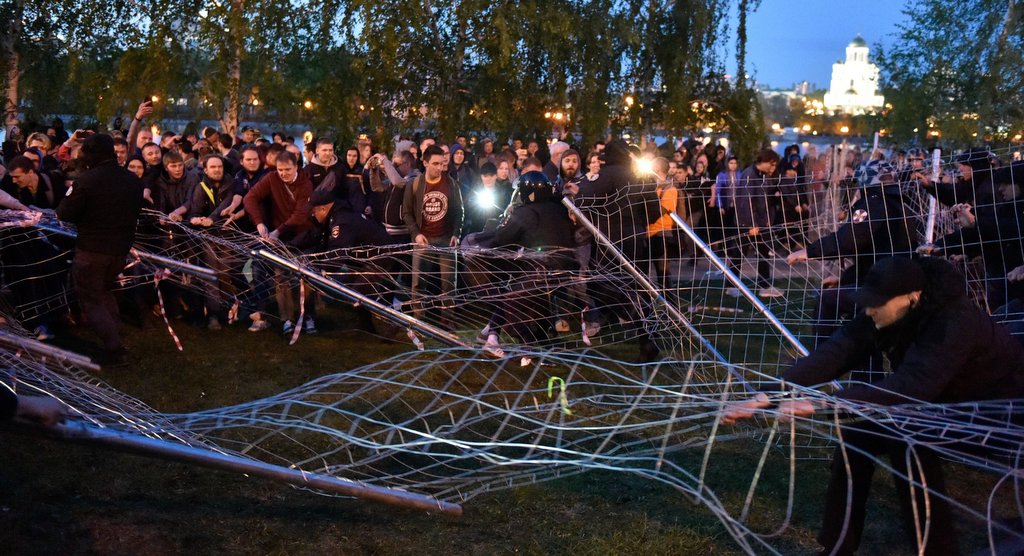
The confrontation that broke out this week between opponents of the construction of a Orthodox church in Yekaterinburg's central park and the church’s supporters — which include the authorities, two major corporations and the Russian Orthodox Church itself — is yet another episode of Russia’s growing civil tensions.
These battles — which pit a largely chaotic and informal civil society on one side and the authorities, as well as the businesses supporting them, on the other — have become widespread throughout Russia.
This unrest is provoked by a variety of issues: The demolition of private houses without the consent of citizens; landfills and waste disposal that are preventing people from living healthy lives; and the endless construction of Orthodox churches in public spaces.
While these protests are spontaneous, without leaders and often marked by desperation, they should still be taken very seriously.
The authorities are increasingly responding not with exhortations, but with direct acts of violence, and violence is often outsourced to strong young people of "sporting appearance."
This is not a new occurrence in Russia. Soviet authorities also made use of "workers with bicycle chains" against "dissidents." In fact, this model of protest suppression has been replicated — there will always be an “outraged supporter” of the authorities.
In spring 2017, the authorities were taken by surprise when protests against the demolition of five-story buildings in Moscow began. The "rulers of the city" could not understand what had happened; they were thinking that moving Muscovites to new houses would make them happy, but locals simply did not trust developers and local officials.
Not long after, locals in Russia’s Far North started to rally against the construction of a landfill that would take in Moscow’s waste. Their protests have been going on for many months now.
The front line has now moved to Yekaterinburg — a city linked to Boris Yeltsin, Russia’s first president and a symbol of democracy in the 1990s — as residents protest to keep their public park.
Despite their intent of uniting people, the building of religious structures is creating gigantic fault lines in Russian society. Previous clashes over a program to build 200 churches in Moscow have not acted as a valuable lesson: Yekaterinburg is stepping on the same rake.
The determination of Yevgeny Kuyvashev, the governor of Sverdlovsk region, to push the initiative through is a testament to the authorities’ determination to act by force.
In Russia, the church and state have become virtually inseparable. But the biggest problem is that officials are not ready to listen to ordinary citizens, who are immediately viewed as paid agents of Russia's enemies. Whoever is against the church is against the state.
But the confrontation between the authorities and citizens isn’t just about officials’ inability to listen to the people. It instead reflects a conscious policy to provoke rather than prevent conflicts.
Three years ago, Denis Volkov, my colleague from the Levada Center polling agency, and I predicted a conflict developing while we were studying a new phenomenon related to the authorities’ deafness to Moscow’s civil society.
At the time, respondents said that they were not against the construction of churches, but that they should be asked if they want to see a church in this place and not in another.
The fierce confrontation between citizens and authorities and the church near Boris Yeltsin Street looks symbolic: What the first Russian president had fought for is now being shamelessly trampled by Russia’s authorities today.
In Yekaterinburg, authorities and church supporters emphasize that those opposed to the construction are a small minority. But the majority that will always stand behind the authorities is, in fact, artificial.
Such a model has been used to build pro-Putin meetings, or "putings," which have become widely known since 2012, and which are being used by "voluntary and forced" state employees, as well as employees of public and private enterprises that are dependent on the state.
The same people voted for Vladimir Putin using these techniques in March 2018, and then reported to their superiors on how and when they fulfilled their "civic duty.”
Yes, the majority consists of such people — and they have passively supported and will support the government. But democracy is the sum of minorities. And civil society is made up of the people who have something to protect, namely their property, their private space and their constitutional rights.
The events in Yekaterinburg have once again showed that a new civil society is emerging in Russia and that it is not afraid to defend its rights.
The authorities will try to buy civil society in order to suppress it, but there are parts of civil society that cannot be bought or sold.
And that is why its confrontation with the state will only worsen. Not just in Moscow and St. Petersburg, where the previously unimaginable happened — arrests during a coordinated May Day procession — but also in Arkhangelsk and Yekaterinburg.
This new reality, however, cannot be called a “new normal.” If local authorities in the regions continue to suppress unrest with the use of force, the degree of not only social but also political tension in the country will only increase. The new social movement has no leaders, but it has a passion and sense of justice.
Former Senior Fellow, Carnegie Russia Eurasia Center
Kolesnikov was a senior fellow at the Carnegie Russia Eurasia Center.
Recent Work
Andrei Kolesnikov
Andrei Kolesnikov
Carnegie does not take institutional positions on public policy issues; the views represented herein are those of the author(s) and do not necessarily reflect the views of Carnegie, its staff, or its trustees.

In the discussions made possible by the State Duma election campaign, one question is being asked more and more loudly. “What next?”

Andrey Pertsev
While the Nazis rushed ahead in a revolutionary fervor, Russia’s modern crusaders against enemies of the state work methodically, giving their targets time to adjust to restrictions before closing the loopholes.

Leonid Bershidsky

When faced with fuel shortages in the past, Central Asian governments could always count on additional supplies from Moscow. That safety net no longer exists.

Galiya Ibragimova

Reading the purported correspondence of celebrity Ksenia Sobchak sheds light on her role within the system, and how journalism and politics function in Putin’s Russia.
Vladislav Gorin

When political power is concentrated in the hands of a small circle of people, a country invariably ends up with technological stagnation.
Aleksei Kiselev