

Paper
Christopher S. Chivvis, Rohan Mukherjee, Milan Vaishnav
{
  "authors": [
    "Milan Vaishnav"
  ],
  "type": "legacyinthemedia",
  "centerAffiliationAll": "dc",
  "centers": [
    "Carnegie Endowment for International Peace"
  ],
  "collections": [],
  "englishNewsletterAll": "ctw",
  "nonEnglishNewsletterAll": "",
  "primaryCenter": "Carnegie Endowment for International Peace",
  "programAffiliation": "SAP",
  "programs": [
    "South Asia"
  ],
  "projects": [],
  "regions": [
    "South Asia",
    "India"
  ],
  "topics": [
    "Political Reform",
    "Foreign Policy"
  ]
}
Source: Getty
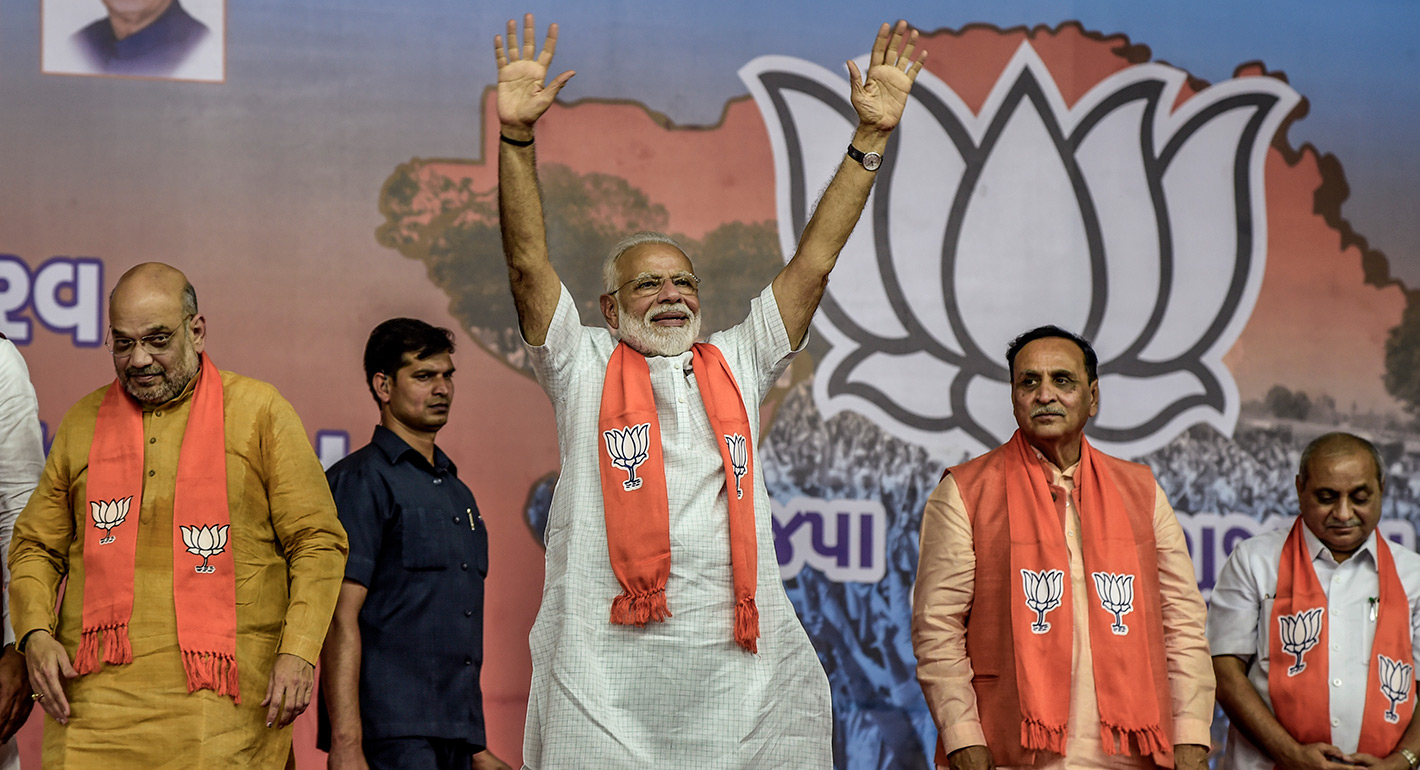
The question of leadership may have successfully diverted attention away from the state of the economy, but Modi’s honeymoon will be short-lived if he does not place it at the top of his agenda.
Source: Washington Post
On Thursday, the ruling Bharatiya Janata Party of Prime Minister Narendra Modi cruised to a decisive reelection in India’s gargantuan national election. Political analysts had tipped the BJP-led National Democratic Alliance (NDA) to do well, but few predicted that it would win in a walkover. The alliance clinched a whopping 352 seats, out of 543, in the lower house of parliament, besting its 2014 tally of 336 seats.
One reason many thought the BJP would struggle to replicate its 2014 benchmark is the uncertain state of the Indian economy. Why didn’t a sputtering economy sink — or at the very least shrink — the BJP’s electoral prospects? An initial parsing of available data suggests that the issue of leadership trumped economic grievances. And, paradoxically, despite their economic anxieties, voters viewed Modi as the best placed to redress their complaints.
Five years ago, Modi campaigned on the promise of ushering in “acche din” (good days) for the Indian economy by generating millions of jobs, stimulating rapid growth and revitalizing India’s sluggish investment cycle. While Modi enacted several economic reforms — such as a nationwide sales tax and a new bankruptcy code to wind up failing businesses — large parts of his promised economic narrative never materialized.
India’s GDP growth has experienced numerous peaks and valleys during the course of Modi’s first term, clocking in at 6.6 percent in the most recent quarter. This is superlative by developed-country standards, but well below the rapid growth India experienced in the 2000s. Unemployment data, documented in a leaked government report, show a spike in joblessness. The growth in farm prices is at an 18-year low and rural wages have stagnated, hurting nearly 1 in 2 working Indians.
And yet the BJP defied these gloomy economic numbers to clinch the country’s first consecutive single-party parliamentary majority since 1984. Any explanation of the BJP’s historic victory must begin with the durability of Modi’s popularity. In May 2014, 36 percent of Indians chose Modi as their preferred prime ministerial candidate, against just 16 percent for Rahul Gandhi, the dynastic leader of the opposition Congress party. Ahead of the 2019 vote, 43 percent of Indians wanted to see Modi return as prime minister. While Gandhi modestly improved his position, the yawning gap between the two men remained. The fractured opposition simply could not counter the fact that not a single one of its leaders possesses the charisma, image or retail political skill Modi boasts.
In fact, the available evidence suggests that Modi’s poll numbers are far better than his own party’s: 32 percent of respondents to one post-election survey say that they would not have voted for the BJP alliance if Modi were not the prime ministerial candidate.
The six-week-long campaign only strengthened Modi’s position, placing leadership above all other considerations. One of the most intriguing findings from a survey conducted by the Center for the Study of Developing Societies is that the salience of economic issues actually declined as the campaign went on. Before voting began, 21 percent of respondents identified jobs as the most critical election issue. That had dropped to 12 percent once campaigning concluded.
In a recent tweet, the political scientist Neelanjan Sircar perceptively remarked that analysts often focus on individual issues at the expense of a party or leader. But if voters feel a close attachment to a leader, they will find reasons to support him or her. This is why I had previously noted that many Indian voters appeared to be looking for an “excuse” to support Modi.
The terrorist attack on Indian forces in the state of Jammu and Kashmir in mid-February and the government’s subsequent airstrikes on terrorist camps in Pakistan further fueled Modi’s stature, reinforcing the very characteristics that Modi often touts — leadership, decisiveness and muscularity. Although relatively few Indians identified national security as a topmost electoral concern, the strikes may have had an indirect impact on voter behavior: Voters who were aware of the airstrikes were more likely to support another term for Modi. These same voters were also more inclined to give economic issues a pass; in other words, national security became a prism through which voters weighed the importance of economic concerns.
There are, of course, a host of other factors that propelled Modi’s victory. Many voters were touched by at least one of the many social service schemes launched by the Modi government, ranging from toilets to cooking gas connections and affordable housing. Even voters who have not experienced the state’s public provision of private goods hold out hope that government largesse will find its way into their homes. The Congress party tried to blunt Modi’s appeal by promising an annual cash handout of around $1,000 to India’s poorest households if it came to power. However, its announcement came far too late in the game and was too garbled in its rollout to have much of an impact.
The question of leadership may have successfully diverted attention away from the state of the economy, but Modi’s honeymoon will be short-lived if he does not place it at the top of his agenda.
Privately, economists estimate that official growth numbers overstate the true extent of Indian growth by at least one to two percentage points. Thanks to increased social spending and underwhelming tax revenue, India’s ambitious deficit consolidation has gone for a toss. Exports remain subdued and a brewing crisis among non-bank financial lenders is rattling investors.
After just one term in office, voters are sympathetic to Modi’s pleas of needing more time to fulfill his lofty promises of a “New India.” But with the election done and dusted, the clock has begun ticking.
This article was originally published by the Washington Post.

Director and Senior Fellow, South Asia Program
Milan Vaishnav is a senior fellow and director of the South Asia Program and the host of the Grand Tamasha podcast at the Carnegie Endowment for International Peace. His primary research focus is the political economy of India, and he examines issues such as corruption and governance, state capacity, federalism, and electoral behavior. He also conducts research on the Indian diaspora.
Recent Work
Christopher S. Chivvis, Rohan Mukherjee, Milan Vaishnav



Sophia Besch, Eric Ciaramella, Steve Feldstein, …
Carnegie does not take institutional positions on public policy issues; the views represented herein are those of the author(s) and do not necessarily reflect the views of Carnegie, its staff, or its trustees.

Japan’s long-term security policy is driven by concerns about China, and there is little appetite for (or interest in) pursuing a confrontation with Moscow.

James D.J. Brown

Putin’s conservative staffing policies and search for ever greater control have cemented parliament’s transformation into a bureaucratic appendage of the executive branch.

Andrey Pertsev

Without a ceasefire with Ukraine on attacking each other’s energy infrastructure—to which the Kremlin is unlikely to agree—the diesel agreement between Putin and Trump is largely for show, rather than representing a genuine increase in the volumes of Russian diesel on the global market.

Sergey Vakulenko

Ex-president Gurbanguly Berdimuhamedov remains interested in politics, but his son Serdar, Turkmenistan’s current president, is becoming increasingly independent and willing to break with his father’s legacy. If their covert rivalry goes too far, both risk losing power.

Galiya Ibragimova

Despite a new textbook, an influx of Russian teachers and managers, and an end to the teaching of Ukrainian, the Kremlin is unlikely to have “reprogrammed” locals.

Konstantin Skorkin