

Paper
A new Carnegie survey of Indian Americans examines shifting vote preferences, growing political ambivalence, and rising concerns about discrimination amid U.S. policy changes and geopolitical uncertainty.
{
  "authors": [
    "Sumitra Badrinathan",
    "Devesh Kapur",
    "Andy Robaina",
    "Milan Vaishnav"
  ],
  "type": "commentary",
  "blog": "Emissary",
  "centerAffiliationAll": "dc",
  "centers": [
    "Carnegie Endowment for International Peace"
  ],
  "collections": [
    "Understanding India’s Diaspora",
    "Parekh Policy Initiative on U.S.-India Relations"
  ],
  "englishNewsletterAll": "ctw",
  "nonEnglishNewsletterAll": "",
  "primaryCenter": "Carnegie Endowment for International Peace",
  "programAffiliation": "SAP",
  "programs": [
    "South Asia"
  ],
  "regions": [
    "India",
    "United States"
  ],
  "topics": [
    "Democracy",
    "Domestic Politics",
    "Foreign Policy"
  ]
}
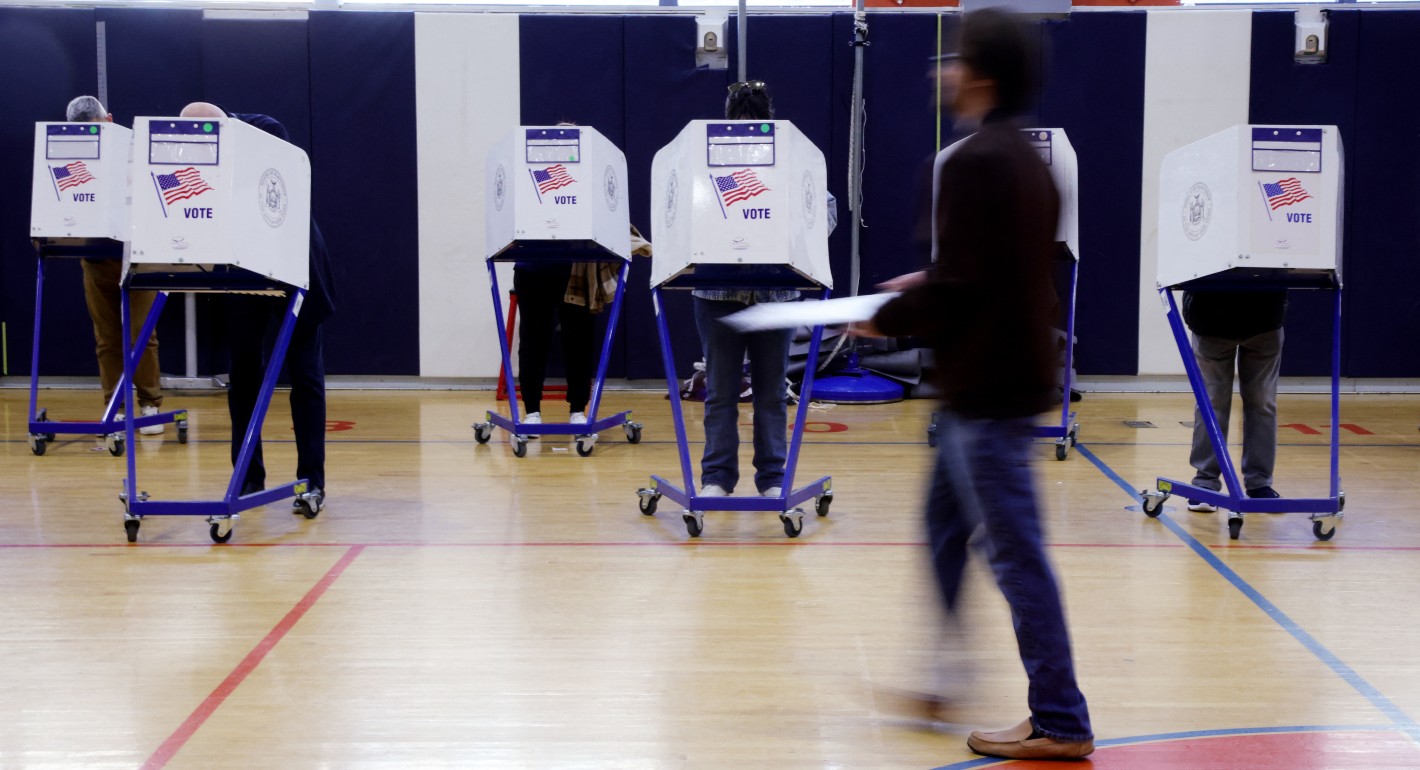
People vote in New York City on November 4, 2025. (Photo by Leonardo Munoz/AFP via Getty Images)
New data from the 2026 Indian American Attitudes Survey show that Democratic support has not fully rebounded from 2020.
Indian Americans remain one of the most Democratic-leaning constituencies in American politics—but their partisan attachment is softening. New nationally representative data from our 2026 Indian American Attitudes Survey show that while roughly seven in ten Indian Americans disapprove of President Donald Trump’s performance—and majorities oppose his approach to immigration and the economy—Democratic support has not fully rebounded.
In a hypothetical rerun of the 2024 election, Democratic backing remains about ten points below its 2020 high-water mark. Openness to a third candidate has increased. Party identification has also shifted: the share identifying as Democrats has fallen from 52 percent in 2020 to 46 percent today, with the independent share rising commensurately to nearly one-third of the community.
To understand how we got here, it helps to revisit 2024. That year marked a notable departure from the Democratic Party among Indian Americans. Trump improved the Republican Party’s standing with the community, narrowing what had once been a roughly 70–20 Democratic margin to about 60–30. The movement mirrored broader Republican gains among Black, Hispanic, and Asian American voters—and was especially striking given Democratic candidate Kamala Harris’s Black and Indian American heritage.
Still, claims of a wholesale realignment are overstated. The community’s ideological center of gravity remains moderate and left-of-center. Moderates constitute the single largest bloc—about one-third of respondents—and only about one in five identify as conservative. Indian Americans remain more Democratic-leaning than the American electorate as a whole.
But measures of political “affect”—how warmly voters feel toward parties—suggest declining enthusiasm among Democrats. Ratings of the Democratic Party and its leaders have fallen over the past two years. Overall evaluations of the Republican Party remain low, but Republican identifiers continue to express strong warmth toward their party and its candidates. Across three waves of the survey—in 2020, 2024, and 2026—Indian American Republicans have consistently rated their party at 72 out of 100. Democrats, by contrast, appear less enthusiastic about theirs: they rated their party at 75 in 2020 and 69 in 2026.
There are even more mixed signals for Democrats. The sharp 2024 swing of young men toward Trump has largely reversed. But Democratic gains have been uneven. Support among older voters, lower-income households, and those without a college degree has softened since 2024, contributing to stagnation in topline Democratic support.
At the same time, Indian Americans are confronting a sharp rise in online hostility and anti-Indian rhetoric—an escalation significant enough that Ohio Republican gubernatorial candidate Vivek Ramaswamy, himself the son of Indian immigrants, felt compelled to denounce the hard-right demonization of Indians in a New York Times column. Nearly half of Indian Americans fault the Republican Party for discrimination against their community, and at least one-third view the GOP as intolerant of minorities, suggesting there may be a ceiling on GOP growth, for now. But that disapproval has not translated into renewed consolidation behind the Democrats.
Looking ahead, pocketbook concerns remain paramount. When asked to name the most important issue facing them personally, inflation and prices top the list, followed closely by jobs and the broader economy.
Immigration matters—but it is not decisive. Foreign policy barely registers, which helps explain why dissatisfaction with Trump’s handling of U.S.-India relations has not meaningfully reshaped vote intentions. Like most Americans, Indian Americans evaluate politics primarily through the lens of cost-of-living concerns.
Taken together, these trends suggest that 2024 was neither a fluke nor a full-scale realignment. Indian Americans remain disproportionately Democratic, but reflexive, high-intensity loyalty appears to be eroding. Opposition to Trump remains broad-based—yet Republican identifiers display a level of partisan attachment that is weakening among Democrats. The result is a community that leans left but less enthusiastically than in the past.
As the 2026 midterms approach, the lesson for both parties is straightforward: Indian Americans are not drifting wholesale to the right—but they are signaling that their support must be earned, not assumed.
A new Carnegie survey of Indian Americans examines shifting vote preferences, growing political ambivalence, and rising concerns about discrimination amid U.S. policy changes and geopolitical uncertainty.
This commentary is based on a nationally representative online survey of 1,000 Indian American adults, conducted between November 25, 2025, and January 6, 2026, in partnership with YouGov.

Sumitra Badrinathan
Assistant Professor of Political Science, American University
Sumitra Badrinathan is an assistant professor of political science at American University’s School of International Service.
Devesh Kapur
Starr Foundation Professor, Johns Hopkins (SAIS)
Devesh Kapur is the Starr Foundation Professor of South Asian studies at the Johns Hopkins School of Advanced International Studies (SAIS). He is the author of three books on migration, including The Other One Percent: Indians in America (with Sanjoy Chakravorty and Nirvikar Singh).
Andy Robaina
Research Assistant, South Asia Program
Andy Robaina is a research assistant in the Carnegie South Asia Program.

Director and Senior Fellow, South Asia Program
Milan Vaishnav is a senior fellow and director of the South Asia Program and the host of the Grand Tamasha podcast at the Carnegie Endowment for International Peace. His primary research focus is the political economy of India, and he examines issues such as corruption and governance, state capacity, federalism, and electoral behavior. He also conducts research on the Indian diaspora.
Carnegie does not take institutional positions on public policy issues; the views represented herein are those of the author(s) and do not necessarily reflect the views of Carnegie, its staff, or its trustees.
Why Pakistan, Saudi Arabia, and Turkey are joining forces on regional security.


Alper Coşkun, Amr Hamzawy

Despite public disputes over trade and immigration, the strategic partnership’s foundations remain sturdy.

Sameer Lalwani

It signals a new era of tech diffusion and warfare.

Steve Feldstein
Despite its flop at the box office, the film raises important questions for the climate community to answer.
Leonardo Martinez-Diaz
Fatima El Mansouri is the country’s first female prime minister. She’s also a privileged insider in a largely ceremonial position.

Sarah Yerkes