

Commentary
- +3
Marwan Muasher, Amr Hamzawy, Rain Ji, …
{
  "authors": [
    "Yasmine Farouk"
  ],
  "type": "commentary",
  "centerAffiliationAll": "dc",
  "centers": [
    "Carnegie Endowment for International Peace",
    "Malcolm H. Kerr Carnegie Middle East Center"
  ],
  "collections": [],
  "englishNewsletterAll": "menaTransitions",
  "nonEnglishNewsletterAll": "",
  "primaryCenter": "Carnegie Endowment for International Peace",
  "programAffiliation": "MEP",
  "programs": [
    "Middle East"
  ],
  "projects": [],
  "regions": [
    "North America",
    "United States",
    "Middle East",
    "Saudi Arabia",
    "Gulf"
  ],
  "topics": [
    "Foreign Policy"
  ]
}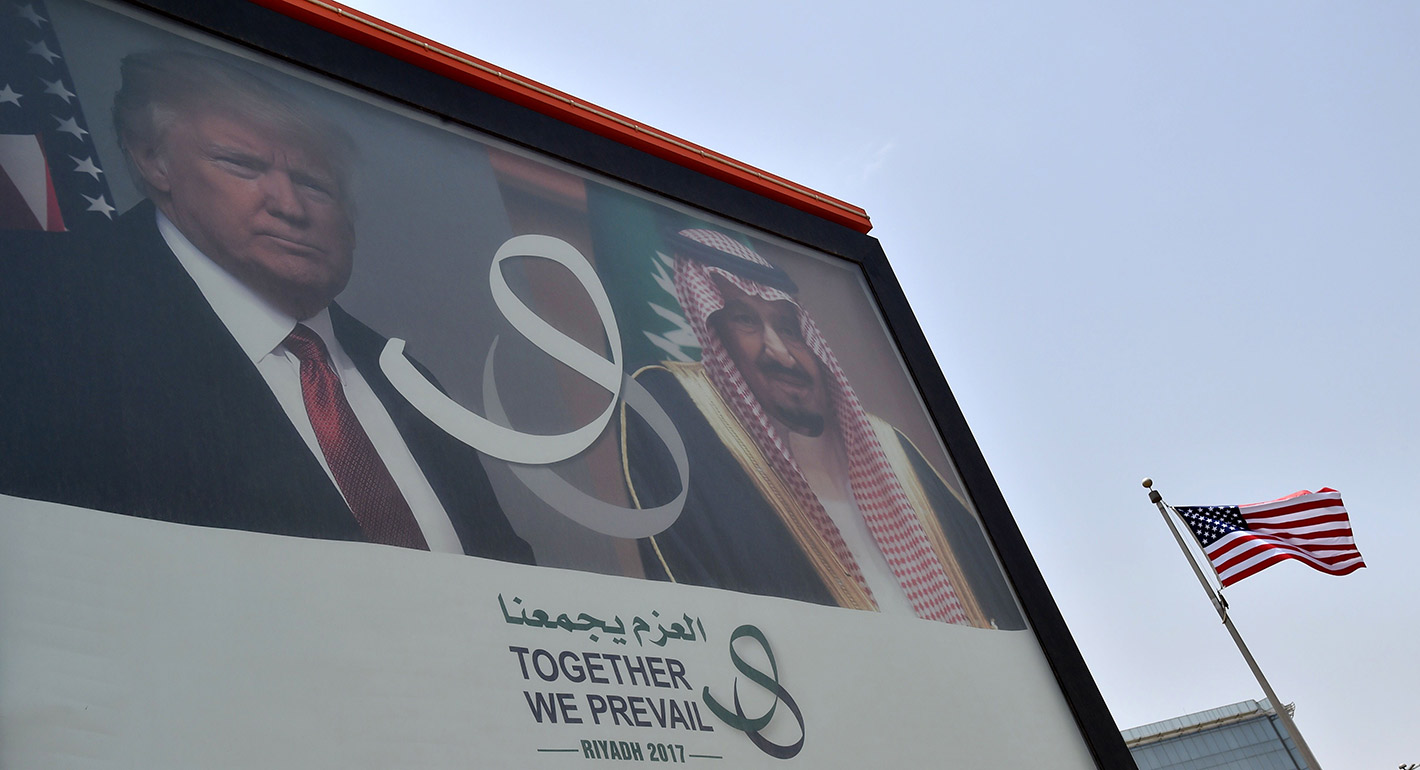
Source: Getty
On his first visit overseas as U.S. president, Trump pledged to improve security and relations with the Middle East. But that is not what has actually happened.
Two years ago, Saudi Arabia’s King Salman invited Donald Trump, the new president of the United States, to Riyadh for his first foreign trip, along with representatives from more than fifty Arab and Muslim states. While visiting what he called “the heart of the Muslim world,” Trump gave a speech in which he doubled down on his inaugural promise “to strengthen America’s oldest friendships, and to build new partnerships in pursuit of peace” and pledged “to conquer extremism and vanquish the forces of terrorism.”
Yet two years on, the Trump administration has failed to achieve any of these goals. One reason could be that it doesn’t want to commit what is required.
Instead of nurturing old U.S.-Arab friendships, the Trump administration has prioritized one new personal relationship. One month after the summit, Mohammed bin Salman (MBS) was appointed Saudi Arabia’s new crown prince. In a series of unprecedented moves, the Saudi regime sidelined some of the United States’ oldest allies in Saudi Arabia and centralized economic, political, and military power in the hands of the new crown prince. The crown prince then benefited from an open line with the White House, which turned a blind eye and even shielded the crown prince from the consequences of his destabilizing actions inside and outside of the Kingdom.
But the U.S. Congress has become increasingly wary of the crown prince and his perceived carte blanche. As a consequence, the historic friendship between these two countries, beyond the current relationship between the executive branches, has suffered significant damage.
The United States has not invested in building the strong foundations needed to develop new partnerships. The idea for a Middle East strategic alliance, announced in the Riyadh declaration, hasn’t taken root. One major reason for its failure is the ongoing political conflicts between U.S. friends in the Middle East, such as the dispute between Qatar and the Saudi-UAE-Egypt-Bahrian block. Washington hasn’t used its leverage to resolve these conflicts, which continue to sustain regional disputes. There are also differences of opinion over how to combat Iran. The recent escalation of tensions in the Persian Gulf has emphasized the strategic alliance’s shortcomings. Middle Eastern allies are increasingly uncertain as to whether the United States can deal with Iran in a way that protects their interests and minimizes their damages.
To achieve peace, Trump needs a comprehensive policy that encompasses all the multilayered consequences and collateral damage caused by U.S. actions. In pursuit of a Palestinian-Israeli peace agreement, Trump’s determination to “discard those strategies that have not worked,” along with pressure for Arab states to publicly normalize relations with Israel, has created a divide between the United States and some of its allies. The U.S. administration is overlooking the significance of the Palestinian-Israeli conflict in the region, and this short-sighted approach and aggressive escalation will only add fuel to the fire.
In Libya, Sudan, and Yemen, the United States is supporting the policies of other Middle Eastern countries instead of leading its own. The result has been that the United States has got entangled in the political conflicts that are currently playing out inside the three nations. With U.S. commitment to regional security in question, Moscow and Beijing are exploiting the growing mistrust between the United States and its Arab friends. Russia and China may not have American weapons, but they’ve demonstrated their willingness to stand up for autocratic allies (for example, Russia’s decisive defense of Bashar al-Assad’s regime in Syria).
The territorial defeat of the self-proclaimed Islamic States was the model of a successful, American-led partnership. But that is not enough. So far, efforts to “combat extremist ideology” have mainly, if not only, meant that the Gulf states have stopped directly funding radicalization and extremism, and started funding the fight against them.
The United States should be asking for a strong commitment to reversing decades-long policies, not just stopping them. Saudi and then Qatari policies have shaped—and continue to influence—Islam and Islamist ideology across the globe. Successfully reversing those policies must utilize the same techniques that made them so influential. Radicalization has spread though money, the circulation of religious manuals, and the building of religious schools, mosques, and Islamic Centers. The same countries that spread, supported, and sustained radical interpretations of Islam must use their platforms to spread a new, moderate understanding.
Two years after the Riyadh summit, King Salman will convene Arab and Gulf states again for two summits in Mecca at the end of May. These will be extraordinary meetings, held in the context of escalating tensions with Iran and Houthi attacks on Saudi soil. Yet Qatar says it hasn’t received an invitation. Once again, the Middle East’s need for a collective mechanism of defense is obvious. But Trump’s promises two years ago in Riyadh to improve regional security and U.S.-Arab partnerships have failed to materialize.

Former Nonresident Scholar, Middle East Program
Yasmine Farouk was a nonresident scholar in the Middle East Program at the Carnegie Endowment for International Peace.
Recent Work


Marwan Muasher, Amr Hamzawy, Rain Ji, …
Yasmine Farouk
Carnegie does not take institutional positions on public policy issues; the views represented herein are those of the author(s) and do not necessarily reflect the views of Carnegie, its staff, or its trustees.
Although Ukrainian strikes have led to a noticeable decline in the physical volume of Russian oil exports, the rise in prices has more than made up for it.

Sergey Vakulenko
The Russian leadership wants to avoid a dangerous precedent in which it is squeezed out of Iran by the United States and Israel—and left powerless to respond in any meaningful way.

Nikita Smagin

Orbán created an image for himself as virtually the only opponent of aid to Ukraine in the entire EU. But in reality, he was simply willing to use his veto to absorb all the backlash, allowing other opponents to remain in the shadows.
Maksim Samorukov

Central Asia’s digital ambitions are achievable, but only if policy is aligned with the region’s physical constraints.

Aruzhan Meirkhanova
Not only does the fighting jeopardize regional security, it undermines Russian attempts to promote alternatives to the Western-dominated world order.
Ruslan Suleymanov