

Commentary
Andrei Kolesnikov
{
  "authors": [
    "Andrei Kolesnikov"
  ],
  "type": "legacyinthemedia",
  "centerAffiliationAll": "",
  "centers": [
    "Carnegie Endowment for International Peace",
    "Carnegie Russia Eurasia Center"
  ],
  "collections": [
    "Inside Russia"
  ],
  "englishNewsletterAll": "",
  "nonEnglishNewsletterAll": "",
  "primaryCenter": "Carnegie Endowment for International Peace",
  "programAffiliation": "",
  "programs": [],
  "projects": [],
  "regions": [
    "Russia"
  ],
  "topics": [
    "Political Reform"
  ]
}
Source: Getty
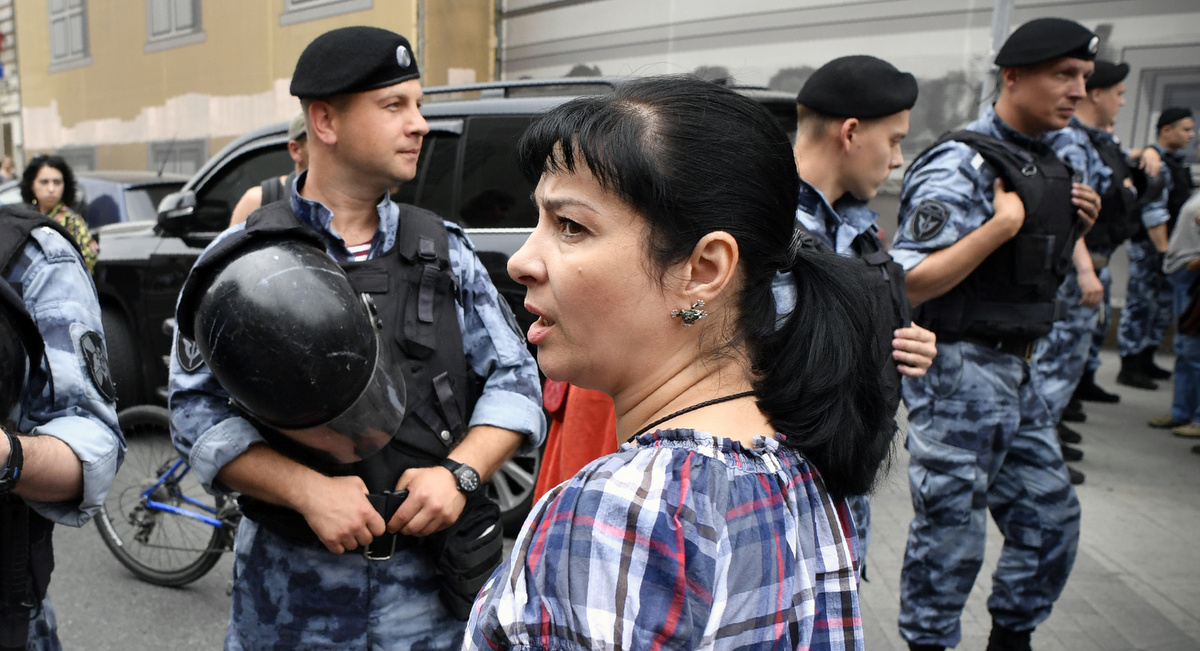
The society of citizens and its representatives in Russia face a dilemma. One option is to cut a deal with the state and work in its interests and on its terms. The other option is marginalisation, to become outcasts destined to be in constant conflict with the state.
Source: Centre for East European and International Studies
As the authoritarian regime in Russia has matured since the days of former president Boris Yeltsin, the state has gradually returned to politics, the economy, and the spiritual and social realms. A crisis of representation in politics and an erosion of state institutions have been accompanied by a nationalisation of civil society.
In recent years, the Russian authoritarian state has been splintering civil society into segments that are willing to cooperate with the state and ones that are not, as well as intimidating civil society with repressive laws. In this situation, to quote Russian politician Yegor Gaidar, ‘society becomes a colony of the state’.
True civil society—let’s call it the society of citizens—in today’s Russia is born of nonviolent but confrontational resistance: civil disobedience. In the case of resistance in Russia, people resist the authorities that themselves violate the law (in particular, article 31 of the constitution about freedom of assembly), but the authorities can provide a legal justification for their position.
The society of citizens participates in several types of confrontation. The first and main category is confrontation with the state. The second is confrontation with the inert segment of society. This is a confrontation with the man of the crowd, who is the opposite of what Hannah Arendt calls the ‘citoyen’ and is willing to support the state. The third type of confrontation is with the segment of society that operates under the state’s supervision and competes with civic organisations that the regime opposes.
This community seeks—and receives—grants, or at least support, from the state. To coordinate their interaction with the public, the authorities create something akin to ministries: public chambers or units of the All-Russia People’s Front, that are imitating different kinds of civic activity. The state imitates independent civil society by feeding controlled communities and NGOs. Some organisations from the society of citizens are forced to switch over to the state-controlled segment of the public if they want to continue their work.
In Russia, the umbrella term ‘public’ can also be applied to organisations that are traditionally considered part of conservative civil society. These are groups that the state supports directly or indirectly. For example, the directorate in the Moscow mayor’s office responsible for relations with the Cossacks officially engages Cossack organisations in defending public order. Yet in May 2018, mysterious Cossack formations participated in violence against protesters. The question follows: is the state losing its monopoly on legitimate violence?
In recent years there has been resistance to a range of state initiatives such as the demolition of two perfectly livable blocks in Moscow’s Kuntsevo district, where developer PIK and the Moscow mayor’s office decided to build new apartment buildings; the conflict surrounding the construction of a landfill site in the Arkhangelsk region for Moscow’s rubbish; and multiplying conflicts over the construction of churches, most notably in Yekaterinburg. And one of the most significant protests in the whole Putin era rose against the detainment of investigative journalist Ivan Golunov on the basis of false accusation (he was released after an unprecedented wave of solidarity).
The approach to solving ostensibly technical problems turns conflicts into matters of civic importance and, under certain conditions, of political significance. Citizens begin to resist, and what they are protecting is not just their personal space and property but public spaces, such as parks, squares, and backyards. Protecting public spaces from the incursion of external forces becomes the basis for civic alliances on a negative basis.
The next step is the transition from negative to positive identification and solidarity, and it is very difficult to make, considering the growing number of legal prohibitions and traps. This is the process of de-bureaucratising civil society. The new methods and forms of its existence are highly informal, and civic associations are extremely mobile. The society of citizens that is growing from this new foundation is not just a conglomerate of organisations. It is also a community of individuals who do not have to unite into formal structures.
The society of citizens and its representatives in Russia face a dilemma. One option is to cut a deal with the state and work in its interests and on its terms. The other option is marginalisation, to become outcasts destined to be in constant conflict with the state. As a result, conflict and polarisation in Russia are on the rise.
Former Senior Fellow, Carnegie Russia Eurasia Center
Kolesnikov was a senior fellow at the Carnegie Russia Eurasia Center.
Recent Work
Andrei Kolesnikov
Andrei Kolesnikov
Carnegie does not take institutional positions on public policy issues; the views represented herein are those of the author(s) and do not necessarily reflect the views of Carnegie, its staff, or its trustees.

The European far right might fail to steer EU policy in the direction Russia wants, but they will create enough chaos inside Europe to benefit the Kremlin.

Dimitar Bechev

If the Russian-speaking community in Latvia cannot articulate their interests without being seen as disloyal, they could end up embracing a pro-Kremlin agenda.

Sergejs Potapkins

Russia’s ruling party would have benefited from Putin appearing as its distant patron, but as an active frontman imposing his views on the public, he has done nothing but harm both the party’s election campaign and the ruling system overall.

Andrey Pertsev

Depleted financial reserves and a shrinking tax base mean it is no longer possible to simultaneously deliver high defense spending, price stability, and economic growth.

Alexandra Prokopenko
Blurring the line between humans and animals is a long-standing tradition in social utopian prose. In his latest novel, Leonid Bershidsky reminds us that in social experiments, people are often treated no differently than animals.

Alexander Baunov