

Commentary
Japan’s long-term security policy is driven by concerns about China, and there is little appetite for (or interest in) pursuing a confrontation with Moscow.
James D.J. Brown
{
  "authors": [
    "Sharanya Rajiv 64592"
  ],
  "type": "legacyinthemedia",
  "centerAffiliationAll": "",
  "centers": [
    "Carnegie Endowment for International Peace",
    "Carnegie India"
  ],
  "collections": [],
  "englishNewsletterAll": "",
  "nonEnglishNewsletterAll": "",
  "primaryCenter": "Carnegie India",
  "programAffiliation": "",
  "programs": [],
  "projects": [],
  "regions": [
    "South Asia",
    "India",
    "Russia"
  ],
  "topics": [
    "Foreign Policy"
  ]
}
Source: Getty
The special and privileged strategic partnership between India and Russia now spans across both Eurasia and the Indo-Pacific.
Source: Moscow Times
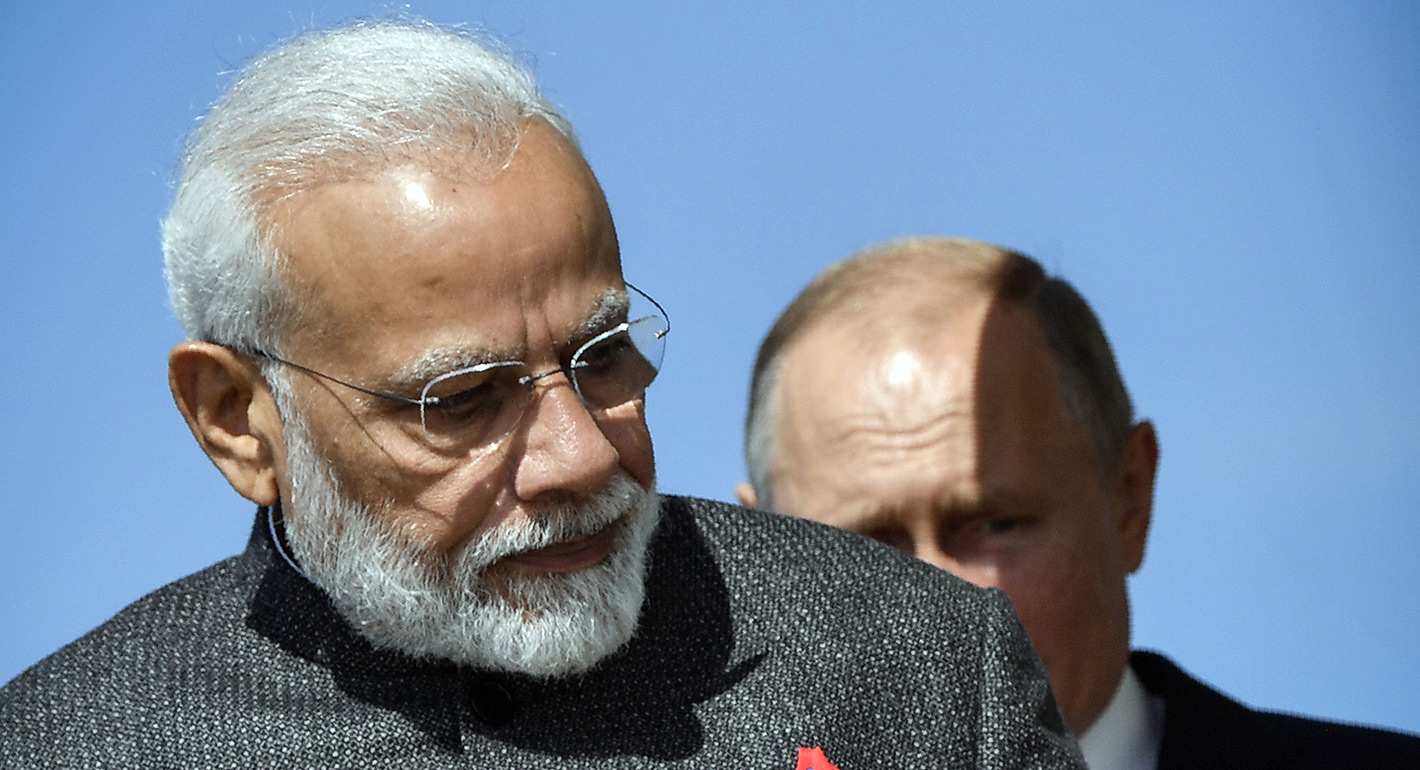
Last week, Narendra Modi was the first Indian prime minister to visit Russia’s Far Eastern city of Vladivostok. He was there to attend the 20th India-Russia Annual Summit followed by the fifth Eastern Economic Forum (EEF), in which he was the chief guest. During the visit, the sides announced a slew of bilateral deals.
These ranged from expanding cooperation in military technology and civil nuclear energy — for which Russia is India’s foremost partner — to hydrocarbons, mining and space, among other areas.
Most significantly, the countries signed a joint statement that recognized Greater Eurasia and the “regions of the Indian and Pacific Oceans” as forming part of a common space and agreed to intensify consultations on complementarities between their respective integration initiatives.
The special and privileged strategic partnership between India and Russia now spans across both Eurasia and the Indo-Pacific.
The first is a mutual recognition of converging interests in the Indo-Pacific region.
While Russia may not be quick to adopt the term — with leaders like President Putin continuing to use the term Asia-Pacific — its invitation of Prime Minister Modi as the EEF’s chief guest is an acknowledgement of the confluence of the Indian and Pacific oceans.
To understand this overlap, we must consider Moscow’s criticism of the Indo-Pacific concept. It supposes that the U.S. and Japan, who “authored” the term, plan to impose it on others. Russia thinks the West is unlikely to establish an equitable regional mechanism that considers the legitimate interests of all players, which threatens to fragment this shared space.
Moscow also considers regional states, particularly those in the Association of Southeast Asian Nations (ASEAN), to be the central elements in regional integration and cooperation processes. This, in turn, does not stand in opposition to India’s vision for the Indo-Pacific, which is premised on inclusiveness, openness and ASEAN’s centrality and unity.
The second process has a longer history — cooperation in their shared extended neighborhood in the Eurasian continent.
On Russia’s vision for a “greater Eurasia” during the St. Petersburg International Economic Forum in 2016, President Putin observed an emergent integration area and proposed a Eurasian partnership — with the Eurasian Economic Union as one of the centers, and with close partners like China, India, Pakistan and Iran.
While Moscow’s deepening partnerships with Islamabad and Beijing worry India, both have shared interests in ensuring a more prosperous and stable Eurasia. India is working alongside Moscow in initiatives across the continent.
These range from transport corridors, particularly the long-delayed International North-South Transport Corridor which became partly operational last year, to regional organizations such as the Shanghai Cooperation Organization — which India was admitted into in 2017 with Moscow’s support.
Finally, the Russian Far East will now serve as a crucial point linking the continental and maritime geographies. In Vladivostok, India unveiled its “Act Far East Policy” and announced a $1 billion line of credit for development projects in the region, while both sides signed an agreement to develop a Vladivostok-Chennai sea route, which can become India’s springboard in the Northeast Asian market.
Prime Minister Modi noted that the Far East “will become a confluence of the Eurasian Union on one side and the open, free and inclusive Indo-Pacific on the other.”
As the future of the Indo-Pacific is intrinsically linked with that of Eurasia — and both are the site of competition among major powers — this is well thought out.
This provides a new vision for the India-Russia partnership. It could also help mitigate the strategic and political divergence that several commentators have highlighted in recent years — particularly Russia’s partnership with China and India’s with the West.
However, this does not indicate that Russia will turn away from China nor that India will turn away from the West. These relationships are driven by deeper strategic and economic imperatives. What it does indicate is that India and Russia are expanding their foreign policy options.
Sharanya Rajiv, 64592
Carnegie India
Sharanya Rajiv is a senior program coordinator and research assistant at Carnegie India
Carnegie does not take institutional positions on public policy issues; the views represented herein are those of the author(s) and do not necessarily reflect the views of Carnegie, its staff, or its trustees.

Japan’s long-term security policy is driven by concerns about China, and there is little appetite for (or interest in) pursuing a confrontation with Moscow.

James D.J. Brown

The truth of the strategic situation is that Europe and Russia are extremely unlikely to be able to “turn the page” on their confrontation within the next two decades.

Arkady Moshes

Russia spent years building a “sovereign internet,” concentrating web infrastructure exclusively within Russian territory. Ukrainian drone attacks have shown how vulnerable that approach has left the Russian internet.

Maria Kolomychenko

Putin’s conservative staffing policies and search for ever greater control have cemented parliament’s transformation into a bureaucratic appendage of the executive branch.

Andrey Pertsev

Russia’s AI-driven propaganda campaigns operate in a fragmented, chaotic, and often illogical manner. That’s not necessarily a problem for the Kremlin, though: It’s much easier to mimic genuine public debate that way.

Ilya Klishin