

Article
Alejandro Martin Rodriguez, Joy Arkeh, Sarah Yerkes
{
  "authors": [
    "Sarah Yerkes"
  ],
  "type": "legacyinthemedia",
  "centerAffiliationAll": "dc",
  "centers": [
    "Carnegie Endowment for International Peace",
    "Malcolm H. Kerr Carnegie Middle East Center"
  ],
  "collections": [],
  "englishNewsletterAll": "menaTransitions",
  "nonEnglishNewsletterAll": "",
  "primaryCenter": "Carnegie Endowment for International Peace",
  "programAffiliation": "MEP",
  "programs": [
    "Middle East"
  ],
  "projects": [
    "Tunisia Monitor"
  ],
  "regions": [
    "North America",
    "United States",
    "North Africa",
    "Tunisia",
    "Maghreb"
  ],
  "topics": [
    "Political Reform",
    "Democracy",
    "Foreign Policy",
    "Global Governance"
  ]
}
Source: Getty
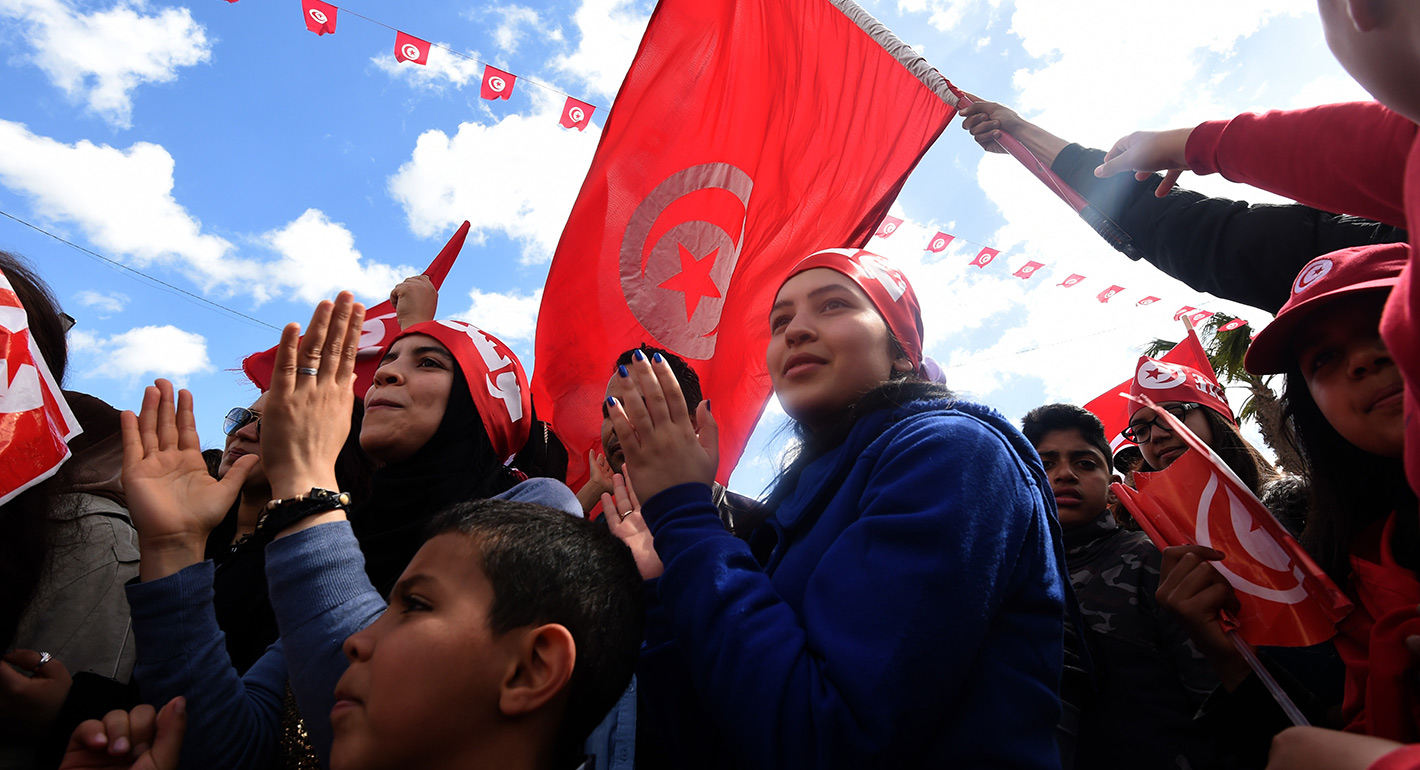
Tunisia an unprecedented opportunity for a democratic opening.
Source: Foreign Affairs
The story of how the Tunisian revolution began is well known. On December 17, 2010, a 26-year-old fruit vendor named Mohamed Bouazizi from the town of Sidi Bouzid set himself on fire outside a local government building. The man’s self-immolation—an act of protest against repeated mistreatment by police and local officials—sparked protests that quickly spread across the country. Within a few weeks, President Zine el-Abidine Ben Ali had stepped down and fled the country after 23 years in power, offering Tunisia an unprecedented opportunity for a democratic opening. A massive wave of uprisings soon swept the country’s neighbors, reaching all the way to the Levant and the Persian Gulf.

Acting Co-Director and Senior Fellow, Middle East Program
Sarah Yerkes is acting co-director and a senior fellow in Carnegie’s Middle East Program, where her research focuses on Tunisia’s political, economic, and security developments as well as state-society relations in the Middle East and North Africa.
Recent Work


Alejandro Martin Rodriguez, Joy Arkeh, Sarah Yerkes
Alejandro Martin Rodriguez, Sarah Yerkes
Carnegie does not take institutional positions on public policy issues; the views represented herein are those of the author(s) and do not necessarily reflect the views of Carnegie, its staff, or its trustees.

The European far right might fail to steer EU policy in the direction Russia wants, but they will create enough chaos inside Europe to benefit the Kremlin.

Dimitar Bechev

Minsk clearly expected the dialogue with Washington to yield more results, in particular the lifting of EU sanctions and permission to export potash.

Artyom Shraibman

If the Russian-speaking community in Latvia cannot articulate their interests without being seen as disloyal, they could end up embracing a pro-Kremlin agenda.

Sergejs Potapkins

Russia’s ruling party would have benefited from Putin appearing as its distant patron, but as an active frontman imposing his views on the public, he has done nothing but harm both the party’s election campaign and the ruling system overall.

Andrey Pertsev

In the tenth year of his presidency, President Mirziyoyev’s system is becoming even more personalized than that of his predecessor Karimov.

Galiya Ibragimova