

Commentary
The European far right might fail to steer EU policy in the direction Russia wants, but they will create enough chaos inside Europe to benefit the Kremlin.
Dimitar Bechev
{
  "authors": [
    "Stephen Boucher"
  ],
  "type": "commentary",
  "centerAffiliationAll": "dc",
  "centers": [
    "Carnegie Endowment for International Peace",
    "Carnegie Europe"
  ],
  "collections": [],
  "englishNewsletterAll": "democracy",
  "nonEnglishNewsletterAll": "",
  "primaryCenter": "Carnegie Europe",
  "programAffiliation": "DCG",
  "programs": [
    "Democracy, Conflict, and Governance"
  ],
  "projects": [
    "Reshaping European Democracy"
  ],
  "regions": [
    "Europe",
    "Western Europe"
  ],
  "topics": [
    "EU",
    "Democracy"
  ]
}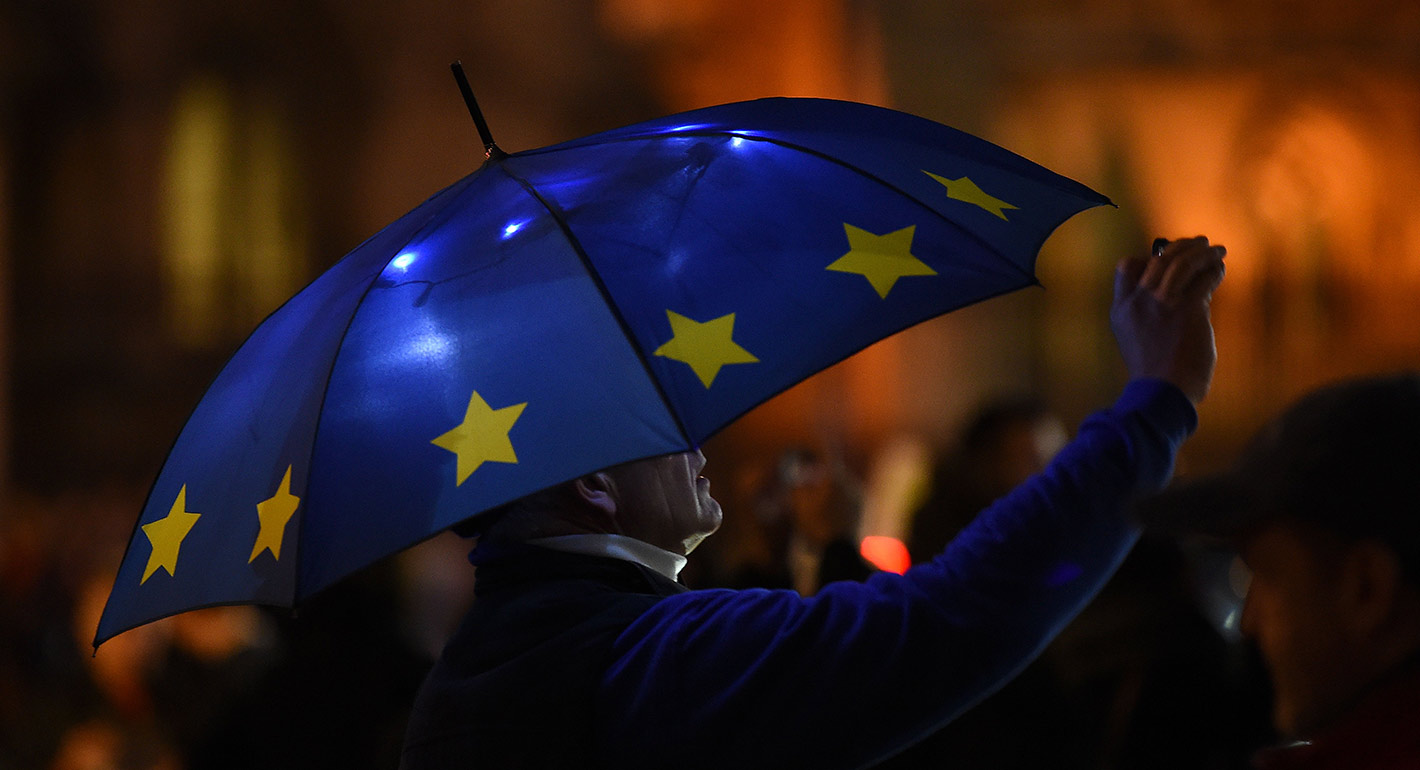
Source: Getty
The EU could benefit from tapping into the smart ideas behind its many successful local projects, and then adapting them to benefit other member states.
Improving EU democracy is high on the agenda at the upcoming Conference on the Future of Europe, a two-year consultation proposed by the president of the European Commission Ursula von der Leyen. Will the radical reforms needed to improve European democracy really be on the table, given the forcefulness of those attacking them?
When debating democratic reform in Europe, it is important to keep in mind three benchmarks of success. First, public decisionmaking processes must address society’s challenges more effectively and inclusively. Second, democratic institutions should be redesigned to encourage political innovation. Finally, any new measures, experiments, policies, or rules that have been proven to work should move swiftly through the political system and be put into practice.
At present this does not happen much. Indeed, the EU institutional system more often acts as a barrier to the spread of good ideas than as an enabler of policy innovation. In contrast, many approaches have made an impact at a local level across Europe: for example, initiatives like Greece’s SynAthina digital platform for citizen initiatives; the Finnish Kokeilun Paikka (“place of experiment”), which offers funding for problem-solving ideas; the Territoires Zéro Chômeurs de Longue Durée jobs program in France; and the British “What Works Network,” aimed at improving public services. But these have not been picked up and adapted further afield.
Too many local solutions do not percolate through the EU system. Large-scale state inefficiency often coexists with pockets of enlightened citizen innovation. There are plenty of useful individual experiments in participation, but policies are still failing to gather and use smart ideas from the broader population.
The kind of reform options now being discussed within the EU center around rather formalistic, institutional changes. They have little to do with harnessing the spirit of collective intelligence.
For example, the EU has recently committed to extending subsidiarity: the idea that political decisions should be taken at a local level, rather than by a central authority. This is presented as a way of deepening democracy. But the EU understands subsidiarity in an overly rigid way, focused on delegating decisionmaking powers down the chain. The subsidiarity principle is too often a means to justify the EU’s existence, simply giving it permission to act where other levels have rather passively accepted its primary role.
Instead, Europe needs a fluid form of subsidiarity in which all levels of governance work together. It needs to become better at building on different local, regional and national experiments and to react more quickly to grassroots innovations to help them permeate the whole system.
What if, for instance, the idea behind France’s Territoire Zéro Chômeur de Longue Durée experiment, which redirects public funds aimed at addressing long-term unemployment to finance new jobs, had been spotted by EU officials, encouraged, and legally allowed earlier on? What if the lessons learned could benefit all member states and inform relevant EU legislation? What if the successful approach to the integration of Muslim fundamentalists in the city of Grimhojvej near Aarhus in Denmark was not an isolated experiment, but part of systematic set of initiatives encouraged at EU level? The EU needs to think much harder about how to capitalize on this kind of knowledge and bring solutions to scale.
The EU could thus ditch its notion that multi-level governance means handing over decisionmaking power to the lower echelons. Rather, it would push power and responsibility up and down to foster new ideas for useful policies. This would help all levels of government to prioritize democratic participation, creativity, and innovation.
The push for democracy that is on the policy agenda needs to be approached in a fresh spirit. A few formal, institutional tweaks will not be enough. The EU needs a system that more people can actively take part in. It needs to take advantage of Europe’s societal complexity, which can be the source of diverse collective ideas.
To achieve this, the EU should try to give all stakeholders, citizens, corporations, civil society, and local, regional, and national authorities a chance to suggest solutions to social problems. This could be done through a revised system of interest group representation, permanent citizen co-legislation processes and an increased role for science in policymaking. This would deepen member states’ ability to tackle thorny issues effectively over the long-term.
The European Union must reinvent democratic governance to meet the challenges of a polycentric, complex, and risky world through collective intelligence. The upcoming Conference on the Future of Europe provides a chance to do this and that must not be lost.
Stephen Boucher is the founder of Dreamocracy.
Stephen Boucher
Stephen Boucher is managing director of Fondation EURACTIV. He published the Petit manuel de créativité politique in 2017, which looks at how to foster creativity in policymaking.
Carnegie does not take institutional positions on public policy issues; the views represented herein are those of the author(s) and do not necessarily reflect the views of Carnegie, its staff, or its trustees.

The European far right might fail to steer EU policy in the direction Russia wants, but they will create enough chaos inside Europe to benefit the Kremlin.

Dimitar Bechev

If the Russian-speaking community in Latvia cannot articulate their interests without being seen as disloyal, they could end up embracing a pro-Kremlin agenda.

Sergejs Potapkins
Ultimately, Zelensky sided neither with the reform camp nor with the military establishment as such, but with political control.

Balázs Jarábik

Andrey Melnichenko’s essay offers no answer to the fundamental question of how, under any kind of negotiated settlement, Europe can protect itself from the Russian ressentiment that is inevitable in all scenarios except for an outright victory for Putin.

Leonid Bershidsky

Whether PAS can refocus on the unfinished business of state-building may ultimately prove more consequential for Moldova’s European future than the pace of its accession negotiations.
Balázs Jarábik