

Commentary
Leonid Bershidsky
{
  "authors": [
    "Leonid Bershidsky"
  ],
  "type": "commentary",
  "blog": "Carnegie Politika",
  "centerAffiliationAll": "",
  "centers": [
    "Carnegie Endowment for International Peace",
    "Carnegie Russia Eurasia Center"
  ],
  "englishNewsletterAll": "",
  "nonEnglishNewsletterAll": "",
  "primaryCenter": "Carnegie Russia Eurasia Center",
  "programAffiliation": "",
  "regions": [
    "Russia",
    "Europe"
  ],
  "topics": [
    "Domestic Politics",
    "EU Foreign Policy",
    "Security",
    "Global Governance"
  ]
}
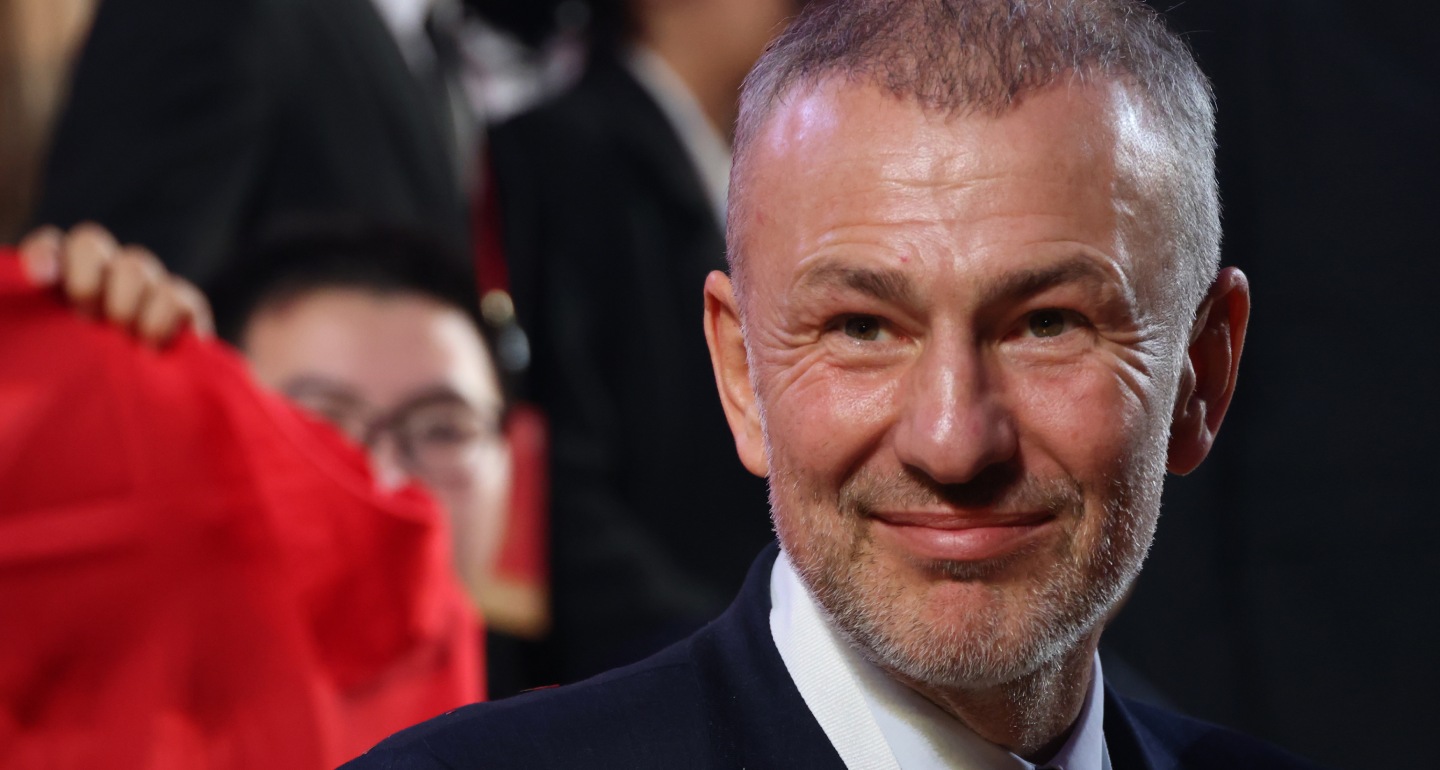
Source: Getty
Andrey Melnichenko’s essay offers no answer to the fundamental question of how, under any kind of negotiated settlement, Europe can protect itself from the Russian ressentiment that is inevitable in all scenarios except for an outright victory for Putin.
In line with a horoscope that had predicted that May 10, 1941, would be an auspicious day for the world, Rudolph Hess, deputy to the Führer and an experienced pilot, climbed into a Messerschmitt Bf 110E and set off on a solo flight to the British Isles. Once over Scotland, Hess ran out of fuel and parachuted out of the plane. An eccentric character even by the standards of Hitler’s entourage, Hess sought to negotiate an end to the war with the British “party of peace”—specifically, with the Scottish Duke of Hamilton, a fellow pilot who had attended the Berlin Olympics in 1936.
No parachutists from Russia’s Security Council have yet been spotted in the skies over Scotland, Brandenburg, or the suburbs of Washington. But both formal and informal signals that Moscow is ready to talk have been issuing from Russia in recent weeks with unusual intensity. Some of the signals do not even appear to envisage the participation in negotiations of the Kremlin or President Vladimir Putin himself; at least, that is how the Economist’s Russia editor, Arkady Ostrovsky, understood the message from the billionaire Andrey Melnichenko, whose essay made the cover of its latest issue. According to the Economist, the veiled proposal is to start negotiations with “elites with a stake in the country.”
Instead of negotiating with his surprise visitor, Hamilton handed him over to the British authorities, who were never able to ascertain whether Hess was acting with Adolf Hiter’s knowledge. Today, historians largely agree that Hess’s journey was made at his own initiative, and that he erroneously imagined that a British “party of peace” would agree to carve out spheres of influence: continental Europe for Hitler, and the overseas British empire territories for the UK.
While there may have been a peace faction in Britain in the 1930s, by 1941 the prevailing view was that of Prime Minister Winston Churchill: that no agreement could be made with Hitler because he could not be trusted not to subsequently make further demands. Nor were the British counting on the German opposition: Even if they had managed to topple Hitler, the threat of a resurgence of German imperial ressentiment—just like after World War I—was too great. The threat to Britain, in other words, was not so much from the Nazis as from German sovereignty, and the only solution was to crush Germany once and for all.
In his essay, Melnichenko writes at length about Russia’s sovereignty, which he argues must be upheld in the interests of global security and predictability. At the same time, the “fertilizer king” cites the example of Weimar Germany. “A durable peace cannot be made with a supplicant, because a supplicant is not truly responsible for its decisions,” writes Melnichenko. “Any deal made in such circumstances will not lead to permanent peace; only to a temporary pause between phases of conflict.”
Both Melnichenko’s essay and the accompanying articles in the Economist contain suggestions of hope that an agreement can be reached with Russia’s pragmatic elites, since war and instability are not in their interests. Such hopes are likely based on far more solid ground than Hess’s fanciful idea that the racially kindred Anglo-Saxons would prefer to reach an agreement than to keep fighting to the bitter end. The idea of driving a wedge between Putin and the Russian elites—especially the billionaires—is popular among both Western political commentators and Russian opposition figures.
After all, surely there are more rational people inside Russia than Putin, who is hell-bent on fighting until victory, regardless of what happens at the front. And surely the West must have common interests with these rational people, who are primarily concerned with preserving their assets and their children’s future. It wasn’t so long ago that the West could offer them both of those things.
For now, however, doubts persist over the value of negotiating with sovereign Russia, regardless of whether Putin is involved or not, just as the British did not believe in 1941 that a lasting agreement could be reached with any Germans, even the opposition.
Even U.S. President Donald Trump, who initially believed that rational financial interests would inevitably prevail and lead to peace, appears to have been disabused of that notion. For politicians who put less faith in material incentives, there is still a practical question that has gone unanswered all these years: In the event of an under-the-table deal with Russia’s elites, where will the inevitable Russian revanchism go? What was the war fought for? Can the country’s richest men really be allowed to stab the army in the back for the sake of preserving their own capital?
Even now, before there is any real prospect of such an agreement, these attitudes are in evidence on social media. Sure, most people are tired of the war and simply want to live a normal life as if nothing had happened—but in 2013, it also seemed that most people wanted a peaceful life and were only worried about their own interests. Just a year later, the annexation of Crimea was greeted with jubilation, and Putin’s ratings skyrocketed.
Melnichenko argues that “a humiliated Russia, lingering on the periphery of the West” will be a more dangerous kind of revanchist Russia than a “sovereign” Russia whose decisionmaking remains independent of the West and China. But if we look again to the Weimar Republic—sovereign but saddled with debt—and compare it to the bombed-out, routed, and occupied post-Nazi Germany, then sovereignty looks more dangerous.
Churchill declined to negotiate with the Germans even before the United States and Soviet Union joined the war. Although he expected they would be drawn into the conflict, it was a gamble, since there was no guarantee. Today’s maximalist Churchills are also taking a risk, warns Melnichenko, that Putin will start a nuclear war. But more than four years into the fighting, during which all of Putin’s red lines have been crossed, few still believe that threat. And so long as the prospect of defeating Russia in a war of attrition appears feasible, the maximalists—like the late U.S. senator Lindsey Graham and German Chancellor Friedrich Merz—see little point in engaging in serious negotiations.
Do messages like Melnichenko’s contain cause for hope in the form of discontent among the elites? Or should they be dismissed as regime-sanctioned efforts to establish new informal communication channels? These questions are not worth considering unless there is an answer to the fundamental question of how, under any kind of negotiated settlement, Europe can protect itself from the Russian ressentiment that is inevitable in all scenarios except for an outright victory for Putin. Melnichenko himself offers no such answer, yet suggests that a sovereign Russia will somehow muddle along via some ill-defined political process.
But after everything that has happened in the last twelve years, who will believe him, or even a parachutist from Russia’s Security Council?

Journalist
Recent Work
Leonid Bershidsky
Leonid Bershidsky
Carnegie does not take institutional positions on public policy issues; the views represented herein are those of the author(s) and do not necessarily reflect the views of Carnegie, its staff, or its trustees.
A leak of Russian gas price data helps establish that China is paying Russia far less than Central Asian countries and Gazprom’s former European customers.

Sergey Vakulenko

Japan’s long-term security policy is driven by concerns about China, and there is little appetite for (or interest in) pursuing a confrontation with Moscow.

James D.J. Brown
The truth of the strategic situation is that Europe and Russia are extremely unlikely to be able to “turn the page” on their confrontation within the next two decades.
Arkady Moshes

Russia spent years building a “sovereign internet,” concentrating web infrastructure exclusively within Russian territory. Ukrainian drone attacks have shown how vulnerable that approach has left the Russian internet.

Maria Kolomychenko

Putin’s conservative staffing policies and search for ever greater control have cemented parliament’s transformation into a bureaucratic appendage of the executive branch.

Andrey Pertsev