

Research
- +8
William J. Burns, Michael Chertoff, Catherine Ashton, …
{
  "authors": [
    "William J. Burns"
  ],
  "type": "legacyinthemedia",
  "centerAffiliationAll": "",
  "centers": [
    "Carnegie Endowment for International Peace",
    "Malcolm H. Kerr Carnegie Middle East Center"
  ],
  "collections": [],
  "englishNewsletterAll": "",
  "nonEnglishNewsletterAll": "",
  "primaryCenter": "Carnegie Endowment for International Peace",
  "programAffiliation": "",
  "programs": [],
  "projects": [],
  "regions": [
    "Middle East",
    "Gulf"
  ],
  "topics": [
    "Political Reform",
    "Foreign Policy"
  ]
}
Source: Getty
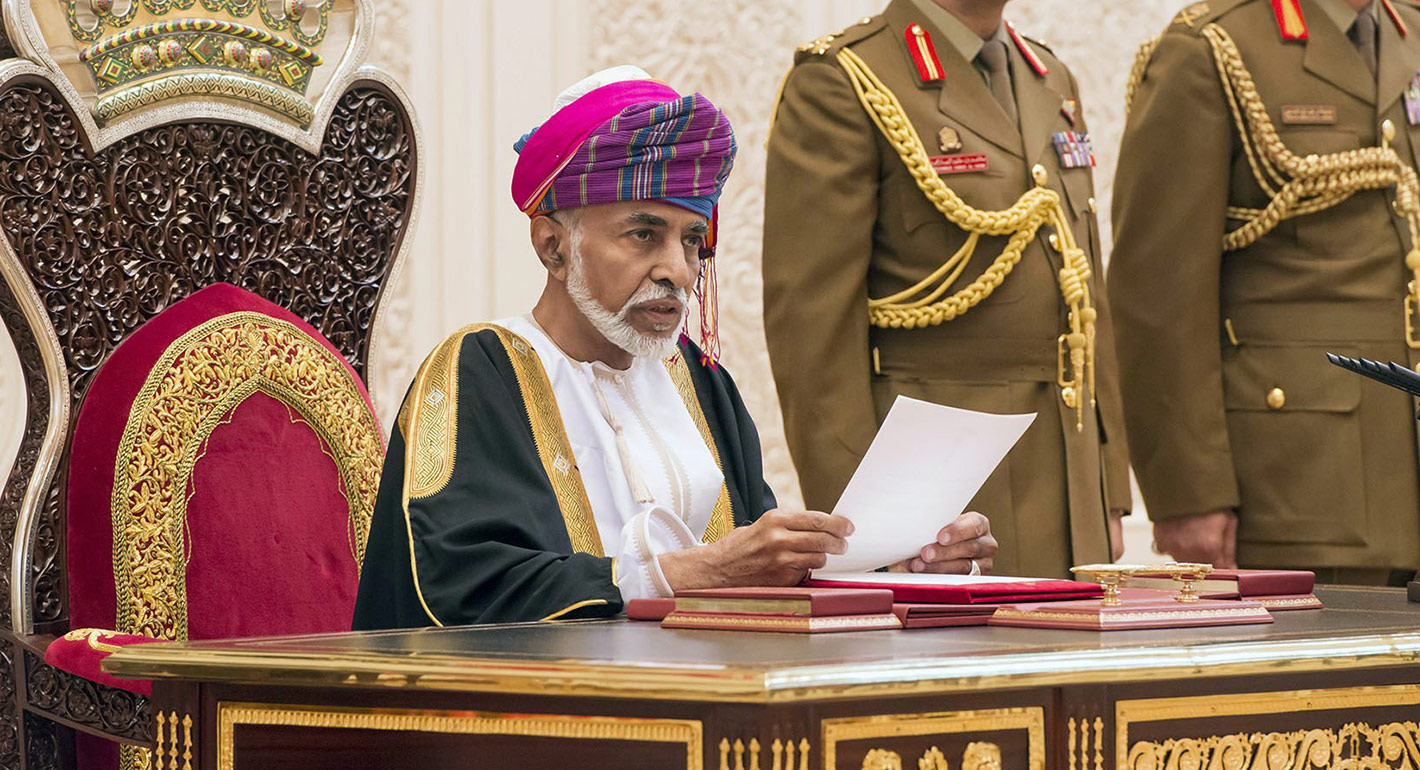
Qaboos seemed an anachronism in his final years on the throne, a temperate leader in an intemperate Middle East. His passing has huge consequences for the fate of his temperate model, with all its imperfections.
Source: Atlantic
“We’re getting close.” Those were the last words I said to Oman’s Sultan Qaboos bin Said. It was the fall of 2013, during the final stretch of secret talks with Iran. Brokered and hosted by the Omanis, those negotiations—the first sustained diplomatic interaction between the United States and Iran in 35 years—would open the door to the comprehensive nuclear agreement with Tehran.
The sultan’s death was announced on Friday. The Iran deal’s demise, all but certain since the U.S. withdrew in 2018, may soon follow. And the flickering possibilities for relative moderation and coexistence in the Middle East seem more uncertain than ever.
Over many years as an American diplomat, including as the senior official responsible for the Middle East, I met with Oman’s shy and reclusive monarch on a number of occasions. Full of wise insight and quiet dignity, the Sultan’s perspective and advice were always well informed, independent, and pragmatic.
When Qaboos took power from his reactionary father a half century ago, Oman was a country with only a few kilometers of paved road, little electricity, and barely any education (none for women and girls). Within a generation, Qaboos had used the country’s limited oil reserves to build up its physical infrastructure and human capital. In so doing he brought Oman out of medieval backwardness into the modern age. Oman today ranks at the top tier of most human-development indexes but with little of the conspicuous consumption or flash of its richer Gulf Arab neighbors. Out of a fractious population of several million, riven by tribal and confessional differences, Qaboos shaped a sense of national identity in a region where sectarian divisions were multiplying.
He supported Anwar Sadat’s diplomacy and Egypt’s peace treaty with Israel in 1979, when the rest of the region opposed it. He openly hosted Israeli prime ministers, breaking a regional taboo. Despite the irritation of the Saudis and Emiratis, he stayed out of their feud with the Qataris in recent years, and served as a mediator in the catastrophic war in Yemen. About the only regional leader he found nearly impossible to engage was Muammar Qaddafi; in one conversation not long after 9/11, when I was describing to Qaboos our efforts to persuade the unhinged Libyan leader to abandon terrorism, the Sultan’s laconic reply was “good luck.”
Qaboos’s biggest diplomatic contribution was his facilitation of the U.S.-Iran back channel. The Omanis were unobtrusive hosts, quiet advocates of persistence, and useful guides who helped us avoid misreading one another. It is no exaggeration to say that without the early efforts of Sultan Qaboos, there would have been no nuclear accord.
Sitting in his cavernous palace at the beginning of the Iran talks, I found optimism hard to come by. The negotiations were off to an unpromising start, with wildly unrealistic expectations from the Iranians. The Sultan was unmoved by my fretting. Soft-spoken and attentive, very much a combination of the English gentleman and the Arab autocrat, Qaboos advised patience. “The Iranians will be very difficult,” he said. “They don’t trust you, and you don’t trust them. But you must persist. The alternative is conflict, in which everyone will lose.” That seems uncomfortably prescient today.
Qaboos seemed an anachronism in his final years on the throne, a temperate leader in an intemperate Middle East. No democrat himself, he floated uneasily between the pressures for reform unleashed by the Arab Spring and the counterrevolutionary fervor of his bigger neighbors. Anchored in a geography he couldn’t escape, his measured style contrasted sharply with the brash, authoritarian overreach of the young Saudi crown prince, the deep-rooted suspiciousness and venom of the theocrats in Tehran, and—in the past few years—the blustery unilateralism of an American president unlike any of the eight he had known before him. Qaboos believed in slow, irreversible evolution. He was allergic to the transformational zeal that tempted so many in the region and so many outside it.
Now Omanis must navigate an unforgiving region without Qaboos, the only leader most of them have ever known. The challenges before the new sultan are formidable: unresolved questions of political voice and participation, unfinished business of creating economic opportunities for a very young population and diversifying beyond an unhealthy dependence on limited energy resources. I served as ambassador to Jordan when King Hussein died in 1999, after nearly a half century of his moderate rule, and know firsthand how important the support and attention of the United States and Oman’s other friends will be during this transition.
Even more consequential than the Sultan’s passing, however, is the fate of his temperate model, with all of its imperfections. Qaboos understood that diplomacy is worth pursuing to manage differences that can’t be solved overnight. He understood too that Arab societies that don’t apply some moderation and tolerance at home will eventually become brittle and break. If those wider lessons about the region and its dysfunctions continue to go unheeded, then Qaboos’s passing really will punctuate the end of one difficult era and the beginning of an even more combustible new chapter for the Middle East.
Former Carnegie President (2015-2021)
A former career diplomat, William J. Burns served as director of the CIA, deputy secretary of State, and ambassador to Russia and Jordan. Burns was also president of the Carnegie Endowment for International Peace from 2015 to 2021.
Recent Work
William J. Burns, Michael Chertoff, Catherine Ashton, …
William J. Burns
Carnegie does not take institutional positions on public policy issues; the views represented herein are those of the author(s) and do not necessarily reflect the views of Carnegie, its staff, or its trustees.

Despite a new textbook, an influx of Russian teachers and managers, and an end to the teaching of Ukrainian, the Kremlin is unlikely to have “reprogrammed” locals.

Konstantin Skorkin

Cargo traffic through Russia’s Northern Sea Route has increased because of the disruption caused by the conflict in the Middle East, the Ukraine war, and U.S.-China tensions.

Mikhail Korostikov

Sergei Kiriyenko used Russia’s parliamentary vote to further hone his strategy of corporate mobilization that is designed to maximize votes for United Russia.

Andrey Pertsev

The European far right might fail to steer EU policy in the direction Russia wants, but they will create enough chaos inside Europe to benefit the Kremlin.

Dimitar Bechev

Minsk clearly expected the dialogue with Washington to yield more results, in particular the lifting of EU sanctions and permission to export potash.

Artyom Shraibman