

Article
Stefan Lehne
{
  "authors": [
    "Stefan Lehne"
  ],
  "type": "commentary",
  "centerAffiliationAll": "",
  "centers": [
    "Carnegie Endowment for International Peace",
    "Carnegie Europe"
  ],
  "collections": [
    "EU Integration and Enlargement",
    "Coronavirus"
  ],
  "englishNewsletterAll": "",
  "nonEnglishNewsletterAll": "",
  "primaryCenter": "Carnegie Europe",
  "programAffiliation": "",
  "programs": [],
  "projects": [],
  "regions": [
    "Europe",
    "Eastern Europe",
    "Western Europe"
  ],
  "topics": [
    "EU",
    "Economy",
    "Global Governance"
  ]
}
Source: Getty
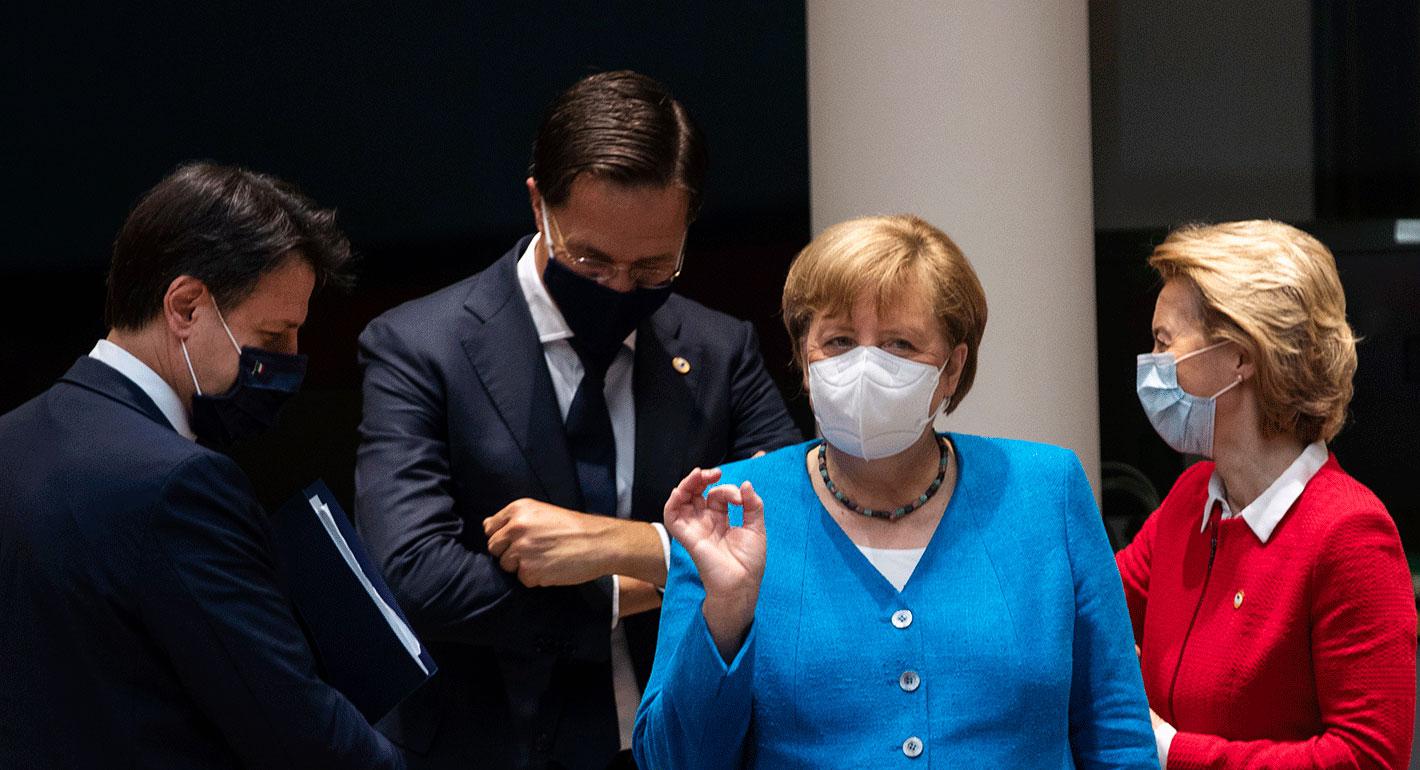
In the chaotic early weeks of the pandemic, when Europe was ground zero for the international spread of the coronavirus, European unity seemed a distant prospect. But Merkel’s leadership combined with a gigantic recovery fund have helped the EU bounce back.
Only a few months ago, the EU presented an image of disarray. The southern member states had been severely alienated ever since the 2007–2008 financial crisis. Between east and west, acrimony increased around the rule of law deficits in Hungary and Poland and around asylum reform. In the north, the Netherlands—slipping into the UK’s role as chief EU sceptic—assembled a coalition called the New Hanseatic League to resist deeper integration. Not that there was much to mobilize against. French President Emmanuel Macron’s fervent appeals for a stronger Europe had mostly fallen on deaf ears in Berlin. At the EU summit in February, Germany argued for reducing the EU budget to one percent of its gross national income.
The coronavirus crisis at first accelerated these trends. National governments dominated the crisis management, sidelining the European Commission’s efforts at coordination. A mindset of “every state for itself” left little space for European solidarity, turning the populations in the most heavily affected southern countries against the EU. And negotiations on an economic response to the crisis were hampered by the old ideological divisions between north and south.
But this negative dynamic was suddenly reversed by German Chancellor Angela Merkel. Strengthened internally by her successful management of the coronavirus, Merkel understood that the disastrous economic consequences of the pandemic for the southern member states posed great risks for the future of the Eurozone. Abandoning three long-standing German taboos in one stroke, she supported a massive expansion of EU funds, allowed the commission to raise additional money on the financial markets, and agreed that most of it would be disbursed as grants.
All this corresponded to urgent demands from the southern countries and France. The German move kickstarted French-German cooperation, resulting in an ambitious joint initiative. The Central and Eastern European countries, initially concerned that the attention to the south would come at their expense, were brought on board by the commission’s elaboration of the French-German plan, which made clear that they too would benefit from the new programs.
While the great majority of member states supported the project, not everybody was happy. The so-called frugals (Austria, Denmark, the Netherlands, Sweden, and informally Finland) pushed back and won some concessions, but the size and structure of the recovery program remained largely intact. Coupling the recovery fund with the EU budget proved the right approach, as the urgency of finding a response to the recession accelerated work on the immensely complex financial framework.
Do these decisions amount to a historic transition toward fiscal union? Probably not. The recovery program is strictly time limited, and the extent to which the collective debt will be repaid by new EU taxes is left open. Will the successful summit usher in an era of harmony in the EU? This too is quite unlikely. On trade, migration, monetary union, and security, different coalitions will form, and divisions will reappear.
But the summit made a large contribution to defusing the most acute danger: the widening economic disparity between the north and the south. And it resulted in a remarkable political comeback of the EU, which emerged as a key instrument to secure the economic recovery of Europe. With more resources and new responsibilities, EU institutions should now also be able to tackle the climate and digital challenges with greater confidence and determination.

Senior Fellow, Carnegie Europe
Stefan Lehne is a senior fellow at Carnegie Europe in Brussels, where his research focuses on the post–Lisbon Treaty development of the European Union’s foreign policy, with a specific focus on relations between the EU and member states.
Recent Work
Stefan Lehne
Stefan Lehne
Carnegie does not take institutional positions on public policy issues; the views represented herein are those of the author(s) and do not necessarily reflect the views of Carnegie, its staff, or its trustees.

Minsk clearly expected the dialogue with Washington to yield more results, in particular the lifting of EU sanctions and permission to export potash.

Artyom Shraibman

If the Russian-speaking community in Latvia cannot articulate their interests without being seen as disloyal, they could end up embracing a pro-Kremlin agenda.

Sergejs Potapkins

Depleted financial reserves and a shrinking tax base mean it is no longer possible to simultaneously deliver high defense spending, price stability, and economic growth.

Alexandra Prokopenko

With the growth in points of friction between the great powers, organizations like the SCO will continue to play a role in the strategic adaptation of the smaller powers caught between them.

Temur Umarov

When faced with fuel shortages in the past, Central Asian governments could always count on additional supplies from Moscow. That safety net no longer exists.

Galiya Ibragimova