

Other
François Godement, Ashley J. Tellis
{
  "authors": [
    "François Godement"
  ],
  "type": "legacyinthemedia",
  "centerAffiliationAll": "dc",
  "centers": [
    "Carnegie Endowment for International Peace"
  ],
  "collections": [],
  "englishNewsletterAll": "asia",
  "nonEnglishNewsletterAll": "",
  "primaryCenter": "Carnegie Endowment for International Peace",
  "programAffiliation": "AP",
  "programs": [
    "Asia"
  ],
  "projects": [],
  "regions": [
    "East Asia",
    "China",
    "Western Europe"
  ],
  "topics": [
    "Foreign Policy"
  ]
}
Source: Getty
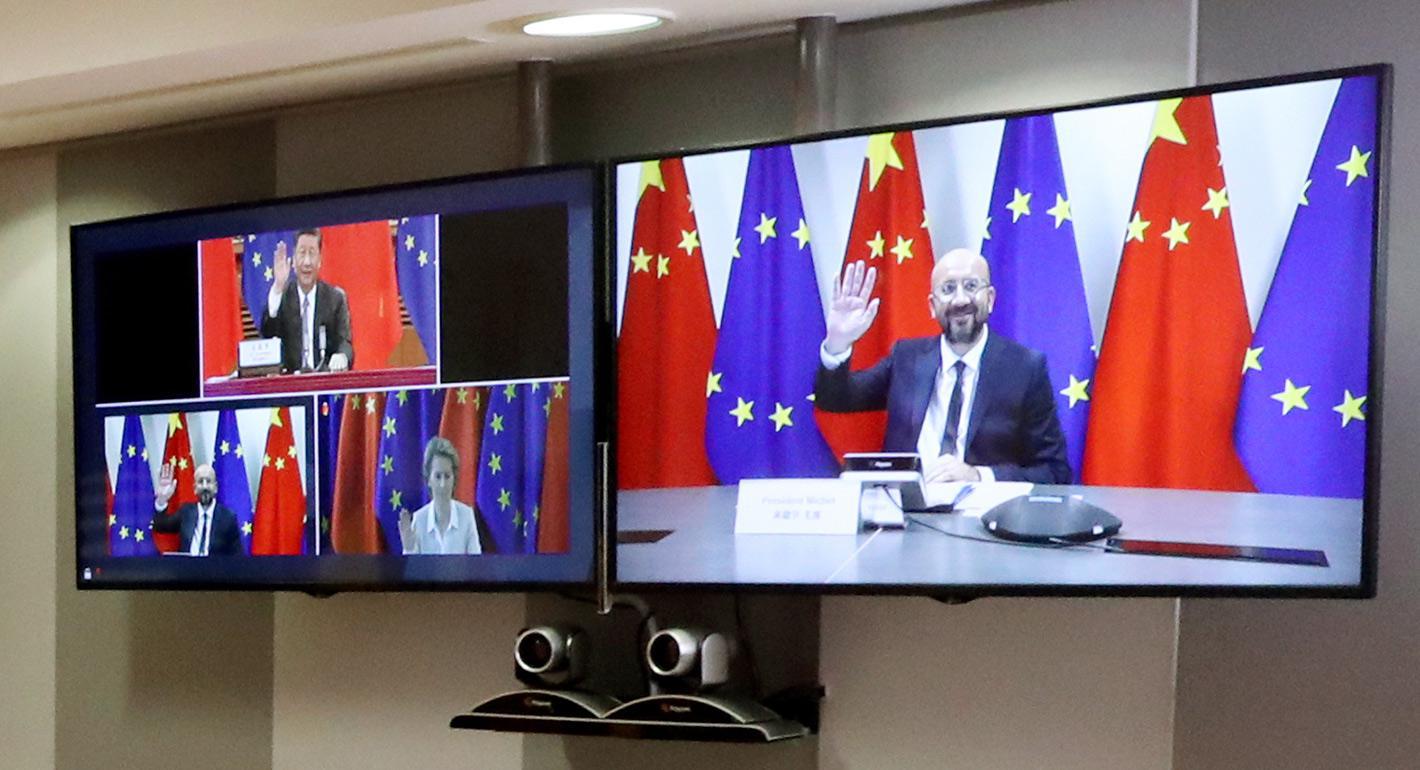
China’s diplomacy has entered a game of hide and seek with the European Union in preparation for another virtual summit on September 13-14 between Xi Jinping and EU leaders.
Source: Institut Montaigne
China’s diplomacy has entered a game of hide and seek with the European Union in preparation for another virtual summit on September 13-14 between Xi Jinping and EU leaders - Ursula von der Leyen, Charles Michel and Angela Merkel, since Germany chairs the Council this semester.
One should first note that Beijing did not blink an eye after von der Leyen and Michel gave a blisteringly critical press conference on June 22, concluding another summit that ended without a joint communiqué. No answer from Beijing was probably the best short-term tactic, since the list of European grudges is so long. Although technical negotiations on a potential investment agreement deal have continued, there is little report of any progress – save perhaps on technology transfers: that is an issue where China fears new restrictions, and it is therefore mostly a Chinese ask, not a European one. Market access, subsidies and SOEs are issues on which there is no sign of China intending to budge. Meanwhile, of course, European public opinion has greatly soured on China, for reasons known to all: Xinjiang, Hong Kong, military posturing or violence against several Asian neighbors, the denial of responsibility on Covid-19 and a crude "mask diplomacy", the attacks or threats on several European governments – this year, it is the Czech Republic and United Kingdom’s turn, but a dispute with Sweden also lingers.
It is against this background that Foreign Minister Wang Yi has just concluded a tour of China’s four main export destinations in Europe – Italy, France, the Netherlands and Germany, with Norway, a non-EU country thrown in. Oddly, it is on the last day of this tour that another coming trip – this time by Yang Jiechi, Wang’s predecessor and now Politburo member in charge of foreign policy, was announced, reportedly to Greece and Spain.
This article was originally published by Institut Montaigne.

Former Nonresident Senior Fellow, Asia Program
Godement, an expert on Chinese and East Asian strategic and international affairs, was a nonresident senior fellow in the Asia Program at the Carnegie Endowment for International Peace.
Recent Work
François Godement, Ashley J. Tellis

François Godement, Abigaël Vasselier
Carnegie does not take institutional positions on public policy issues; the views represented herein are those of the author(s) and do not necessarily reflect the views of Carnegie, its staff, or its trustees.
A leak of Russian gas price data helps establish that China is paying Russia far less than Central Asian countries and Gazprom’s former European customers.

Sergey Vakulenko

Japan’s long-term security policy is driven by concerns about China, and there is little appetite for (or interest in) pursuing a confrontation with Moscow.

James D.J. Brown

Without a ceasefire with Ukraine on attacking each other’s energy infrastructure—to which the Kremlin is unlikely to agree—the diesel agreement between Putin and Trump is largely for show, rather than representing a genuine increase in the volumes of Russian diesel on the global market.
Sergey Vakulenko

Despite a new textbook, an influx of Russian teachers and managers, and an end to the teaching of Ukrainian, the Kremlin is unlikely to have “reprogrammed” locals.

Konstantin Skorkin

Cargo traffic through Russia’s Northern Sea Route has increased because of the disruption caused by the conflict in the Middle East, the Ukraine war, and U.S.-China tensions.

Mikhail Korostikov