

Commentary
James D.J. Brown
{
  "authors": [
    "James D.J. Brown"
  ],
  "type": "commentary",
  "blog": "Carnegie Politika",
  "centerAffiliationAll": "",
  "centers": [
    "Carnegie Endowment for International Peace",
    "Carnegie Russia Eurasia Center"
  ],
  "englishNewsletterAll": "",
  "nonEnglishNewsletterAll": "",
  "primaryCenter": "Carnegie Russia Eurasia Center",
  "programAffiliation": "",
  "regions": [
    "Russia",
    "Japan"
  ],
  "topics": [
    "Security",
    "NATO",
    "Global Governance",
    "Foreign Policy"
  ]
}
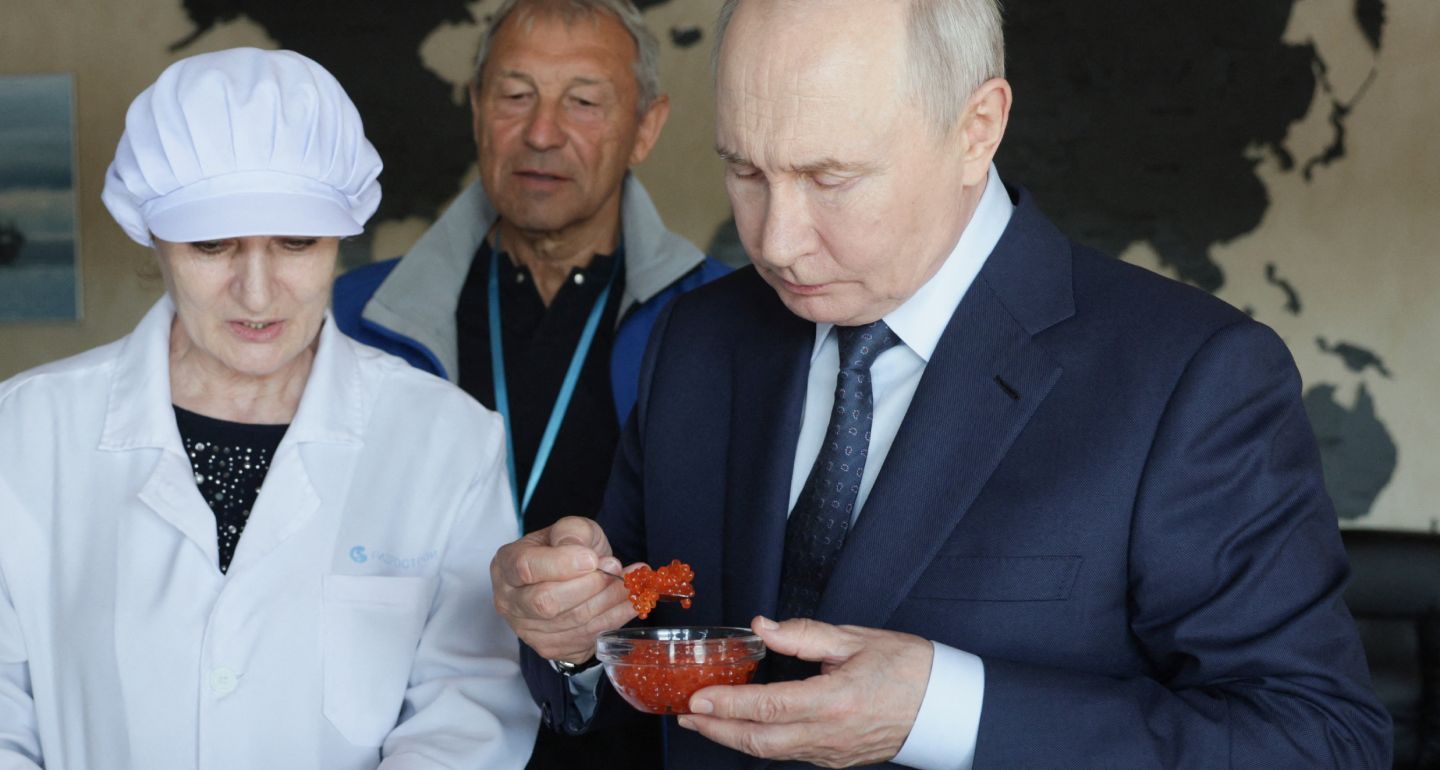
Фото: Getty Images
Japan’s long-term security policy is driven by concerns about China, and there is little appetite for (or interest in) pursuing a confrontation with Moscow.
The Russian authorities have recently engaged in several provocations against Japan. Most notable was President Vladimir Putin’s visit to Iturup on August 13. Japan claims this island, which it calls Etorofu and is part of the disputed Southern Kuril chain, as “inherent” Japanese territory.
In addition to condemning the visit, Tokyo imposed new sanctions on thirty-five ships in Russia’s “shadow fleet” of oil tankers on October 2 and slapped asset freezes on a further nine individuals and thirty-three companies linked to Russia’s military-industrial complex. However, Japan’s Foreign Ministry emphasized that these sanctions were unconnected to Putin’s Etorofu visit, and simply closed loopholes used by Moscow to circumvent Western sanctions. So what explains this surprisingly passive response?
Putin’s trip took place despite repeated requests from the Japanese government for him to stay away. Other Russian officials, including Deputy Chair of the Security Council Dmitry Medvedev and Prime Minister Mikhail Mishustin, had already set foot on the contested island. However, until this year, Putin—out of apparent consideration for Japan—had refrained from doing so.
To make matters worse, Putin’s visit came just days after the August 9 anniversary of the start of the Soviet attack in 1945 that led to the seizure of the islands from Japan. Many Japanese view this attack as particularly egregious since it occurred in violation of the Soviet-Japanese Neutrality Pact of 1941.
Further provocative steps soon followed in an apparent bid by the Kremlin to punish Japan for its support for Ukraine and to drum up patriotic sentiments in the Russian Far East ahead of State Duma elections on September 18–20.
On September 4, a new monument commemorating the Soviet victory over Japan was unveiled in the Far Eastern city of Khabarovsk. Ordered by the Russian Military Historical Society, an organization headed by Putin aide Vladimir Medinsky, the vast statue depicts a Soviet soldier destroying a border marker embossed with the Imperial Japanese chrysanthemum. The flower, which remains the symbol of Japan’s much-revered imperial family, has controversially been cleaved in two on the Khabarovsk statue.
Doubling down on this aggressive stance, Foreign Minister Sergey Lavrov used his speech at the United Nations General Assembly on September 26 to condemn Japan (as well as Germany) for taking “the path of militarization and revanchism.”
In addition to the hostile rhetoric, Russian armed forces have conducted regular military activities close to Japan, including large-scale live-fire drills in the Sea of Okhotsk in August. In early September, two Russian destroyers transited the Tsugaru Strait between the main Japanese islands of Honshu and Hokkaido, and a Russian Vishnya-class intelligence ship probed Japan’s coastline.
To top it all, on 12 October Russia’s FSB arrested a Japanese journalist on almost-certainly trumped-up espionage charges.
Japanese Prime Minister Takaichi Sanae, who took office in October 2025, has presented herself as the “Iron Lady” of Japan. As an unapologetic nationalist, she has made her name by taking a forthright stance against China, including suggesting that Japan’s armed forces could become involved in a conflict over Taiwan. This assertive position has proved popular, helping propel her Liberal Democratic Party (LDP) to a historic landslide in February elections.
Given Takaichi’s reputation, there were expectations that she would lead a bold response to Russia’s provocations. On August 13, Takaichi told reporters that Putin’s visit to Etorofu was “utterly unacceptable.” She added that it had “further hardened public sentiment toward Russia in Japan and made it more difficult to restore Japan-Russia relations over the medium to long term.”
Observers speculated about what form Japan’s response would take. Media discussed a potential recall of the ambassador or greater assistance for Ukraine. Another option mentioned was tightening visa rules, which have remained comparatively liberal since the start of Russia’s full-scale invasion of Ukraine in 2022. As a result, a record 195,000 Russian tourists visited Japan in 2025.
And yet, apart from the (apparently unconnected) sanctions against Russia’s shadow fleet, nothing happened. This is due first and foremost to the prime minister’s lack of leadership on the issue. While Takaichi has strong, fixed views on China, especially regarding the fraught history of Japan-China relations, she appears to know and care little about Russia. That meant the initiative was ceded to the bureaucracy, which urged restraint.
Japan’s Ministry of Economy, Trade, and Industry (METI), whose officials wield influence within the Prime Minister’s Office, cautioned against a firm response due to energy security concerns. Japan continues to import about 9 percent of its natural gas from Russia, a figure largely unchanged since Russia’s full-scale invasion of Ukraine in 2022. These imports have become even more important since the U.S.-Iran conflict disrupted energy supplies from the Middle East. METI’s concern is that a robust Japanese response would jeopardize Russian energy supplies, with dire consequences for the Japanese economy.
Japan’s Ministry of Foreign Affairs (MOFA) is similarly hesitant. As always, its principal concern is that Japan’s policy should not stray far from that of the United States.
Japan’s diplomats have been closely watching the Trump administration’s renewed engagement with the Putin regime, including a September visit to Moscow by presidential envoys Jared Kushner and Steve Witkoff, and the controversial deal announced on October 9 for the United States to ease sanctions on Russia to permit the purchase of diesel. MOFA’s priority is to avoid escalating tensions with Russia at a time when Donald Trump is doing business with it.
The resulting stasis is a source of frustration for Japan’s most ardent supporters of Ukraine, some of whom have taken matters into their own hands. On September 14, Mori Eisuke, speaker of Japan’s House of Representatives, visited Kyiv, where he donned a traditional vyshyvanka shirt and condemned Russia’s “barbaric actions.” At the start of October, a delegation of Japanese parliamentarians led by former Defense Minister Onodera Itsunori also visited the Ukrainian capital, where they met with President Volodymyr Zelensky.
By failing to respond decisively to Russia’s provocations, Japan risks being seen as weak and inviting further pressure. Overall, however, Japan’s main policies toward Russia and Ukraine remain unchanged.
Sanctions against Russia look set to be maintained and regularly updated to align with those of Tokyo’s Western partners. Cooperation with Ukraine will also continue: Japan committed to this in a ten-year accord signed in June 2024.
Forthcoming Japanese support is, however, unlikely to include air-defense missiles. Japan produces Patriot missiles and has stocks of older HAWK surface-to-air missiles. Kyiv has lobbied for the transfer of these systems, yet Japan’s government remains cautious over concerns that the supply of lethal weaponry would contradict the country’s pacifist principles.
More generally, Japan looks set to proceed with its gradual evolution into a more capable and less constrained security actor. This has little to do with Russia and is primarily driven by China, which is perceived as a much greater threat. Japanese security reforms include increased defense spending—possibly as high as 3.5 percent of GDP—and greater cooperation with NATO.
Since 2025, Japan has hosted U.S. Typhon missiles. These are ground-launched intermediate-range missiles whose deployment was prohibited under the now-defunct Intermediate-Range Nuclear Forces (INF) Treaty. Russian Foreign Ministry spokeswoman Maria Zakharova has described the Typhons temporarily housed in Japan as a direct threat to Russia’s Far East.
There is also an ongoing debate in Japan about revising the country’s three non-nuclear principles formulated in 1967 that pledge Japan will not produce, possess, or host nuclear weapons. Some in Tokyo would like the country to be able to host U.S. nuclear weapons in a crisis (particularly one related to Taiwan).
In short, while the Takaichi administration has shown indecision about how to respond to Moscow’s latest provocations, Japan’s longer-term security policy is steadily developing in a direction counter to Russian interests.

Professor of Political Science at Temple University
Recent Work
James D.J. Brown
James D.J. Brown
Carnegie does not take institutional positions on public policy issues; the views represented herein are those of the author(s) and do not necessarily reflect the views of Carnegie, its staff, or its trustees.
The truth of the strategic situation is that Europe and Russia are extremely unlikely to be able to “turn the page” on their confrontation within the next two decades.
Arkady Moshes
Russia spent years building a “sovereign internet,” concentrating web infrastructure exclusively within Russian territory. Ukrainian drone attacks have shown how vulnerable that approach has left the Russian internet.

Maria Kolomychenko
Putin’s conservative staffing policies and search for ever greater control have cemented parliament’s transformation into a bureaucratic appendage of the executive branch.

Andrey Pertsev

Russia’s AI-driven propaganda campaigns operate in a fragmented, chaotic, and often illogical manner. That’s not necessarily a problem for the Kremlin, though: It’s much easier to mimic genuine public debate that way.

Ilya Klishin
Without a ceasefire with Ukraine on attacking each other’s energy infrastructure—to which the Kremlin is unlikely to agree—the diesel agreement between Putin and Trump is largely for show, rather than representing a genuine increase in the volumes of Russian diesel on the global market.
Sergey Vakulenko