

Commentary
A leak of Russian gas price data helps establish that China is paying Russia far less than Central Asian countries and Gazprom’s former European customers.
Sergey Vakulenko
{
  "authors": [
    "Liana Fix"
  ],
  "type": "commentary",
  "centerAffiliationAll": "",
  "centers": [
    "Carnegie Endowment for International Peace",
    "Carnegie Russia Eurasia Center"
  ],
  "collections": [],
  "englishNewsletterAll": "",
  "nonEnglishNewsletterAll": "",
  "primaryCenter": "Carnegie Endowment for International Peace",
  "programAffiliation": "",
  "programs": [],
  "projects": [],
  "regions": [
    "Russia",
    "Western Europe",
    "Germany"
  ],
  "topics": [
    "Economy"
  ]
}
Source: Getty
The new Berlin government is in a difficult spot when it comes to dealing with Russia.
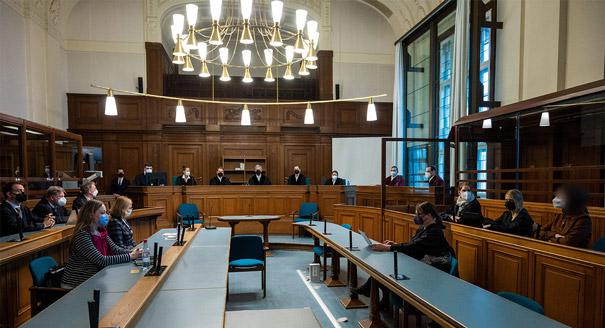
The new German government’s Russia policy could not have gotten off to a more difficult start. Barely a week after Annalena Baerbock was sworn in as Germany’s new foreign minister, she had to expel two Russian diplomats after a Berlin court found a Russian FSB agent guilty of a 2019 “murder by state contract” in the city’s central Tiergarten park. Meanwhile, many of new chancellor Olaf Scholz’s meetings in his first week in office were at least partly dedicated to Russia’s unprecedented amassing of troops at Ukraine’s borders, and to Europe’s reaction.
It’s no surprise that Moscow is testing the mettle of the longtime German chancellor Angela Merkel’s successor—and the EU’s readiness to stand firm in its Eastern Neighborhood. The timing is perfect for the Russian leadership to relegate the EU to the back seat of talks on European security: a new coalition has just been formed in Berlin, French President Emmanuel Macron is up for reelection in the spring, and a direct bilateral U.S.-Russian channel was recently established for strategic stability talks. The Normandy format (France, Germany, Russia, and Ukraine) suffered a serious blow last month when the Russian Foreign Ministry published confidential letters it had exchanged with German and French diplomats.
Moscow is taking advantage of the situation and demanding to discuss European security directly with the United States as the only actor the Russian leadership takes seriously and feels equivalent to—knowing full well that Washington’s priority is China.
The publication of a proposed U.S.-Russian treaty drafted by Moscow, including a number of unrealistic demands regarding European security, casts doubt on Russia’s seriousness about parleying, especially given the backdrop of the open military threat to Ukraine. Under these circumstances, Germany’s traditional approach of engagement with Moscow is becoming increasingly difficult to pursue, especially in a three-party coalition with diverging approaches to Russia.
Despite Russia’s violations of the European security order, Germany has always been a supporter of continuous engagement with Moscow. Although then Russian president Dmitry Medvedev’s proposals for a new European security order from 2009 were met with skepticism, Merkel and her foreign policy advisor Christoph Heusgen devised the “Meseberg initiative” in response. When deterrence measures became necessary, Germany advocated for respecting existing agreements, such as the 1997 NATO-Russia Founding Act, and preferred to station rotating troops rather than permanent ones in eastern NATO member states.
This approach often caused frustration among the Eastern Neighbors, whose warnings ahead of the 2008 war in Georgia, the annexation of Crimea in 2014, and the war in Donbas were perceived as unfounded prophecies of doom in Berlin—until the nightmarish wake-up call of 2014. Underestimating Russia’s willingness to act militarily is not a mistake Germany will make twice. But it now lacks the counterpart for the diplomatic engagement it had in the past, as Moscow is showing no willingness to engage in talks with Berlin on European security.
At the same time, the new-old Russia policy of the so-called “traffic light coalition” of the Social Democratic Party, the Free Democratic Party, and the Green Party is still in the making and reflects the different approaches of the three parties. After intense discussions on the best approach to Russia (between the normative approach backed by the Greens and to some extent the Free Democrats, and the engagement-oriented approach backed by the Social Democrats), a language was found that is deemed satisfactory to all.
While it is still sharper than the language of previous coalition agreements, some differences remain. The focus on human rights and the rejection of the Nord Stream 2 gas pipeline by the Green Party is difficult to square with the Social Democrats’ legacy of Willy Brandt’s Ostpolitik and support for the pipeline. Furthermore, the question of a credible security policy toward Russia remains on the table: Green Party leader Robert Habeck has been fiercely criticized for his support of defensive weapon deliveries to Ukraine. Although the Greens have moved toward the center in terms of security policy, skepticism of the traditional concept of deterrence remains, just as it does in the left wing of the Social Democrats. How to deal with the Nord Stream 2 pipeline in the event of a Russian invasion of Ukraine will be the litmus test for the new coalition to prove that its Russia policy is more than the sum of its parts.
In the last two years, Moscow has managed to strengthen its position in the neighborhood, particularly in Belarus and in the South Caucasus, and to put the European gas market under significant pressure. Now, on the thirtieth anniversary of the collapse of the Soviet Union, the Russian leadership is trying to underpin and substantiate its claim for influence in Ukraine. Germany and its new coalition government will have to adapt Berlin’s traditional approach of engagement to provide a credible response to Russia’s military threats.
This material is part of the Russia-EU: Promoting Informed Dialogue project, supported by the EU Delegation to Russia.

Liana Fix
Senior Fellow, Council on Foreign Relations
Liana Fix is a senior fellow for Europe at the Council on Foreign Relations.
Carnegie does not take institutional positions on public policy issues; the views represented herein are those of the author(s) and do not necessarily reflect the views of Carnegie, its staff, or its trustees.
A leak of Russian gas price data helps establish that China is paying Russia far less than Central Asian countries and Gazprom’s former European customers.

Sergey Vakulenko

Japan’s long-term security policy is driven by concerns about China, and there is little appetite for (or interest in) pursuing a confrontation with Moscow.

James D.J. Brown

The truth of the strategic situation is that Europe and Russia are extremely unlikely to be able to “turn the page” on their confrontation within the next two decades.
Arkady Moshes
Russia spent years building a “sovereign internet,” concentrating web infrastructure exclusively within Russian territory. Ukrainian drone attacks have shown how vulnerable that approach has left the Russian internet.

Maria Kolomychenko

Putin’s conservative staffing policies and search for ever greater control have cemented parliament’s transformation into a bureaucratic appendage of the executive branch.

Andrey Pertsev