

Commentary
Russia spent years building a “sovereign internet,” concentrating web infrastructure exclusively within Russian territory. Ukrainian drone attacks have shown how vulnerable that approach has left the Russian internet.
Maria Kolomychenko
{
  "authors": [
    "Benjamin Silverstein"
  ],
  "type": "commentary",
  "centerAffiliationAll": "dc",
  "centers": [
    "Carnegie Endowment for International Peace"
  ],
  "collections": [
    "Carnegie Space Project"
  ],
  "englishNewsletterAll": "ctw",
  "nonEnglishNewsletterAll": "",
  "primaryCenter": "Carnegie Endowment for International Peace",
  "programAffiliation": "TIA",
  "programs": [
    "Technology and International Affairs"
  ],
  "projects": [],
  "regions": [
    "Iran"
  ],
  "topics": [
    "Technology"
  ]
}
Source: Getty
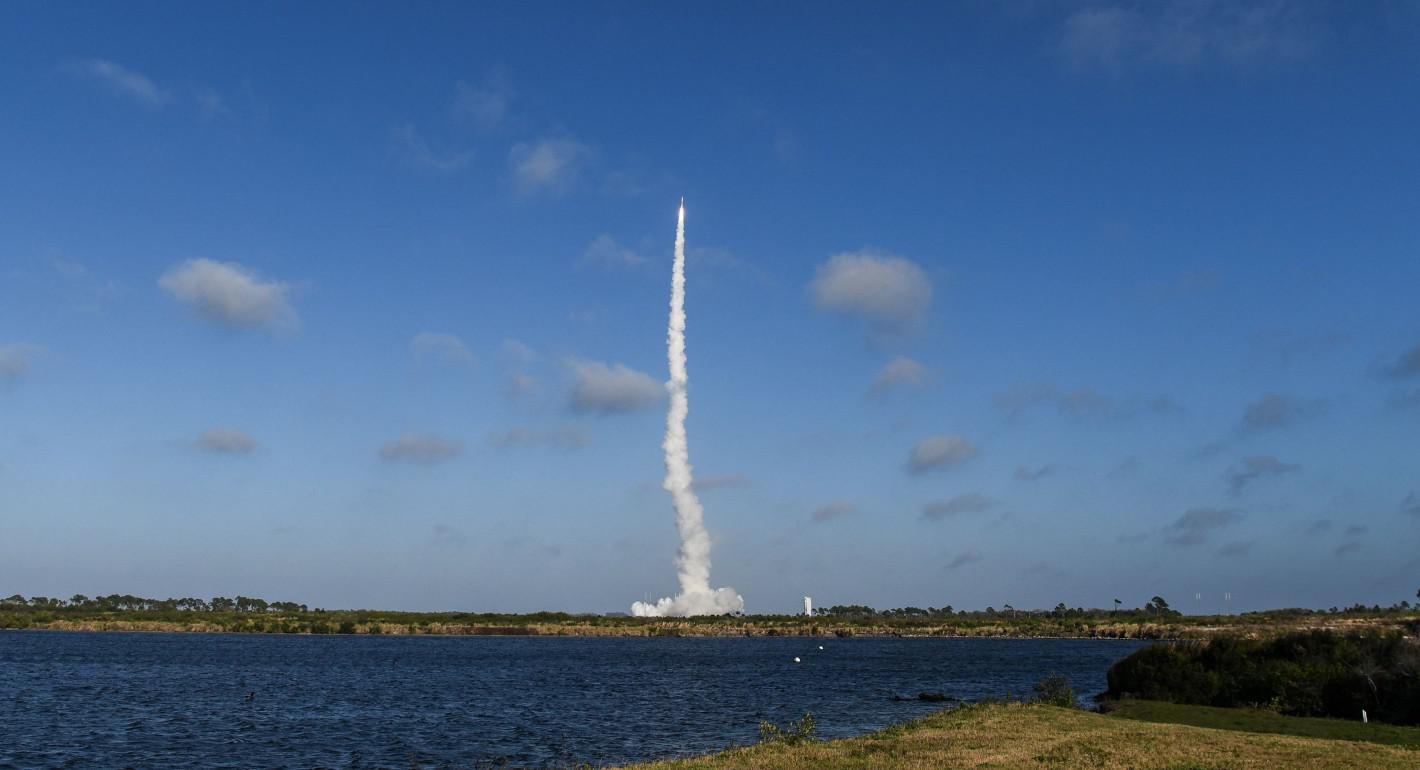
Riskier launch operations may hasten the danger of orbital debris.
Growing interest in networks of thousands of satellites in low Earth orbit (LEO)—often called megaconstellations—has elevated concerns about the sustainability of human activities in outer space. State and private actors alike are interested in deploying megaconstellations in pursuit of advantages in commerce and interstate competition, despite the attendant risks of orbital overcrowding and collisions between spacecraft. In response, states should collaboratively enhance multinational space traffic coordination to reduce the chances of collision and curb the spread of debris in orbit.
Plummeting costs of manufacturing and launching satellites into orbit have prompted companies and governments to reconsider previously cost-prohibitive satellite network designs that provide global coverage. Moreover, faster mass production practices and more accessible launch services enable operators to replace broken satellites more rapidly. The financial risks of mission failure have declined, leading to riskier operations that may hasten the proliferation of orbital debris from failed or failing satellites.
Thus far, governments have been slow to adapt regulatory oversight practices to address risks specific to megaconstellations, let alone override deployments. Yet major government stakeholders are beginning to voice concerns about the risks stemming from tens of thousands of new satellites in LEO. Within the U.S. government, NASA recently expressed concerns about SpaceX’s plans for its Starlink megaconstellation. In a letter to the Federal Communications Commission, which has regulatory responsibility for commercial satellite launches, NASA outlined how more megaconstellations could significantly hamper access to Earth’s orbits and constrain space activities.
NASA’s letter is a notable indicator of shifting perceptions of the risks of megaconstellations. NASA and SpaceX signed a ten-year commitment in 2021 to coordinate collision avoidance maneuvering. Under this agreement, SpaceX took the onus for moving satellites in its Starlink megaconstellation out of NASA’s way to preclude instances in which both operators attempt to avoid a collision between their satellites and accidentally maneuver into one another. Just over a year into the agreement, it appears that NASA considers this type of ad hoc arrangement insufficient for supporting space safety.
Several nongovernmental observers share NASA’s concerns that current space governance mechanisms cannot manage risks related to megaconstellations. It is unlikely that the sources of risks in LEO will abate in the imminent future. More megaconstellation deployments, operated by actors from multiple countries with various motivations, necessitate better space traffic coordination. An orbital traffic management system capable of handling new megaconstellations will require states to hold both their domestic industry and each other accountable for collecting, sharing, and analyzing data on satellites in LEO.
Currently, most of the world relies on the U.S. Department of Defense to collect and analyze data on objects in LEO. The 18th Space Control Squadron alerts the owners of spacecraft when analyses indicate potential conjunctions. These warnings are often rendered meaningless by significant margins of error, blurring expectations about risk-reducing behaviors. Even when analyses precisely uncover an imminent conjunction, there is no threshold collision probability that absolutely warrants an avoidance maneuver, nor globally accepted rules for how, where, and when to move.
To address the looming spike in imprecise conjunction warnings stimulated by a boom in megaconstellations, states should share relevant data about satellites in addition to orbital elements. States can build on existing measures such as the Long-Term Sustainability Guidelines, agreed to by members of the United Nations Committee on the Peaceful Uses of Outer Space, to foster cooperation on a centralized mechanism for data collection and conjunction analyses. Building on this foundation, states can establish and enforce rules about collision avoidance maneuvers. This would engender trust and transparency among state and commercial satellite operators alike.
The international community has arranged rules for terrestrial, maritime, and aeronautical collision avoidance. It is high time to establish similar rules for Earth’s orbits.
Benjamin Silverstein
Former Research Analyst, Space Project
Benjamin Silverstein was a research analyst for the Space Project at the Carnegie Endowment for International Peace.
Carnegie does not take institutional positions on public policy issues; the views represented herein are those of the author(s) and do not necessarily reflect the views of Carnegie, its staff, or its trustees.

Russia spent years building a “sovereign internet,” concentrating web infrastructure exclusively within Russian territory. Ukrainian drone attacks have shown how vulnerable that approach has left the Russian internet.

Maria Kolomychenko

Russia’s AI-driven propaganda campaigns operate in a fragmented, chaotic, and often illogical manner. That’s not necessarily a problem for the Kremlin, though: It’s much easier to mimic genuine public debate that way.

Ilya Klishin

While France and Australia are seeking to establish the legal obligations of messaging apps like Telegram, Russia wants total subordination.
Maria Kolomychenko

The war in Ukraine and a change in ownership led VK to neglect its commercial ventures in favor of implementing the Kremlin’s online agenda. Now it’s been sanctioned by the EU.
Maria Kolomychenko

When political power is concentrated in the hands of a small circle of people, a country invariably ends up with technological stagnation.

Aleksei Kiselev