• Research
  • Politika
  • About
Carnegie Russia Eurasia center logoCarnegie lettermark logo
  • Donate
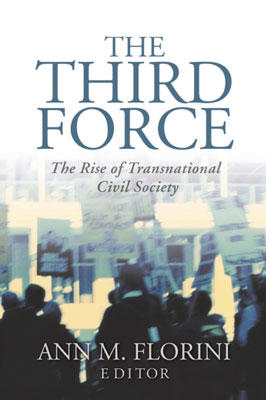
Third Force: The Rise of Transnational Civil Society
Book

Third Force: The Rise of Transnational Civil Society

The book's six case studies investigate the role of transnational civil society in the global anti-corruption movement, nuclear arms control, dam-building and sustainability, democracy movements, landmines, and human rights.

Link Copied
By Ann M. Florini
Published on Oct 2, 2000

Additional Links

Chapter OneTable of ContentsPaperback - $19.95Kindle - $9.99iTunes - $9.99Nook - $10.39

Source: Washington

Transnational networks of civil society groups are seizing an ever-greater voice in how governments run countries and how corporations do business. This volume brings together a multinational group of authors to help policy makers, scholars, corporate executives, and activists themselves understand the profound issues raised. How powerful are these networks? Is their current prominence a temporary fluke or a permanent change in the nature of international power? What roles should they play as the world struggles to cope with the new global agenda? The book's six case studies investigate the role of transnational civil society in the global anti-corruption movement, nuclear arms control, dam-building and sustainability, democracy movements, landmines, and human rights. The conclusion draws out lessons and argues for a new understanding of the legitimate role of transnational civil society.

Advance Praise

“An excellent, comprehensive, and timely analysis of a phenomenon that could redraw the contours of global governance in inspiring and challenging ways in the twenty-first century.”
    —Kumi Naidoo, Secretary General and CEO of CIVICUS: World Alliance for Citizen Participation

“Provides an excellent overview to the issues and trends in the rise of transnational civil society. Policy makers, students, and academics will appreciate the lively prose, diverse and well-documented case studies, lucid conclusions, and useful annotated bibliography.”
   —Kathryn Sikkink, University of Minnesota

Ann M. Florini
Former Senior Associate
Security

Carnegie does not take institutional positions on public policy issues; the views represented herein are those of the author(s) and do not necessarily reflect the views of Carnegie, its staff, or its trustees.

More Work from Carnegie Russia Eurasia Center

  • Commentary
    Carnegie Politika
    Russia’s Unspoken Condition for Ending the War Is Zelensky’s Resignation

    Insisting on Zelensky’s resignation is not just a personal vendetta, but a clear signal that the Kremlin would like to send to all its neighbors: even if you manage to put up some resistance, you will ultimately pay the price—including on a personal level.

      Vladislav Gorin

  • Commentary
    Carnegie Politika
    For Putin, Increasing Russia’s Nuclear Threat Matters More Than the Triad’s Modernization

    For Putin, upgrading Russia’s nuclear forces was a secondary goal. The main aim was to gain an advantage over the West, including by strengthening the nuclear threat on all fronts. That made growth in missile arsenals and a new arms race inevitable.

      Maxim Starchak

  • Commentary
    Carnegie Politika
    Japan’s “Militarist Turn” and What It Means for Russia

    For a real example of political forces engaged in the militarization of society, the Russian leadership might consider looking closer to home.

      James D.J. Brown

  • Commentary
    Carnegie Politika
    Why Is Ukraine Extending a Hand to the Belarusian Opposition-in-Exile?

    The risk posed by Lukashenko today looks very different to how it did in 2022. The threat of the Belarusian army entering the war appears increasingly illusory, while Ukraine’s ability to attack any point in Belarus with drones gives Kyiv confidence.

      Artyom Shraibman

  • Commentary
    Carnegie Politika
    Russia Won’t Give Up Its Influence in Armenia Without a Fight

    Instead of a guaranteed ally, the Kremlin now perceives Armenia as yet another hybrid battlefield where it is fighting the West.

      Mikayel Zolyan

Get more news and analysis from
Carnegie Russia Eurasia Center
Carnegie Russia Eurasia logo, white
  • Research
  • Politika
  • About
  • Experts
  • Events
  • Contact
  • Privacy
Get more news and analysis from
Carnegie Russia Eurasia Center
© 2026 Carnegie Endowment for International Peace. All rights reserved.