

Commentary
Russia spent years building a “sovereign internet,” concentrating web infrastructure exclusively within Russian territory. Ukrainian drone attacks have shown how vulnerable that approach has left the Russian internet.
Maria Kolomychenko
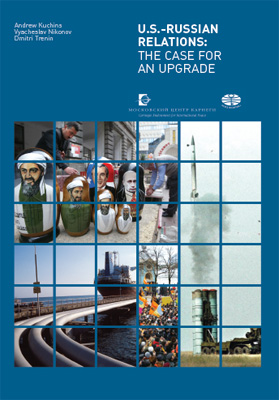
Highly touted in both Washington and Moscow as a "strategic partnership" in 2001, the relationship has drifted and the gap between glowing rhetoric and thin substance has grown. When major policy differences emerge, as over war in Iraq in 2002-2003 and recently over Ukraine, all too easily the U.S.-Russian relationship spirals into "crisis," and the threat of a "new Cold War" looms.
"The recent sharp dispute over the Ukrainian presidential elections vividly illustrated the fragile and shallow nature of the U.S.-Russian relationship. Highly touted in both Washington and Moscow as a "strategic partnership" in 2001, the relationship has drifted and the gap between glowing rhetoric and thin substance has grown. When major policy differences emerge, as over war in Iraq in 2002-2003 and recently over Ukraine, all too easily the U.S.-Russian relationship spirals into "crisis," and the threat of a "new Cold War" looms."
Click on the link above for full text of this Carnegie report in English and Russian.
About the Authors
Andrew C. Kuchins is Director of the Carnegie Moscow Center. He conducts research and writes widely on Russian foreign and security policy. He is a member of the governing council of the Program on Basic Research and Higher Education in Russia, the advisory committee of Washington Profile, and the editorial board of the journal, Demokratizatsiya.
Vyacheslav Nikonov is the President of the Polity Foundation in Moscow. He is the author of "Contemporary Russian Politics" (2003), "The Age of Change: Russia of the 1990s through Conservative's Eyes" (1999), "Conservative Manifesto" (1994), "The Republicans: From Nixon to Reagan" (1988), "Iran-Contra Affair" (1987), "The Republicans : From Eisenhower to Nixon" (1984).
Dmitri Trenin is Deputy Director of the Carnegie Moscow Center, where he also co-chairs the Program on Foreign and Security Policy. He is the author of numerous articles and books on Russian security issues, including, most recently, Russia’s Restless Frontier: The Chechnya Factor in Post-Soviet Russia (Carnegie, 2004)

Former Senior Associate and Director, Russian & Eurasian Program
Vyacheslav A. Nikonov
Polity Foundation
Former Director, Carnegie Moscow Center
Trenin was director of the Carnegie Moscow Center from 2008 to early 2022.
Carnegie does not take institutional positions on public policy issues; the views represented herein are those of the author(s) and do not necessarily reflect the views of Carnegie, its staff, or its trustees.

Russia spent years building a “sovereign internet,” concentrating web infrastructure exclusively within Russian territory. Ukrainian drone attacks have shown how vulnerable that approach has left the Russian internet.

Maria Kolomychenko

Putin’s conservative staffing policies and search for ever greater control have cemented parliament’s transformation into a bureaucratic appendage of the executive branch.

Andrey Pertsev

Russia’s AI-driven propaganda campaigns operate in a fragmented, chaotic, and often illogical manner. That’s not necessarily a problem for the Kremlin, though: It’s much easier to mimic genuine public debate that way.

Ilya Klishin

Without a ceasefire with Ukraine on attacking each other’s energy infrastructure—to which the Kremlin is unlikely to agree—the diesel agreement between Putin and Trump is largely for show, rather than representing a genuine increase in the volumes of Russian diesel on the global market.

Sergey Vakulenko

Russian strikes are weakening the economy sustaining Ukraine’s war effort. Closing the growing funding gap will require more European support and politically contentious reforms in Kyiv.

Balázs Jarábik