

Commentary
For every ruble allocated to social policy, health, and education in 2027, double that amount is earmarked for the army, the police, and the security services.
Alexandra Prokopenko
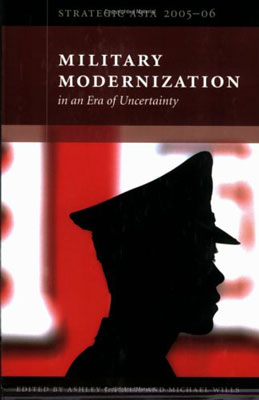
Through a combination of country, regional, and topical studies, Strategic Asia 2005–06: Military Modernization in an Era of Uncertainty assesses how Asian states are modernizing their military programs in response to China's rise as a regional power, the war on terrorism, changes in U.S. force posture, the revolution in military affairs, and local security dilemmas.
Source: The National Bureau of Asian Research

Through a combination of country, regional, and topical studies, Strategic Asia 2005–06: Military Modernization in an Era of Uncertainty assesses how Asian states are modernizing their military programs in response to China's rise as a regional power, the war on terrorism, changes in U.S. force posture, the revolution in military affairs, and local security dilemmas. In addition to this central theme, each chapter examines the changing balance of power in Asia and identifies likely threats and opportunities that may arise in the next five years.
Order this book, or read the introduction by Ashley J. Tellis for free.
About the Authors
Ashley J. Tellis, senior associate at the Carnegie Endowment for International Peace, served in the U.S. Department of State as senior advisor to the Ambassador at the U.S. embassy in India and on the National Security Council staff as special assistant to the president and senior director, strategic planning and Southwest Asia. He is the author of India’s Emerging Nuclear Posture and co-author of Interpreting China’s Grand Strategy. He has co-edited Strategic Asia 2004-05: Confronting Terrorism in the Pursuit of Power.
Michael Wills is the Strategic Asia program director at the National Bureau of Asian Research.
Former Senior Fellow
Ashley J. Tellis was a senior fellow at the Carnegie Endowment for International Peace.
Michael Wills
National Bureau of Asian Research
Michael Wills is senior vice president for strategy and finance at NBR.
Carnegie does not take institutional positions on public policy issues; the views represented herein are those of the author(s) and do not necessarily reflect the views of Carnegie, its staff, or its trustees.

For every ruble allocated to social policy, health, and education in 2027, double that amount is earmarked for the army, the police, and the security services.

Alexandra Prokopenko

Cargo traffic through Russia’s Northern Sea Route has increased because of the disruption caused by the conflict in the Middle East, the Ukraine war, and U.S.-China tensions.

Mikhail Korostikov

Minsk clearly expected the dialogue with Washington to yield more results, in particular the lifting of EU sanctions and permission to export potash.

Artyom Shraibman

Depleted financial reserves and a shrinking tax base mean it is no longer possible to simultaneously deliver high defense spending, price stability, and economic growth.
Alexandra Prokopenko

In the tenth year of his presidency, President Mirziyoyev’s system is becoming even more personalized than that of his predecessor Karimov.

Galiya Ibragimova