

Commentary
The European far right might fail to steer EU policy in the direction Russia wants, but they will create enough chaos inside Europe to benefit the Kremlin.
Dimitar Bechev
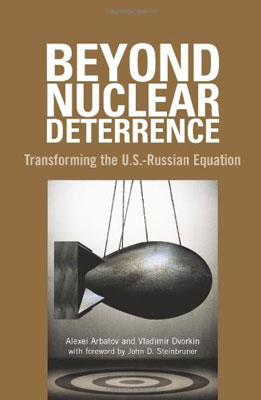
While deterrence as a concept has always been paradoxical, it is poorly equipped to handle today’s most significant nuclear challenges: proliferation and terrorism. Nuclear arms control must move beyond the deadlock of deterrence.
Source: Washington

For nearly fifty years—and the decade and a half since the end of the Cold War—deterrence has remained the central nuclear arms control policy between the United States, Russia, and other principal nuclear powers. The question today is: Has it outlived its usefulness?
In Beyond Nuclear Deterrence, two of Russia’s top nonproliferation and international security experts, Alexei Arbatov and Vladimir Dvorkin, critically assess the history of deterrence as it emerged between the Soviet Union and the U.S. and evolved through the Cold War to include an expanding nuclear club. The authors argue that while deterrence as a concept has always been paradoxical, it is poorly equipped to handle today’s most significant nuclear challenges: proliferation and terrorism. Nuclear arms control must move beyond the deadlock of deterrence. The U.S. and Russia need to take the first bilateral steps to remove mutual nuclear deterrence as the foundation of their strategic relationship and implement changes that can be exported internationally.
Alexei Arbatov is Scholar-in-Residence and Program Co-chair of Nuclear Nonproliferation at the Carnegie Moscow Center and head of the Center for International Security at the Institute for International Economy and International Relationships of the Russian Academy of Sciences.
Vladimir Dvorkin is a senior researcher at the Center for International Security at the Institute for World Economy and International Relations of the Russian Academy of Sciences and former director of the Fourth Central Research Institute in Moscow.
“Beyond Nuclear Deterrence helps us face the fact that we have been marking time in arms control since the signing of the CTBT in 1996 and that nuclear arms control and proliferation issues do not go away if ignored but tend to get more complicated and critical.”
—Jack Mendelsohn, Adjunct Professor, George Washington University and member of U.S. SALT II and START I delegations

Alexey Arbatov
Alexey Arbatov is the head of the Center for International Security at the Primakov National Research Institute of World Economy and International Relations.
Vladimir Dvorkin
Major General Dvorkin (retired) is a chief researcher at the Center for International Security at the Institute of World Economy and International Relations.
Carnegie does not take institutional positions on public policy issues; the views represented herein are those of the author(s) and do not necessarily reflect the views of Carnegie, its staff, or its trustees.

The European far right might fail to steer EU policy in the direction Russia wants, but they will create enough chaos inside Europe to benefit the Kremlin.

Dimitar Bechev

Minsk clearly expected the dialogue with Washington to yield more results, in particular the lifting of EU sanctions and permission to export potash.

Artyom Shraibman

Russia’s ruling party would have benefited from Putin appearing as its distant patron, but as an active frontman imposing his views on the public, he has done nothing but harm both the party’s election campaign and the ruling system overall.

Andrey Pertsev

Depleted financial reserves and a shrinking tax base mean it is no longer possible to simultaneously deliver high defense spending, price stability, and economic growth.

Alexandra Prokopenko

Blurring the line between humans and animals is a long-standing tradition in social utopian prose. In his latest novel, Leonid Bershidsky reminds us that in social experiments, people are often treated no differently than animals.

Alexander Baunov