

In The Media
Minxin Pei
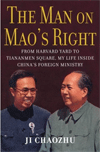
China’s capitalist revolution presents two divergent political paths for the country: autocracy or democracy. While the current strength of the CCP might suggest China is traveling down the first path, there are signs that citizen resistance on issues like growing economic disparities and environmental degradation may be on the rise and become more potent in the future.
Source: Book Review

The party has done well since 1989, but the legitimacy of outright repression is declining. The party may incarcerate those trying to set up an opposition party, but it cannot deploy brute force against ordinary citizens demanding clean air, drinkable water, and affordable health care. The Chinese citizenry today is becoming sophisticated enough to probe the soft spots (such as corruption, inequality, and incompetence) of the autocratic system and challenge it without taking excessive risks.
Former Adjunct Senior Associate, Asia Program
Pei is Tom and Margot Pritzker ‘72 Professor of Government and the director of the Keck Center for International and Strategic Studies at Claremont McKenna College.
Recent Work
Minxin Pei
Minxin Pei
Carnegie does not take institutional positions on public policy issues; the views represented herein are those of the author(s) and do not necessarily reflect the views of Carnegie, its staff, or its trustees.

The European far right might fail to steer EU policy in the direction Russia wants, but they will create enough chaos inside Europe to benefit the Kremlin.

Dimitar Bechev

If the Russian-speaking community in Latvia cannot articulate their interests without being seen as disloyal, they could end up embracing a pro-Kremlin agenda.

Sergejs Potapkins

Russia’s ruling party would have benefited from Putin appearing as its distant patron, but as an active frontman imposing his views on the public, he has done nothing but harm both the party’s election campaign and the ruling system overall.

Andrey Pertsev

In the tenth year of his presidency, President Mirziyoyev’s system is becoming even more personalized than that of his predecessor Karimov.

Galiya Ibragimova

With the growth in points of friction between the great powers, organizations like the SCO will continue to play a role in the strategic adaptation of the smaller powers caught between them.

Temur Umarov