

Commentary
Amr Hamzawy
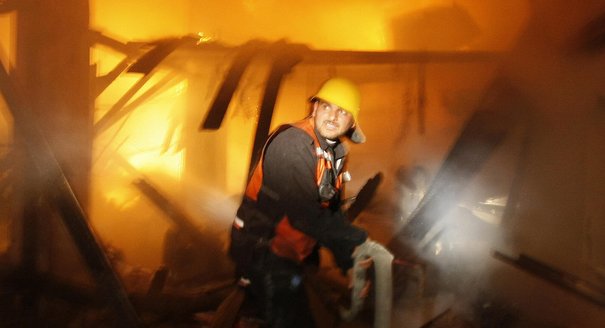
Source: Getty
As domestic opposition and the broader Arab public turn against the Egyptian position and accuse president Hosni Mubarak of complicity in Israel's continued attacks against the Palestinians, Egypt and other moderate Arab governments are losing their ability to negotiate an outcome that protects their interests.

After Hamas took power in the Gaza Strip and seized the Palestinian National Authority security apparatus in summer 2007, Egypt’s official approach toward the Gaza crisis sought to achieve three principal objectives: a reconciliation between Hamas and Fatah, which still controls the West Bank and the PNA institutions; the stabilization of Gaza and prevention of violence between Israel and Hamas, which threatens to spill over into the adjacent Egyptian territories; and securing the crossings along the Gaza-Egypt border, where as many as 75,000 Palestinians destroyed the fence and overran the border in early 2008.
Hamas made a wrong strategic choice in deciding not to prolong the six-month truce that expired in December, giving Israel an alibi to strike Gaza. But the truce did not provide much for the Palestinians in terms of ending the Israeli economic blockade and opening the crossings between Egypt and Gaza. The Mubarak government showed no disappointment over the ongoing blockade or Israel’s repeated targeted killing of Hamas activists and other Palestinian militants, which reflected poorly on it among Palestinians and Arabs across the region, who accused Egypt of being complicit in the "Israeli blockade" on Gaza and indifferent to Palestinian rights.
The visit of Israeli foreign minister Tzipi Livni to Egypt two days before the start of the strike against Gaza only reinforced this perception. The Egyptian foreign minister’s statements after the start of the Israeli action blamed Hamas for failing to pay heed to Egyptian warnings, echoing Livni’s threats of eradicating Hamas two days earlier in Cairo. Worse, Egypt’s foreign minister initially restrained from blaming Israel for the war against Gaza compounded, closure of the Rafah crossing with Gaza, worsened its image in the eyes Egyptian and Arab public opinion.
Diplomatically, Egypt’s efforts have either lacked swiftness or strategic direction. Ongoing Egyptian diplomatic efforts -- coordinated with Turkish and European initiatives -- have asked for an Israeli cessation of military actions and an opening of the border crossings under the supervision of international observers, as well as a commitment from Hamas to reconcile with Fatah and stop launching rockets on Israel. But, Hamas has been reluctant to accept Egypt’s proposals, especially because they do not require Israel to withdraw its troops from Gaza and because Hamas is opposed to stationing international observers at the border crossings.
Hamas has become skeptical of Egypt’s neutrality. As the fighting wears on, Hamas becomes more convinced that Egypt is biased in favor of Fatah, and in favor of Israel. Meanwhile, Egyptian and regional public opinion becomes ever more distant from official Egyptian policy. This distance has been clearly expressed by large demonstrations in Arab capitals such as Rabat, Beirut, Damascus, and of course Cairo that have almost equated Israel and Egypt. The public outcry against Egypt in the Arab world has further weakened its position as an effective mediator between the Palestinians and Israelis, as critics note that it has shown almost no ability to influence Israel. Egypt has relied on the leverage of the United States to strengthen its negotiating position in the mediation process, but the Bush administration has shown no desire to end the fighting, and whatever Barack Obama believes, it will be two weeks before it’s his call.
The Egyptian diplomatic failure in Gaza has now been highlighted by the success of other Arab states to push the UN Security Council to endorse a resolution calling for an end to Israeli military actions and the withdrawal of troops from Gaza. Whatever happens in Gaza, Egypt's regional influence is waning, and it is bound to be one of the main losers of the war.

Director, Middle East Program
Amr Hamzawy is a senior fellow and the director of the Carnegie Middle East Program. His research and writings focus on Egypt’s and other middle powers’ involvement in regional security in the Middle East, particularly through collective diplomacy and multilateral conflict resolution
Recent Work
Amr Hamzawy
Amr Hamzawy
Carnegie does not take institutional positions on public policy issues; the views represented herein are those of the author(s) and do not necessarily reflect the views of Carnegie, its staff, or its trustees.

Cargo traffic through Russia’s Northern Sea Route has increased because of the disruption caused by the conflict in the Middle East, the Ukraine war, and U.S.-China tensions.

Mikhail Korostikov

Sergei Kiriyenko used Russia’s parliamentary vote to further hone his strategy of corporate mobilization that is designed to maximize votes for United Russia.

Andrey Pertsev

The European far right might fail to steer EU policy in the direction Russia wants, but they will create enough chaos inside Europe to benefit the Kremlin.

Dimitar Bechev

Minsk clearly expected the dialogue with Washington to yield more results, in particular the lifting of EU sanctions and permission to export potash.

Artyom Shraibman

If the Russian-speaking community in Latvia cannot articulate their interests without being seen as disloyal, they could end up embracing a pro-Kremlin agenda.

Sergejs Potapkins