

Paper
Douglas H. Paal
Source: Getty
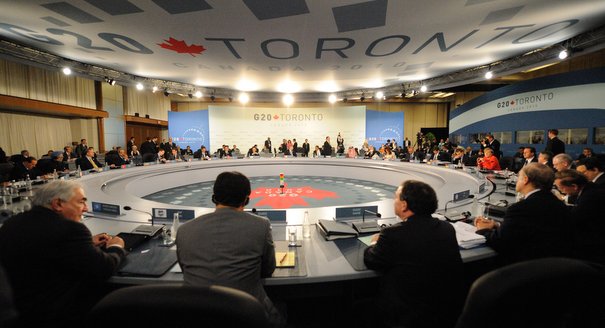
Obama’s bilateral meetings with key Asian leaders on the sidelines of the Toronto G-20 have put the United States back on a positive track in the region.
After months of starts and stops caused mostly by domestic considerations—including passage of the health care bill and the BP oil spill—President Obama reengaged with Asian leaders at the G8 and G20 meetings in Toronto at the end of June. The bilateral meetings with four Asian leaders put the United States back on a positive track in the region. This goal had been lost in recent months and now the key is to stay on track.
South Korea: The most substantial meeting of the sideline discussions was with President Lee Myung-bak. Coming in the still turbulent wake of the March 26 sinking of the South Korean corvette, the Cheonan, the meeting permitted the two leaders to send a strong message of solidarity to North Korea—and to China and Russia.
One significant announcement was the decision to postpone, by three years, the planned 2012 transfer of operational control in wartime of Korean forces from a U.S. commander to a Korean commander. The transfer was originally agreed to when Seoul was still led by left-leaning president Roh Moo-hyun and a time when former Defense Secretary Rumsfeld was eager to shed U.S. responsibilities in Korea for other priorities.
But President Lee’s election campaign promised to delay the transfer until South Korea’s armed forces commanders are better prepared to take responsibility. Senior American and Korean officers repeatedly expressed skepticism that South Korea’s top generals have adequate experience across the range of capabilities necessary and the postponement buys time for greater preparation.
The second major accomplishment of the Obama-Lee meeting was Obama’s commitment to complete negotiations over the Korea-U.S. free trade agreement before Obama’s state visit to the country in November. Obama had pandered to anti-trade interests during the 2008 primary elections and raised doubts about the bilateral trade agreement. With time and a pressing need to boost exports, Obama is now edging away from his former position. The key issues are vehicles (particularly, the pick-up truck market that Ford wants to protect) and beef (whose U.S. producers overplayed their hand in the early stages of negotiations). Both of these issues are sensitive but are also susceptible to technical fixes—both leaders seem prepared to follow through.
The Obama-Lee meeting also underscored the alliance’s unity and strength in the aftermath of the Cheonan sinking and loss of 46 lives. China has been courting South Korean public opinion for years, but the North’s action has forced Beijing back into Pyongyang’s corner. Chinese leaders cannot be happy to see that Kim Jong Il has squandered so much South Korean goodwill, put China in the position of defending the indefensible at the United Nations Security Council, and effectively scuttled the six-party talks, which were on the verge of revival when the Cheonan was torpedoed.
Japan: Predictably, Obama’s meeting with newly installed Prime Minister Naoto Kan was largely a review of established talking points. Less determined than his predecessor to ignore the bureaucrats and certainly too fresh in the job to offer settled thoughts of his own, Kan followed professional advice.
This meeting, however, is a case of symbolism being more important than substance. Kan represents a return to stable alliance management after eight months of false signals from former Prime Minister Yukio Hatoyama. Kan told Obama that he will stick to his publicly stated commitment to resolve the nettlesome Futenma airbase relocation issue and he stood firmly by the United States and South Korea over the Cheonan incident.
China: Presidents Obama and Hu Jintao had every reason to have a positive meeting overall. Taiwan, Tibet, and renminbi revaluation are in the rear-view mirror for the moment. Obama also offered a state visit to Washington which was accepted (negotiations will now begin to discuss the details and timing of the trip next year).
The two reviewed their common actions on Iran in the UN Security Council and Obama briefed Hu on the impending Iran sanctions legislation in Congress. Obama warned that neither the United States nor Japan will welcome efforts by Chinese firms to fill the void left when other western nations show restraint from entering Iran’s market.
Obama also tried to prod Hu to accept compromise language on the Cheonan incident in the UN Security Council, much as compromises had occurred with respect to Iran. But in the face-to-face meeting, Hu refused to recognize the North’s responsibility despite Obama’s view that this was the most serious violation of the Korean armistice in 60 years.
Evidently surprised by the implicit irresponsibility of a rising power equivocating over aggression by North Korea, Obama later used tough language about China’s “willful blindness to consistent problems.” This led to a public exchange between Chinese and American spokesmen. The diplomatic exchanges over a UN Security Council statement condemning North Korea are continuing in New York and will be followed by a visit to Beijing by Deputy National Security Advisor Thomas Donilon and National Economic Council Director Lawrence Summers in August.
Obama also pushed for a visit to China by Defense Secretary Gates, after Gates expressed frustration in Singapore with China’s efforts to insist on conditions for a visit. There was some slight movement in that direction when the foreign liaison chief for China’s army said a trip would be welcomed, however, he then repeated conditions still unacceptable to the United States.
Indonesia: President Susilo Bambang Yudhoyono is the Asian head of state who has probably been most harmed by Obama’s repeated cancellations of his travel to the region. As a former resident and student, Indonesian expectations have been high for Obama’s visit. Yudhoyono has prodded his government to meet U.S. concerns in the economic and security arenas and helped forge a “comprehensive partnership.”
In Toronto, however, Obama rekindled hopes for a visit after the November Asia Pacific Economic Cooperation (APEC) meetings. But a simple look at the calendar suggests this promise will be difficult to keep. State visits to Japan and Korea, APEC, and the G20 summit are all scheduled in November and there is a promised stop in India on the way back. The best outlook for Indonesia is probably an all too short drop-by, at a time when Obama is likely to look weaker in the immediate aftermath of the mid-term elections.
The Obama administration and Congress can fairly be faulted for failing to overcome one abiding and unnecessarily irritating issue in the relationship with Jakarta. In the more than ten years since the fall of Suharto, the United States has frozen relations with Kopassus, Indonesia’s special forces. Human rights organizations have alleged past abuses at the hands of Kopassus troops in Jakarta and East Timor.
Over the past decade, however, the military leadership has moved on and completely transformed itself and U.S. armed forces have many common interests with Indonesia’s security establishment—from counterterrorism to counter-piracy. Timorese leaders themselves acknowledge that the Indonesian military has reformed itself.
With Yudhoyono among the last of the American-trained generals in Indonesia, the United States should seize the opportunity to write a new chapter of cooperation and build influence with a new Indonesian military.
Distinguished Fellow, Asia Program
Paal previously served as vice chairman of JPMorgan Chase International and as unofficial U.S. representative to Taiwan as director of the American Institute in Taiwan.
Recent Work
Douglas H. Paal


Douglas H. Paal, Tong Zhao, Chen Qi, …
Carnegie does not take institutional positions on public policy issues; the views represented herein are those of the author(s) and do not necessarily reflect the views of Carnegie, its staff, or its trustees.

With the growth in points of friction between the great powers, organizations like the SCO will continue to play a role in the strategic adaptation of the smaller powers caught between them.

Temur Umarov

When faced with fuel shortages in the past, Central Asian governments could always count on additional supplies from Moscow. That safety net no longer exists.

Galiya Ibragimova

Despite unhappiness on the ground, Moscow is determined to use both carrot and stick to ensure there is record support for United Russia in occupied Ukraine.

Konstantin Skorkin
The recent damage inflicted by Ukrainian drones and missiles on Russia has made Belarus aware of its own vulnerabilities—and surprisingly amenable to Kyiv’s demands.

Artyom Shraibman
Russia looks set to reap economic benefits from closer ties with Southeast Asian countries that are keen to find reliable energy suppliers and diversify trade ties.

Alexander Gabuev