

Paper
Douglas H. Paal
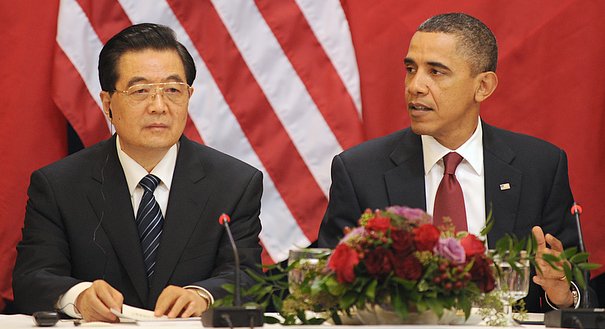
Source: Getty
Leaders in both the United States and China need to move beyond heated rhetoric and political electoral considerations and look for areas of cooperation in building a constructive bilateral agenda.
As election season in the United States heats up, America’s bilateral relationship with China could drift further into troubled waters as sensitive issues are pushed to the surface by American candidates competing for electoral victories. This is complicated on the Chinese side as Communist Party officials jockey for top positions ahead of the country’s leadership change in 2012. But leaders need to move beyond the heated rhetoric and look for possibilities for cooperation on economics, security, and China’s rising influence.
Despite Beijing issuing sharp words and threats over U.S. arms sales to Taiwan and President Obama’s meeting with the Dalai Lama in the White House, leaders from the two countries were able to compose their differences long enough for President Hu to attend March’s nuclear security summit meeting in Washington. When the top leaders engage each other, priorities become more rational, but when they don't the relationship begins to deteriorate.
As seen during the less than successful Strategic and Economic Dialogue in Beijing last month and the Shangri-La Dialogue in Singapore last week, anger and frustration are now outpacing structured efforts at building a common agenda.
On economics, expectations have been high for months that China will adjust its method for currency valuation and reduce the trade advantages it has gained by pegging the renminbi to the U.S. dollar. Senators Schumer and Graham are openly threatening trade action against China through legislation if this does not occur and Treasury Secretary Geithner publicly urged China to act. But the underlying situation has changed.
The bilateral trade deficit with China has been dramatically reduced and U.S. exports to China are soaring. With the collapse of the euro, China’s currency undervaluation has been reduced by more than half against a trade-weighted basket. To increase the value of the renminbi now would reduce China’s exports to its largest market, the European Union. This would cost Chinese jobs, slow domestic growth, and eventually hurt the United States as exports to China fall. Many expect a cascade of trade disputes brought by both sides before the November elections.
For security matters, questions of military-to-military ties, North Korea, and Iran are all testing the relationship between Washington and Beijing. Defense Secretary Gates and Admiral Mullen, chairman of the Joint Chiefs, recently raised the decibel level of complaints about China’s continued refusal to engage in serious military-to-military talks about its expanding capabilities and intentions. Chinese military figures are increasingly outspoken about U.S. arms sales to Taiwan, activities in the South China Sea, and spy flights and maritime surveillance opposite China. These are not idle remarks. Both militaries are increasing their activities in the Western Pacific and are frequently operating at uncomfortably close distances—a serious incident is just waiting to happen. China needs to drop its preconditions to resumed talks between the militaries.
In the aftermath of the sinking of a South Korean corvette by a North Korean torpedo in March, Secretary Clinton worked hard to win Chinese support for United Nations Security Council condemnation of Pyongyang. But Beijing has resisted and it’s clear that China’s most senior leaders put stability in North Korea ahead of every other consideration, including nuclear proliferation. China did vote for new UN sanctions on Iran, but China sees little to be gained by joining criticism of North Korea.
Finally, there is no avoiding discussion of the growing sense in the United States of surging Chinese economic, military and possibly political power. And on the other side, there is a perception that the United States is beset by financial, fiscal, technical and regional challenges. That President Obama’s political advisors felt he had to again put off an important trip to Guam, Indonesia, and Australia while the BP oil spill is uncapped and dominating the news is but one glaring example of a country that is widely seen as stumbling.
The accumulating American setbacks in Afghanistan, imminent departure of combat troops from Iraq, and blockbuster fiscal deficits without end are feeding Chinese self-confidence and assertiveness. Many relevant Chinese officials know China is still far from displacing American power now—if ever—but it is not in their political interest to try to defy the rising tide of triumphal sentiment at home.
Domestic politics in the United States and China jeopardize the overall relationship. Politicians need to rise above electoral considerations and provide a constructive agenda at home and abroad. Economic concerns, strategic issues, and China’s changing international role all deserve high-level attention from leaders, not politicians.
Distinguished Fellow, Asia Program
Paal previously served as vice chairman of JPMorgan Chase International and as unofficial U.S. representative to Taiwan as director of the American Institute in Taiwan.
Recent Work
Douglas H. Paal

Douglas H. Paal, Tong Zhao, Chen Qi, …
Carnegie does not take institutional positions on public policy issues; the views represented herein are those of the author(s) and do not necessarily reflect the views of Carnegie, its staff, or its trustees.

If the Russian-speaking community in Latvia cannot articulate their interests without being seen as disloyal, they could end up embracing a pro-Kremlin agenda.

Sergejs Potapkins

Russia’s ruling party would have benefited from Putin appearing as its distant patron, but as an active frontman imposing his views on the public, he has done nothing but harm both the party’s election campaign and the ruling system overall.

Andrey Pertsev

Depleted financial reserves and a shrinking tax base mean it is no longer possible to simultaneously deliver high defense spending, price stability, and economic growth.

Alexandra Prokopenko

In the tenth year of his presidency, President Mirziyoyev’s system is becoming even more personalized than that of his predecessor Karimov.

Galiya Ibragimova

With the growth in points of friction between the great powers, organizations like the SCO will continue to play a role in the strategic adaptation of the smaller powers caught between them.

Temur Umarov