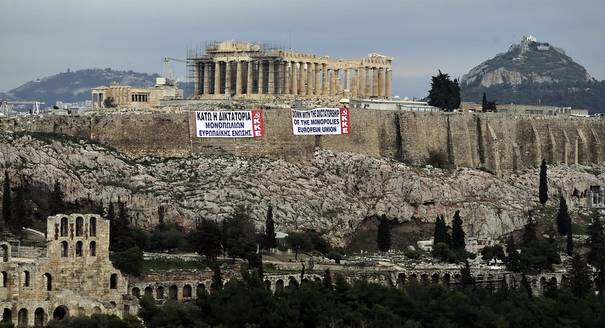
Many Greek voters, like their French counterparts, voted against austerity on Sunday and for the leftists. But the future is far from certain. It looks increasingly likely that a coalition government will not be cobbled together based on Sunday’s results and a new election will be held. Will the government that is eventually formed adhere to the terms of the bailout memorandum—the document outlining the reforms Greece must implement in order to receive the next installment of its bailout funds—or not?
Whatever happens, the new government is sure to be in a difficult position—buffeted on one side by the Greek people’s desire to stay in the eurozone and on the other by the suffering of a nation in its fifth year of recession.
Letting Off Steam at the Polls
On May 6, Greek voters punished the two pro-memorandum parties that have dominated Greek politics for three decades. The conservative New Democracy came in first, but with a disappointing 19 percent of the vote, and the Greek Socialist party (PASOK) finished third, earning a little over 13 percent. Meanwhile, the anti-memorandum SYRIZA party on the left more than tripled its 2009 gains, capturing nearly 17 percent of the vote. Public dismay also registered in a wave of support for small parties. Because most of these groups failed to reach the minimum 3 percent threshold for representation, however, close to a fifth of the electorate may not be represented in parliament.
The race is not over yet. By the end of the week, either a coalition government will form or new elections will be scheduled for June. In the event of a new poll, Greeks may vote somewhat differently. Having flogged the two parties considered responsible for hard times, the public could reconsider its loyalties and vote on a more rational basis.
Given that over 80 percent of Greeks favor staying in the eurozone but oppose the memorandum’s harsh austerity measures, the new government, whatever its composition, will likely have to attempt a renegotiation of some of the bailout memorandum’s terms. The next installment of Greece’s new loan will, meanwhile, be on hold until a new government takes office.
A Drubbing Long in the Making
Incumbent governments throughout Europe, most recently in France and the Netherlands, have fallen on the sword of austerity—the touted remedy for indebtedness. Greece is in the most extreme position. The story of how this came to be is well known but worth reviewing.
For eight years after entering the eurozone, Greece borrowed heavily at 0.2–0.3 percent, generating a period of prosperity but bloating its external debt. The average Greek enjoyed large wage hikes and generous social benefits through 2009, over and above his or her productive output. Competitiveness fell relative to the eurozone core and exports shriveled. Between 2000 and 2008, Greece’s exports accounted for an average of 22 percent of gross national product, compared to an average of 38 percent among eurozone countries. But this trajectory could only continue as long as the cost of borrowing remained low.
In 2008, the U.S. housing bubble and subsequent financial crisis reached Europe. Bond spreads began rising, and borrowing became increasingly expensive. The Socialists, who won the 2009 elections, were not initially aware of the severity of the brewing crisis. After wavering between election promises and the harsh reality of an indebted economy, Prime Minister George Papandreou launched a tax program that devastated vulnerable workers and pensioners. But he failed, probably out of Socialist habit, to trim public expenditures and reform the hapless state.
In 2010, Greece was hit by a perfect financial storm and had to turn to the European Union for rescue. Soon thereafter, the workings of the “troika” composed of the EU, the European Central Bank, and the IMF became a standard feature of Greek life. In June 2011, the Greek parliament passed a package of austerity measures and loans to Greece. But the memorandum proved insufficient to stem the crisis, and in July, it appeared unlikely that Greece would be able to return to the capital markets anytime soon.
The eurozone states, along with the IMF, agreed to support a new rescue package to Greece to cover the financial gap. The maturity of official loans was extended and interest rates were reduced. In October 2011, the financing program of that July, which provided 109 billion euros in loans to Greece, was amended and extended, while private investors under pressure from the eurozone conceded to a 50 percent haircut on the face value of the bonds. (The haircut was increased in February 2012 to 53.5 percent, equivalent to a present-value loss of about 75 percent.)
Following an uproar over a referendum that raised the taboo issue of a eurozone exit, Papandreou resigned in November. He was replaced as prime minister by the European Central Bank’s former deputy director, Lucas Papademos. Papademos, a respected technocrat, took the helm of an interim coalition government and, by April 2012, had completed his herculean task—rescuing Greece from the jaws of hard default while New Democracy, PASOK, and the opposition prepared for elections.
Voting for Greece’s Future
These elections have probably been the least constructive in Greece’s postwar history. If the interim government had been allowed to run its course through the end of the year, some of the hard decisions that lie ahead could have been tackled with a large two-party majority. Given that New Democracy and PASOK received even less support than the 22–23 percent and 15–16 percent, respectively, that they were polling before the election, the possibility of forming a coalition government united in purpose has dimmed considerably.
The election indeed drew the battle lines between two camps: one determined to honor Greece’s financial obligations to its creditors and the other promising its constituency to disavow any such binding decision voted on in parliament. New Democracy and PASOK in the pro-memorandum camp faced off against the Left, which declared the memorandum to be the foremost enemy of the working class, and the extreme Right, which considers it a threat to the national interest.
The new government, whatever its composition, will be faced with a tall order. As part of a deal to obtain a loan of 130 billion euros to tide them over, the Greeks will have to enact budget measures that will eventually bring the country’s debt-to-GDP ratio down from the present 150 percent to 120 percent by 2020. This will mean even more severe austerity programs that will further shrink salaries and pensions, drastically cut public expenditure, and shutter state agencies. It will also mean more recession and unemployment, which will make it more difficult for the government to raise revenue for its normal spending let alone create the primary surpluses necessary for repaying Greece’s debt.
There may be some room for negotiation, but so long as the Greek people wish to stay in the eurozone, the new government will have to mostly adhere to the terms of the bailout memorandum. This will not be easy, as the memorandum sets out a far-reaching program that includes privatization, administrative reform, labor market reform, product market reform, and bank recapitalization. So far, even after punishing the two austerity parties, the Greeks appear committed to making these reforms. But a change of heart could be in the cards.
Thanos Veremis is Professor of Modern History at the University of Athens