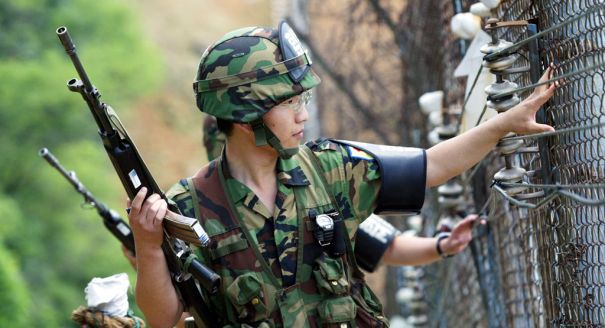
Tension on the Korean Peninsula has increased since North Korean leader Kim Jong-un came to power in 2011. Pyongyang has set a firm course toward consolidating power and eradicating opposition, and it has responded aggressively to international attempts to curb these plans. Russia, long on friendly terms with Pyongyang, stands to lose if Kim Jong-un’s actions destabilize the Korean Peninsula. To prevent this outcome, Moscow needs to pursue a more active Korea policy.
The North Korean Impasse
- In defiance of international sanctions, Kim Jong-un has launched missiles, conducted nuclear tests, and conducted an unprecedented psychological warfare campaign against South Korea and the West.
- Pyongyang continues to operate and expand its nuclear facilities. Diplomatic efforts such as the Six-Party Talks have failed to convince North Korea to abandon its nuclear activities.
- Washington and Seoul have responded to North Korean provocations by strengthening their military power and increasing sanctions against Pyongyang.
- Kim Jong-un’s aggressive actions have put Russia in a difficult position. Friendly relations with Pyongyang bolster Moscow’s role in Northeast Asia, but Russia also wants to see a non-nuclear North Korea and keep the Korean Peninsula stable.
- Helping resolve the Korean problem would establish Russia as a regional power and pave the way for Moscow, Pyongyang, and Seoul to cooperate on projects that advance Russia’s geoeconomic and geopolitical interests, such as a railway transit initiative and construction of a gas pipeline across the Korean Peninsula.
Recommendations for Russian Policymakers
Reach out to Pyongyang. Experience shows that worsening relations with North Korea weaken Russia’s role in Northeast Asia.
Oppose North Korea’s isolation and promote diplomatic solutions. Moscow must ensure that no one resorts to force and that countries seek political and diplomatic solutions to the Korean Peninsula’s problems on a multilateral basis and with Russia’s participation, such as through the Six-Party Talks. The diplomatic process should be used as an instrument for preventing nuclear proliferation and escalation.
Promote peaceful nuclear cooperation with Pyongyang. Russia should propose a “repackaged” system of international sanctions that would let North Korea cooperate with international organizations on peaceful nuclear energy (with Russian organizations at the forefront).
Create a multilateral security system for Northeast Asia. Moscow should promote agreements between participants in the Six-Party Talks that would give legally binding form to each party’s rights and obligations with regard to the Korean Peninsula and make it possible to monitor whether parties fulfill their obligations.
Alexander Vorontsov holds a candidate of science degree in history, is head of the Korea and Mongolia Section of the Russian Academy of Sciences’ Institute of Oriental Studies, lectures at the Russian Foreign Ministry’s Moscow State Institute of International Relations (MGIMO), and is a professor at the Russian Academy of Military Sciences.
Georgy Toloraya holds a doctorate in economics and is the director of Korean programs at the Institute of Economics of the Russian Academy of Sciences, a professor at MGIMO, and the director of the Regional Programs Directorate of the Russian World Foundation. He served as a professional diplomat and holds the rank of minister extraordinary and plenipotentiary.