

Commentary
Trump has promised Belarus a massive potash deal. But Minsk is seeking something greater: restored Western transit and greater room for maneuver from Russia.
Balázs Jarábik
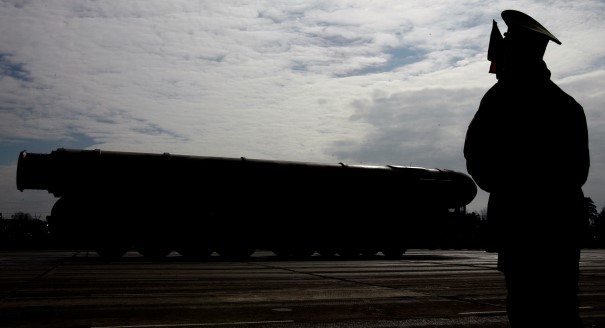
Source: Getty
The nuclear arms control regime is unraveling. An aggressive search for new formats, concepts, and methods is urgently needed to adapt the system to changed realities.
The Ukrainian drama has occupied the world’s attention for more than a year, in competition only with the military offensive and Internet-broadcast atrocities of the Islamic State. Another crisis is, however, looming in the background. While not currently associated with mass casualties and material damage, this crisis may eventually have no less destructive consequences. It is the unraveling of nuclear arms control, both in regard to the limitation of nuclear weapons and their nonproliferation.
Taking the first real limitation on nuclear weapons, the 1963 Partial Test Ban Treaty, as the starting point for the history of nuclear arms control, today marks the first time in a half century that there is a real prospect of losing the legal regime for managing the most horrific instrument of devastation ever created. Although arms control has faced difficulties in the past, never before have virtually all negotiating tracks been simultaneously stalled, existing treaties been eroded by political and technological developments, and the planning for next steps been so in doubt.
It is true that the two key treaties—the 2010 New Strategic Arms Reduction Treaty (New START) and the 1987 Intermediate-Range Nuclear Forces (INF) Treaty—are still in force. However, both are under severe pressure and their futures are by no means assured. The United States rejects any limitation on its ballistic missile defense (BMD) program and has no intention of ratifying the Comprehensive Nuclear-Test-Ban Treaty (CTBT) of 1996. Russia refuses any limitations on its substrategic nuclear arms. In the Russian expert community, there are calls for Moscow to withdraw from the INF Treaty, New START, the CTBT, and even the Nuclear Non-Proliferation Treaty (NPT) itself.During the Ukrainian crisis there has been loose talk about nuclear weapons by senior officials on both sides of the conflict and even provocative “conceptual” speculation over the employment of nuclear arms in a local conflict, to a degree not heard since the Cuban Missile Crisis in 1962.
The seven nuclear-armed states besides Russia and the United States have not moved an inch toward limiting their own nuclear forces. They condition such limitations on the “Big Two” coming much closer to their numerical levels, implying another order-of-magnitude reduction on top of the 80 percent cuts already undertaken by Russia and the United States since 1991.
Nuclear nonproliferation is also in trouble. Barely a single point of the action plan of the 2010 NPT Review Conference has been implemented, including the agreement to hold a conference on the establishment of a weapons of mass destruction–free zone in the Middle East. The November 2013 interim agreement on Iran’s nuclear program has not yet been turned into a long-term, comprehensive one. Negotiations with North Korea have been in limbo for many years and there is no prospect of their revival. There is a high risk that the NPT Review Conference in May 2015 will be another fiasco, possibly triggering the general demise of the NPT regime.
Meanwhile, negotiations on a Fissile Material Cut-Off Treaty have been deadlocked for many years. U.S.-Russian cooperation on the safety and security of nuclear sites and materials was ended in 2014, and Russia has declared that it will not attend the 2016 Nuclear Security Summit.
The Ukraine crisis has greatly exacerbated—but did not cause—the unraveling of nuclear arms control, which became obvious in 2011 but probably started as early as the late 1990s. There are many causes of this crisis.
International politics is one cause. In the post–Cold War world order, nuclear-arms limitations are no longer in the foreground of international security as the principal means of preventing the greatest threat to mankind—global nuclear apocalypse. Local conflicts, international terrorism, and nuclear proliferation have taken their place.
Moreover, global and regional powers with quite different points of view, ambitions, and political and military experiences from Russia and the United States are now important international players. As a result of all these factors, the nuclear arms limitation process has, since the late 1990s, suffered from neglect and the absence of clear priorities and consistent goals.
Other reasons for the current crisis are technological. Developments in non-nuclear BMD systems and long-range, precision-guided offensive weapons, as well as their proliferation, have complicated nuclear arms control. The development and buildup of nuclear arms and ballistic missiles by many states besides the United States and Russia has had a similar effect.
The proliferation of nuclear technologies and materials is blurring the line between the peaceful and military uses of nuclear energy. Nuclear energy programs are changing from a reward for non-nuclear states for accepting the NPT to a legal way of developing the potential to obtain nuclear arms quickly—and of getting to the “nuclear threshold” to satisfy prestige or security ambitions.
The “end of history” for nuclear arms control may be avoided only if a peaceful resolution of the Ukraine crisis is achieved, and if all parties learn the necessary lessons to avoid a repeat. But this, by itself, will not be enough.
An aggressive search for new formats, concepts, and methods is urgently needed to adapt nuclear arms control to the new realities. One possible way forward may be to disentangle the present knot of problems by treating as separate questions further strategic arms reductions; assurances about the capabilities of BMD systems; limitations on existing and emerging long-range, precision-guided offensive forces and programs; and reductions in substrategic nuclear arms.
A search should also start for innovative ways to build confidence about limitations on the nuclear forces of third states. Doing so would help to strengthen the NPT and enhance the nonproliferation regime for missiles and missile technologies.
As difficult as this task is, the main challenge is to restore cooperative relations among key global and regional powers and alliances. These relations should be adapted to the emerging new post-post–Cold War world order. Relationships in this order should be molded through patient negotiations, not through arbitrary resort to military force or economic sanctions. And one of its central pillars should be nuclear arms control—restored and modernized.
This is an abbreviated version of a longer paper that will be published in the coming months on Carnegie.ru.

Alexey Arbatov
Alexey Arbatov is the head of the Center for International Security at the Primakov National Research Institute of World Economy and International Relations.
Carnegie does not take institutional positions on public policy issues; the views represented herein are those of the author(s) and do not necessarily reflect the views of Carnegie, its staff, or its trustees.

Trump has promised Belarus a massive potash deal. But Minsk is seeking something greater: restored Western transit and greater room for maneuver from Russia.

Balázs Jarábik

The European far right might fail to steer EU policy in the direction Russia wants, but they will create enough chaos inside Europe to benefit the Kremlin.

Dimitar Bechev

Minsk clearly expected the dialogue with Washington to yield more results, in particular the lifting of EU sanctions and permission to export potash.

Artyom Shraibman

Russia’s ruling party would have benefited from Putin appearing as its distant patron, but as an active frontman imposing his views on the public, he has done nothing but harm both the party’s election campaign and the ruling system overall.

Andrey Pertsev

Depleted financial reserves and a shrinking tax base mean it is no longer possible to simultaneously deliver high defense spending, price stability, and economic growth.

Alexandra Prokopenko