

Commentary
Sergey Vakulenko
{
  "authors": [
    "Sergey Vakulenko"
  ],
  "type": "commentary",
  "blog": "Carnegie Politika",
  "centerAffiliationAll": "",
  "centers": [
    "Carnegie Endowment for International Peace",
    "Carnegie Russia Eurasia Center"
  ],
  "englishNewsletterAll": "",
  "nonEnglishNewsletterAll": "",
  "primaryCenter": "Carnegie Russia Eurasia Center",
  "programAffiliation": "",
  "regions": [
    "Russia"
  ],
  "topics": [
    "Energy",
    "Climate Change",
    "Domestic Politics"
  ]
}
Source: Getty
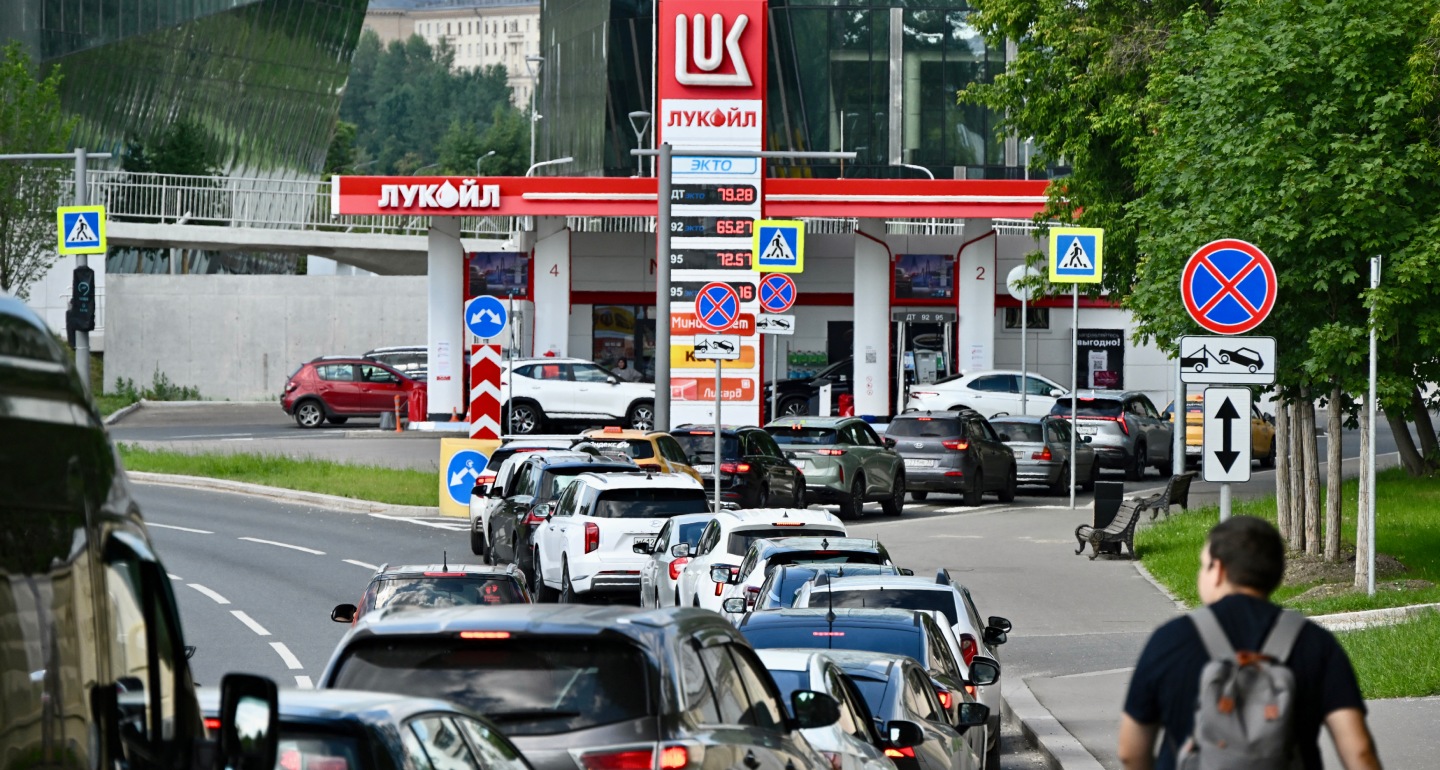
Official discussions about mini oil refineries are unlikely to come to anything—but the mere fact they’re happening reveals the regime is failing to deliver a functioning economy.
A brief mention of mini-refineries at a meeting chaired by President Vladimir Putin about Russia’s gasoline shortage immediately sparked lively debate. At first glance, it looks like a sensible course of action: Russian oil refineries are under the constant threat of Ukrainian attacks, and a broad network of small refineries could mitigate the risks. However, there would be little economic or military advantage to such decentralization. What’s more important is the fact that officials are engaging in such conversations—and what they reveal about the state of Russia’s economy in the summer of 2026.
Immediately after the July 8 meeting, dozens of websites sprang up selling equipment for mini-refineries. Media outlets were filled with speculation about the cost of such refineries, whether they could turn a profit, their legality, and whether or not investment could be justified. Many observers pointed to China’s Great Leap Forward in the 1950s when iron was smelted in just about every backyard to help achieve record steel production.
Admittedly, it was not Putin who brought up the mini-refineries. It was Zabaikalsk region governor Alexander Osipov, who said it was necessary to “look at the possibility of creating a large network” of such facilities. Putin responded that “involving small- and medium-sized businesses in this sphere is also required and encouraged,” and told Osipov that “you’re absolutely right: the bigger the network, the harder it is to damage.”
It is important to understand that all Putin meetings—particularly the sections that are recorded and posted on the Kremlin website—are strictly ceremonial and carefully choreographed. They are not a place for exchanging information or making decisions. However, each participant uses the opportunity to pursue their own agenda by offering a motion that might be beneficial for their area of interest and responsibility. For governors, that might be something for their region; for ministers, something for their sector of the economy; for industrialists, something for their company. Others want to demonstrate their businesslike manner, their statesman-like thinking, or some other quality supposedly befitting a talented and influential official.
These meetings are also an opportunity to make suggestions that have in fact already been agreed upon, and which are subsequently formalized as an official instruction to the relevant ministry or state-owned company. But the initiatives are not spontaneous: speakers are required to submit their talking points to the presidential administration in advance. After Kremlin officials have researched the issue, they prepare a briefing document for Putin, which he uses when giving his answer.
On one level, the wartime idea of replacing a few large facilities producing essential goods with many smaller, more autonomous facilities is a sensible one. When Russia launched its campaign to destroy Ukraine’s power generation capacity, Ukrainians began installing solar panels, diesel generators, and battery energy storage systems in apartment blocks all over the country. Kyiv admits its campaign against Russia’s oil refineries is a response to Russia’s campaign against its power stations.
Refining is a relatively straightforward process: Simple versions of gasoline and diesel can be made in a high-school chemistry lab, and were made in apothecaries in the nineteenth century. The problem lies in the economics and logistics of such a small-scale approach. It is an industry in which size truly matters and economies of scale are quite substantial. For this reason, in most developed countries refineries tend to process at least 100,000 barrels per day.
Once the scale of production goes from one test tube at a time to a constant flow of even 10,000 barrels per day, it requires a substantial amount of specialized kit. It would take months to produce, deliver, and install the equipment for one mini-refinery—and thousands of such facilities would be needed to replace the current system. They would also be expensive: a network of mini-refineries with a capacity of even 50 million tons a year (about 18 percent of the oil refined in Russia in 2024 and half the refining capacity currently idled by Ukrainian strikes) would cost hundreds of billions of rubles.
Mini-refineries would find it difficult to source crude oil, as they could not all be connected to the oil pipeline network, and railroad and truck deliveries are expensive. The existing regulatory framework would make life difficult, and it’s unlikely the authorities would be amenable to easing the rules (oil refining is a fire- and explosion-prone process that also carries serious environmental risks). And, while gasoline produced at mini-refineries would be suitable for engines used in the mid-twentieth century, it could not be used by twenty-first-century vehicles. That requires sophisticated reactors used to clean the fuel of impurities that damage modern engines and achieve high octane numbers without lead-based additives.
Any fuel produced in this way would not just be expensive; it would be prohibitively so. If an estimated price tag for mini-refinery-produced fuels doesn’t look too high, that’s because the calculations haven’t taken into account fuel excise taxes and the need to dispose of the residual fuel oil (mazout), which would amount to more than half the volume of the incoming crude. It might also transpire that site preparation costs and utility connections have been forgotten.
Nor do mini-refineries make much sense from a military point of view. Existing refineries in the Kaluga and Krasnodar regions that have been repeatedly attacked are actually mini-refineries (or former mini-refineries). The size of the target is not that important for drones, and even relatively small oil-refining units are clearly visible and identifiable on consumer-grade satellite images, not to mention military-grade images.
One might think of building mini-refineries in the east of Russia in the hope that they would be out of the reach of drones. But that would create a whole series of logistical problems: above all, large fuel depots would have to be built in European Russia, and significant volumes shipped westward by train. In other words, the idea of building a network of mini-refineries does not stand up to even minimal scrutiny.
Putin’s vague response to the idea without any orders to government officials to look at the matter is a sign that the government is not taking it seriously.
Nevertheless, the mere fact that such conversations are taking place is an interesting political development. Putin has always sought to define his rule in opposition to the unfettered freedom of the “accursed 1990s.” That entailed curbing market freedoms and a return to aspects of dirigisme and a guiding role for the state. Competition might be fine for hairdressers and restaurants—just not for strategically important sectors.
Russians were generally supportive of this arrangement, which led them to believe that, if left unchecked, private owners would export all of Russia’s gasoline or demand exorbitant prices from domestic consumers. Putin, on the other hand, would always ensure there was sufficient, reasonably priced fuel at gas stations. Russia’s propaganda machine has strengthened this way of thinking, both directly and indirectly.
However, this popular consensus was predicated on a belief that the state would always guarantee a functioning economy. And the summer of 2026 has seen the Russian authorities renege on this obligation for the first time. It turns out that the Kremlin is unable to protect Russians from drones, even thousands of miles from the front. And gasoline shortages have demonstrated that the state cannot ensure access to a critical resource.
Most Russians are likely unaware that the only reason their economy was able to cope with the challenges of four years of war was thanks to private enterprise—not the efforts of government ministers. But the government’s poor handling of the gasoline crisis has been obvious to everyone. That has led to people seeking their own solutions, as well as officials admitting that all their hopes lie with small- and medium-sized businesses.
It's extremely unlikely that Russia will ever see a large number of mini-refineries. But the discussions about their viability are a sign that Russia is moving away from the economic principles that have held sway for the last quarter of a century.

Senior Fellow, Carnegie Russia Eurasia Center
Sergey Vakulenko is a senior fellow at the Carnegie Russia Eurasia Center.
Recent Work
Sergey Vakulenko
Sergey Vakulenko
Carnegie does not take institutional positions on public policy issues; the views represented herein are those of the author(s) and do not necessarily reflect the views of Carnegie, its staff, or its trustees.

Russian strikes are weakening the economy sustaining Ukraine’s war effort. Closing the growing funding gap will require more European support and politically contentious reforms in Kyiv.

Balázs Jarábik

Ex-president Gurbanguly Berdimuhamedov remains interested in politics, but his son Serdar, Turkmenistan’s current president, is becoming increasingly independent and willing to break with his father’s legacy. If their covert rivalry goes too far, both risk losing power.

Galiya Ibragimova

Despite a new textbook, an influx of Russian teachers and managers, and an end to the teaching of Ukrainian, the Kremlin is unlikely to have “reprogrammed” locals.

Konstantin Skorkin

For every ruble allocated to social policy, health, and education in 2027, double that amount is earmarked for the army, the police, and the security services.

Alexandra Prokopenko

Cargo traffic through Russia’s Northern Sea Route has increased because of the disruption caused by the conflict in the Middle East, the Ukraine war, and U.S.-China tensions.

Mikhail Korostikov