• Commentary
  • Research
  • Experts
  • Events
Carnegie China logoCarnegie lettermark logo
{
  "authors": [
    "Maria Lipman"
  ],
  "type": "legacyinthemedia",
  "centerAffiliationAll": "",
  "centers": [
    "Carnegie Endowment for International Peace",
    "Carnegie Russia Eurasia Center"
  ],
  "collections": [],
  "englishNewsletterAll": "",
  "nonEnglishNewsletterAll": "",
  "primaryCenter": "Carnegie Russia Eurasia Center",
  "programAffiliation": "",
  "programs": [],
  "projects": [],
  "regions": [
    "North America",
    "United States",
    "Caucasus",
    "Russia"
  ],
  "topics": [
    "Political Reform",
    "Foreign Policy"
  ]
}
Source: Getty

In The Media
Carnegie Russia Eurasia Center

Words for a Russian Ghetto

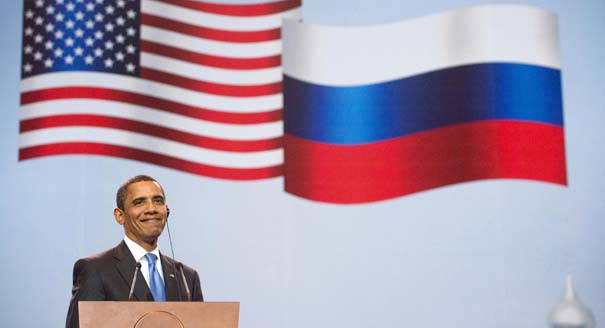
President Obama spoke brilliantly and powerfully at Russia's New Economic School during his Moscow trip. Unfortunately, few Russians heard his speech or got more than a glimpse of the American president on the television news.

Link Copied
By Maria Lipman
Published on Jul 9, 2009

Source: the Washington Post

Words for a Russian Ghetto President Obama spoke brilliantly and powerfully at Russia's New Economic School Tuesday. And his broader effort to reach out to Russian society during his trip -- meeting with civil society and human rights activists, as well as a group of opposition politicians -- was commendable. Unfortunately, few Russians heard his speech or got more than a glimpse of the American president on the television news.

If they had heard Obama's address, they probably would have appreciated that Obama spoke with high respect for Russian culture and history. He paid tribute to Russia's colossal contribution to the victory over Nazi Germany -- a victory in which Russians commonly believe their role is not properly recognized abroad. Obama was delicate and subtle, as well as firm and concrete. He described the end of the Cold War not as a victory of one political order over another but as a result of "the actions of many nations over many years." He admitted that America is not perfect. And he referred to democracy not as a moral virtue but as an effective means toward peaceful, secure and prosperous life.
 
But the president's speech -- at a Westernized institution founded by prominent Russian economists and modeled after the best American universities they attended -- was not broadcast live by any of the mass-audience television channels. These channels, which the Kremlin has long used as effective tools for shaping public opinion, offered benevolent but restrained coverage of the summit. Obama's performance in Russia, his eloquence, his ideas and his charms were thus mostly confined to those limited audiences, venues and outlets where free expression and public debate are still maintained. The Kremlin has mastered the art of keeping these liberal "ghettos" politically irrelevant.
 
The Kremlin keeps a firm grip on societal forces: Its concept of civil society implies loyalty to the state and rules out genuine autonomy. Those who dare defy the Kremlin vision may be tolerated, but they are consistently marginalized. Assistance to such groups from abroad is treated with great suspicion. Moreover, the West, and the United States in particular, are viewed as a threatening force seeking to do harm to Russia.
 
This dramatically hampers Russian development and leaves Russia still further behind the developed nations. A summit with Obama, and his attempt to reach out to the Russian people, no matter how brilliant or subtle, can hardly change this state of affairs. It is up to the Russian people to change this, but they will have to overcome their apathy and fragmentation. "Every country charts its own course," Obama told the students of the New Economic School. Russia is no exception.
 
The article can also be found here.

About the Author

Maria Lipman

Former Scholar in Residence, Society and Regions Program, Editor in Chief, Pro et Contra, Moscow Center

Lipman was the editor in chief of the Pro et Contra journal, published by the Carnegie Moscow Center. She was also the expert of the Carnegie Moscow Center’s Society and Regions Program.

    Recent Work

  • Commentary
    The Russian State Power and the Ukrainian Human Factor

      Maria Lipman

  • Commentary
    Putin’s Crimean Conquest Pushes Russia to an Anti-Modernization Course

      Maria Lipman

Maria Lipman
Former Scholar in Residence, Society and Regions Program, Editor in Chief, Pro et Contra, Moscow Center
Maria Lipman
Political ReformForeign PolicyNorth AmericaUnited StatesCaucasusRussia

Carnegie does not take institutional positions on public policy issues; the views represented herein are those of the author(s) and do not necessarily reflect the views of Carnegie, its staff, or its trustees.

More Work from Carnegie China

  • Commentary
    Malaysia’s Year as ASEAN Chair: Managing Disorder

    Malaysia’s chairmanship sought to fend off short-term challenges while laying the groundwork for minimizing ASEAN’s longer-term exposure to external stresses.

      Elina Noor

  • Commentary
    When It Comes to Superpower Geopolitics, Malaysia Is Staunchly Nonpartisan

    For Malaysia, the conjunction that works is “and” not “or” when it comes to the United States and China.

      Elina Noor

  • Commentary
    Neither Comrade nor Ally: Decoding Vietnam’s First Army Drill with China

    In July 2025, Vietnam and China held their first joint army drill, a modest but symbolic move reflecting Hanoi’s strategic hedging amid U.S.–China rivalry.

      • Nguyen-khac-giang

      Nguyễn Khắc Giang

  • Commentary
    Today’s Rare Earths Conflict Echoes the 1973 Oil Crisis — But It’s Not the Same

    Regulation, not embargo, allows Beijing to shape how other countries and firms adapt to its terms.

      Alvin Camba

  • Commentary
    China’s Mediation Offer in the Thailand-Cambodia Border Dispute Sheds Light on Beijing’s Security Role in Southeast Asia

    The Thai-Cambodian conflict highlights the limits to China's peacemaker ambition and the significance of this role on Southeast Asia’s balance of power.

      Pongphisoot (Paul) Busbarat

Get more news and analysis from
Carnegie China
Carnegie China logo, white
Keck Seng Tower133 Cecil Street #10-01ASingapore, 069535
  • Research
  • About
  • Experts
  • Events
  • Contact
  • Careers
  • Privacy
  • For Media
Get more news and analysis from
Carnegie China
© 2026 Carnegie Endowment for International Peace. All rights reserved.