

Commentary
Maria Lipman
{
  "authors": [
    "Maria Lipman"
  ],
  "type": "commentary",
  "centerAffiliationAll": "",
  "centers": [
    "Carnegie Endowment for International Peace",
    "Carnegie Russia Eurasia Center"
  ],
  "collections": [],
  "englishNewsletterAll": "",
  "nonEnglishNewsletterAll": "",
  "primaryCenter": "Carnegie Russia Eurasia Center",
  "programAffiliation": "",
  "programs": [],
  "projects": [],
  "regions": [
    "Russia",
    "Eastern Europe",
    "Ukraine"
  ],
  "topics": [
    "Political Reform",
    "Democracy",
    "Security",
    "Military",
    "Foreign Policy",
    "Civil Society"
  ]
}
Source: Getty
Russia will likely succeed in holding sway over Ukraine and turning this country into its buffer zone, but it cannot secure itself from the people’s resentment and resistance.
When it comes to Ukraine President Vladimir Putin has repeatedly underestimated the factor of the people and their wills. These days the tremendous advantage of the Russian power over the weak interim government in Kiev may enable the Kremlin to win control over parts of Ukraine, but “victory” over people is a much trickier endeavor.
In Russia the leadership is incapable to ensure good governance, but it is omnipotent when it comes to dealing with defiant citizens. In Ukraine no government has had such power over its public. In 2004 in what became the “Orange Revolution” the people’s protest against the election fraud effectively disrupted the government’s plans: Viktor Yanukovych did not become president of Ukraine, despite the support of Ukrainian establishment or the Kremlin for that matter. Putin, who got personally engaged in the Ukrainian presidential campaign, had to admit defeat—at the hands of the people whose power he would not recognize.
The Ukrainian revolution that broke out in late 2013 was a much more sinister and bloody replay of the standoff between the government and the people. And once again the Kremlin underestimated the people’s power. In the Maidan uprising the protesters were deeply committed to their cause and ready to fight and even die for it. The people’s Maidan won the battle and forced the Ukrainian president to flee the country. To Putin this was another western conspiracy, a clash between Russia and the West that ended with a temporary—and unacceptable—Russian defeat.
Putin promptly turned defeat into a dramatic game-changer that goes way beyond Ukraine: he seized Crimea, demonstrated that the West is powerless to oppose Russia’s expansion and called in serious doubt the foundations of the European security.
Russia’s policies has further weakened the interim government in Kiev and demonstrated that it can’t control its own territory; it also generated fear and hostility among vast Ukrainian constituencies.
At the time of the Cold War the Soviet Union drew on its armed contingents in the countries of Eastern Europe. The Soviet policy in those countries was that of intimidation and suppression. But the resistance to the imposed Communist rule, stronger in some countries and weaker in others, never fully subsided, and as soon as the Soviet Union eased its grip, the Eastern European nations rushed out of the Soviet realm.
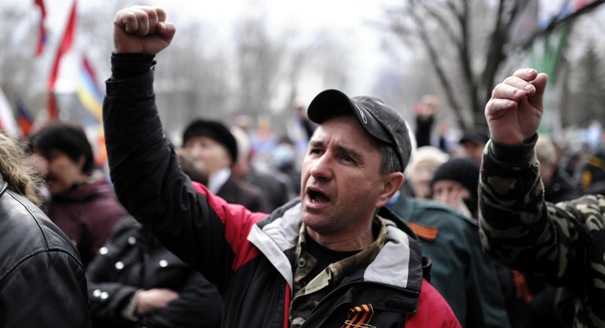
These days the situation looks to be more auspicious for Russia in Eastern Ukraine, but there too the Russian government acts the hard way—drawing in large part on subversive operations and local thugs with little if any concern about the feelings of the ordinary people. The anti-Kiev sentiments in those regions are indeed strong, but being anti-Kiev does not necessarily mean to be pro-Moscow or willing to come under the Kremlin rule. Especially if Russia’s interference in Eastern Ukraine (whatever its substance and degree) makes things messy to say the least, and has led to disorder, violent clashes and on some occasions even bloodshed.
An online account from a resident of Kharkov, Eastern Ukraine’s largest city, describes a division into three, not just two parties—the “Maidanites,” the Ukrainian nationalists who rally for a united, indivisible Ukraine; the pro-Russian “separatists;” and a third group the author refers to as the “Kharkovites” who “do not want imported revolutions or extremism, but love their city, do their jobs and businesses and dislike when somebody … smashes store windows and cars, tears down monuments… and simply gets in the way of street traffic and the life of the city.” His account of the events in Kharkov is not sensational and does not expose any secret operations or evil plots; it sounds credible because it conveys natural human sentiments. Something that the Kremlin prefers to dismiss.
Hard power is on the Russian side. If Russia seeks to hold sway over the territory of Ukraine, turn it into its buffer zone and ensure that the West would be securely barred from approaching the Russian border, it will likely succeed. But it cannot secure itself from the people’s resentment and resistance.
Former Scholar in Residence, Society and Regions Program, Editor in Chief, Pro et Contra, Moscow Center
Lipman was the editor in chief of the Pro et Contra journal, published by the Carnegie Moscow Center. She was also the expert of the Carnegie Moscow Center’s Society and Regions Program.
Recent Work
Maria Lipman
Maria Lipman
Carnegie does not take institutional positions on public policy issues; the views represented herein are those of the author(s) and do not necessarily reflect the views of Carnegie, its staff, or its trustees.

But their "principal to principal" model will only be as effective as the political strength of each leader back home.

Damien Ma

U.S. unpredictability has allowed China to capitalize on its positioning as the “responsible great power”. Paradoxically, the more China wins the perception game, the more likely expectations will rise for Beijing to deliver not just words but to demonstrate with its deeds.

Chong Ja Ian

Hanoi and Beijing have long treated each other as distant cousins rather than comrades in arms. That might be changing as both sides draw closer to hedge against uncertainty and America’s erratic behavior.

Nguyễn Khắc Giang

Across Asia, China is better positioned to withstand energy shocks from the fallout of the Iran war. Its abundant coal capacity can ensure stability in the near term. Yet at the same time, the country’s energy transition away from coal will make it even less vulnerable during the next shock.
Damien Ma

Malaysia’s chairmanship sought to fend off short-term challenges while laying the groundwork for minimizing ASEAN’s longer-term exposure to external stresses.

Elina Noor