

Paper
Matthew Rojansky
{
  "authors": [
    "Matthew Rojansky"
  ],
  "type": "legacyinthemedia",
  "centerAffiliationAll": "dc",
  "centers": [
    "Carnegie Endowment for International Peace",
    "Carnegie Russia Eurasia Center"
  ],
  "collections": [],
  "englishNewsletterAll": "ctw",
  "nonEnglishNewsletterAll": "",
  "primaryCenter": "Carnegie Endowment for International Peace",
  "programAffiliation": "russia",
  "programs": [
    "Russia and Eurasia"
  ],
  "projects": [],
  "regions": [
    "North America",
    "United States",
    "Caucasus",
    "Russia"
  ],
  "topics": [
    "Security",
    "Foreign Policy"
  ]
}
Source: Getty
Both the United States and Russia face the threat of global terrorism, and they should work together and share intelligence in order to respond to terrorist threats.
Source: Russia Today: The Alyona Show
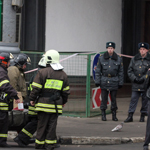
Two female suicide bombers set off explosives at two different Moscow metro stations. The deadly blasts killed 39 people and injured 87. U.S. President Barack Obama released an immediate response to the events, sharing his condolences and stating that the American people stand united with Russia against terrorism.
Matthew Rojansky participated in a live discussion on Russia Today about how the global threat of terrorism can bring two countries together. The United States and Russia both face terrorism at similar levels, asserted Rojansky, but in different ways: the problem manifested in Russia is a domestic threat, whereas the United States is facing a threat that largely comes from the outside. These terrorists are united by the same basic ideology of Islamic fundamentalism, and Rojansky believes that the two countries can learn from each other and work together, to respond to threats of terrorist attack. The basis and the willpower for high-level contact are there, he concluded, but there might be some remaining issues as to what kind of intelligence the two superpowers can share.
Former Deputy Director, Russia and Eurasia Program
Rojansky, formerly executive director of the Partnership for a Secure America, is an expert on U.S. and Russian national security and nuclear-weapon policies.
Recent Work
Matthew Rojansky
Matthew Rojansky
Carnegie does not take institutional positions on public policy issues; the views represented herein are those of the author(s) and do not necessarily reflect the views of Carnegie, its staff, or its trustees.

But their "principal to principal" model will only be as effective as the political strength of each leader back home.

Damien Ma

U.S. unpredictability has allowed China to capitalize on its positioning as the “responsible great power”. Paradoxically, the more China wins the perception game, the more likely expectations will rise for Beijing to deliver not just words but to demonstrate with its deeds.

Chong Ja Ian

Hanoi and Beijing have long treated each other as distant cousins rather than comrades in arms. That might be changing as both sides draw closer to hedge against uncertainty and America’s erratic behavior.

Nguyễn Khắc Giang

Across Asia, China is better positioned to withstand energy shocks from the fallout of the Iran war. Its abundant coal capacity can ensure stability in the near term. Yet at the same time, the country’s energy transition away from coal will make it even less vulnerable during the next shock.
Damien Ma

Malaysia’s chairmanship sought to fend off short-term challenges while laying the groundwork for minimizing ASEAN’s longer-term exposure to external stresses.

Elina Noor