

Article
Thomas de Waal
{
  "authors": [
    "Thomas de Waal"
  ],
  "type": "legacyinthemedia",
  "centerAffiliationAll": "dc",
  "centers": [
    "Carnegie Endowment for International Peace",
    "Carnegie Europe",
    "Carnegie Russia Eurasia Center"
  ],
  "collections": [],
  "englishNewsletterAll": "ctw",
  "nonEnglishNewsletterAll": "",
  "primaryCenter": "Carnegie Europe",
  "programAffiliation": "russia",
  "programs": [
    "Russia and Eurasia"
  ],
  "projects": [],
  "regions": [
    "Caucasus",
    "Georgia"
  ],
  "topics": []
}
Source: Getty
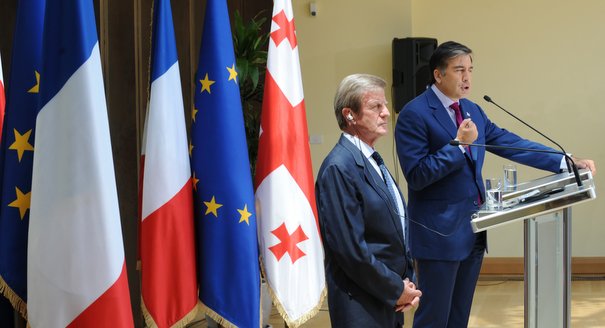
Georgian President Mikheil Saakashvili’s central role in the country’s governance may leave Georgia ill-equipped to handle the growing economic challenges ahead.
Source: The National Interest

There are several reasons for this turnaround. Georgia’s opposition proved to be fractured and unsophisticated—better at shouting slogans than focusing on the issues that the population cares about—and handed back the initiative to the president and ruling party. They have also had to contend with the inherent problems facing anyone who challenges the status quo in the post-Soviet space: lack of organizational structures and regional offices, restricted access to national television and acute problems in raising funds, with potential donors facing intimidation from the tax police. Georgia’s most promising opposition politician, Irakli Alasania, is still finding his feet. He still needs to be able to convert thoughtful policy prescriptions into popular momentum.
But the most compelling reason for Saakashvili’s pre-eminence is his own success in recapturing Georgia’s political space. More than any other politician I can think of, Saakashvili is a magician, who succeeds in being all things to all people. He is by turns Atatürk (the state builder), George W. Bush (the neocon), Zviad Gamsakhurdia (the nationalist) and Vladimir Putin (ruthless centralizer). He also reminds me of Bill Clinton, the natural communicator, and of Boris Yeltsin, who also squared political circles that others never managed to.
Consider how Misha (as everyone calls Saakashvili) manages to be the friend of both Senator John McCain and Belarussian leader Alexander Lukashenko. He still wows Republican audiences in Washington but sets up a visa-free regime with Iran. He is the man who prides himself on his stellar World Bank rating for “ease of doing business” in Georgia but also presides over an economy where monopolies are firmly entrenched.
He is the man who talks about building “Switzerland with elements of Singapore” (low taxes, minimal government) but is also pursuing a free-trade agreement with the European Union (requiring massive new regulation and harmonization with the EU). The same leader talks about traditional values and protecting Georgian culture but is also the author of a shiny new glass bridge disfiguring the old town in Tbilisi, which would be more at home in Atlanta, Georgia.
In almost all policy debates—the economy, Abkhazia and South Ossetia, relations with the European Union, social issues—Saakashvili manages to be on both sides of the debate. He was even recently quoted as saying that if he were the opposition he would be causing the government all sorts of problems. Truly he is the postmodern president.
Some would argue that having such a natural politician in charge of the country has given Georgia stability. At some point or other he gives something to every political constituency in the country. But in the end, this tour de force has to end and Georgia doesn’t yet know how to make it happen. It is an old story: the leader has made a system in which he is the indispensible center and is tempted merely to prolong it. Partly he will find it hard to contemplate life without power, partly he is the arbiter between different factions in the governing elite, who need a stabilizing force to stop civil war breaking out between them.
Georgia’s new constitution, passed in October, dismantles the heavily presidential system that Saakashvili established in 2004 after becoming president, and passes on most of the powers to the office of prime minister—just in time for him to become prime minister in 2013, as he ends his second presidential term. So far, when asked if he wants “to do a Putin” and become prime minister, Saakashvili has been evasive.
Georgians are fond of pointing out that neither of Georgia’s first two presidents left office by election. Zviad Gamsakhurdia was overthrown by force, Eduard Shevardnadze by the peaceful Rose Revolution. Saakashvili’s best legacy would be to step down peacefully and allow a constitutional transfer of power to someone else, who is not himself.
And the postmodern style may not be sustainable as long as that. Next year, 2011, will require tough decisions being taken on the Georgian economy. The big Western aid package supplied in 2008 is coming to an end, foreign direct investment is down and big debt repayments are looming in 2012. Even before the next elections, a different kind of leadership is required, with fewer grand promises and more gritty realism of the kind that is not the strong point of Misha the magician.

Senior Fellow, Carnegie Europe
Thomas de Waal is a senior fellow at Carnegie Europe, specializing in Eastern Europe and the Caucasus.
Recent Work
Thomas de Waal
Thomas de Waal
It’s about managing oil prices, bread prices, and strategic partnerships.



Amr Hamzawy, Karim Sadjadpour, Aaron David Miller, …
As North Korea continues to stall talks with the United States and South Korea, there is a greater need for China to play a more assertive role to help break the impasse.

Tong Zhao
Pitched as a new Silk Road sweeping from Asia to Europe, China’s enormous Belt and Road Initiative is an ambitious, multinational infrastructure project. Experts from four Carnegie global centers explain other countries’ perspectives.


Paul Haenle, Dmitri Trenin, Alexander Gabuev, …
Despite the BRI’s prevalence in discussions of China’s global engagement, many experts are divided on how to interpret it. Is it a global strategy or just an interregional initiative? How can countries and international companies participate in its growth and development?
Feng Yujun, Alexander Gabuev, Paul Haenle, …
With the threat of nuclear war growing, China, Russia, and the United States should not wait until political relations improve before making efforts to manage new technologies.

James M. Acton, Tong Zhao, Li Bin