

Other
Michael D. Swaine
{
  "authors": [
    "Michael D. Swaine"
  ],
  "type": "legacyinthemedia",
  "centerAffiliationAll": "dc",
  "centers": [
    "Carnegie Endowment for International Peace"
  ],
  "collections": [],
  "englishNewsletterAll": "asia",
  "nonEnglishNewsletterAll": "",
  "primaryCenter": "Carnegie Endowment for International Peace",
  "programAffiliation": "AP",
  "programs": [
    "Asia"
  ],
  "projects": [],
  "regions": [
    "East Asia",
    "China"
  ],
  "topics": [
    "Political Reform",
    "Security",
    "Military"
  ]
}
Source: Getty
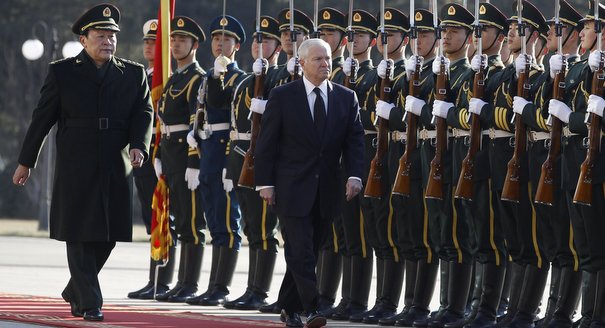
Although much about the interaction between China’s military and those who decide its foreign policy remains unknown or only dimly understood by outsiders, a close look reveals that the military does not wield ongoing decisive influence over fundamental aspects of Beijing’s foreign policy.
Source: China Leadership Monitor

As previous CLM articles in this series have indicated, at least some senior PLA officers have probably played an important role in instigating or intensifying several of these actions. However, clear and conclusive evidence of the precise role of the PLA in China’s foreign policy formulation and implementation processes remains elusive.
Indeed, very little is known about China’s military-related policy decision-making structure and process in general, both in normal times and especially during political-military crises. Most of the available information on civil-military relations and the policy process relates to the formal organizational structures involved, and less to those internal formal and informal processes and activities that produce decisions and actions throughout the process. Also, more is known about interactions between major bureaucratic players at the ministerial level and below than about interactions among the most senior civilian and military leadership and their staffs.
Moreover, it is extremely difficult to verify what little information is obtained about such policy processes. Some sources (such as many Hong Kong and Taiwan media) are notoriously unreliable; others (such as interviewees) are highly subjective and possibly biased in their interpretation, and in many cases are relating information or rumors obtained from other unverifiable sources.
In this article, we will attempt to summarize and assess what is reliably known, on an unclassified level, about the role of the PLA in China’s foreign policy and foreign policy-related policy processes. We begin with a background overview of the changing relationship of the PLA to the overall PRC leadership system and political power structure in China.
The Chinese military would presumably play a significant role in any major policy process if it wields significant power at the apex of China’s political system. This is followed by a look at the organizational and procedural relationship of the PLA to the foreign policy process in particular. This includes an examination of both senior-level interactions and those occurring at subordinate, operational levels. The article concludes with a summary and some general observations. The next CLM will examine what is known in unclassified circles about the role of the PLA in the decision-making process involving foreign political-military crises.

Former Senior Fellow, Asia Program
Swaine was a senior fellow at the Carnegie Endowment for International Peace and one of the most prominent American analysts in Chinese security studies.
Recent Work
Michael D. Swaine
Michael D. Swaine
Carnegie does not take institutional positions on public policy issues; the views represented herein are those of the author(s) and do not necessarily reflect the views of Carnegie, its staff, or its trustees.

China’s political future will be shaped between now and next October. As the Communist Party enters its intense “campaign season” to prepare for a major political transition in 2027, reading Beijing's actions and responses may become more difficult as domestic politics weigh on its behavior more than usual.

Damien Ma

China has showcased its engineering prowess with small modular reactor demonstration projects. But turning these technological achievements into commercial success will be a greater challenge.

Tong Zhao

The Plaza Accord was not an externally imposed punishment of Japan but part of a broader restructuring that Japanese economists and policymakers themselves recognized was necessary. Its effects were undermined, however, when Tokyo responded to the resulting slowdown with policies that exacerbated investment, credit expansion, and the very imbalances the adjustment was intended to resolve.

Michael Pettis

The nuclear relationship between China and the United States is increasingly shaped by widening perception gaps rather than deliberate strategic design.
Tong Zhao
China’s banking crisis in the 2000s was resolved by transferring the costs to households through financial repression—a decision that recapitalized the banks while exacerbating the structural imbalances that continue to shape the Chinese economy today.
Michael Pettis