• Commentary
  • Research
  • Experts
  • Events
Carnegie China logoCarnegie lettermark logo
{
  "authors": [
    "Evan A. Feigenbaum"
  ],
  "type": "legacyinthemedia",
  "centerAffiliationAll": "dc",
  "centers": [
    "Carnegie Endowment for International Peace"
  ],
  "collections": [],
  "englishNewsletterAll": "asia",
  "nonEnglishNewsletterAll": "",
  "primaryCenter": "Carnegie Endowment for International Peace",
  "programAffiliation": "AP",
  "programs": [
    "Asia"
  ],
  "projects": [],
  "regions": [
    "South Asia",
    "Pakistan",
    "East Asia",
    "China"
  ],
  "topics": []
}
Source: Getty

In The Media

China’s Pakistan Conundrum: The End of the All-Weather Friendship

China will not simply bail out Pakistan with loans, investment, and aid, as those watching the deterioration of U.S.-Pakistani relations seem to expect. Rather, China will pursue profits, security, and geopolitical advantage regardless of Islamabad's preferences.

Link Copied
By Evan A. Feigenbaum
Published on Dec 4, 2011

Source: Foreign Affairs

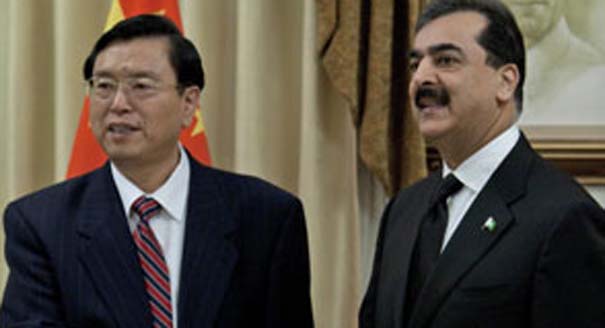
China is often called an "all-weather friend" to Pakistan -- a strategic partner, a reliable source of trade and aid, and Islamabad's closest military ally. Pakistani Prime Minister Yousef Raza Gilani has described the friendship between the two countries as "higher than mountains, deeper than oceans, stronger than steel, and sweeter than honey." In September, he told the visiting Chinese Public Security Minister Meng Jianzhu, "Your friends are our friends," continuing, "your enemies are our enemies, and your security is our security." 

But do things look so straightforward when viewed from Beijing? To be sure, Chinese money pours into places Western cash fears to tread. But Beijing is not oblivious to risk. In fact, Chinese money flows disproportionately to investments that carry little to no risk and deliver returns that, however modest, are predictable. Moreover, at least some Chinese companies have proved willing to abandon investments as their perception of risk has risen. In September, for example, Kingho, a large private Chinese miner, is reported to have abandoned a proposed $19 billion investment to build a coal mine and power and chemical plants in Pakistan's Sindh province after reassessing investment and security risks.
 
Indeed, Beijing's investment calculus is increasingly based on a sophisticated balancing of three types of risk: geopolitical, political, and financial.
 
Geopolitical risk (not least China's rivalry with India) has long led Beijing to support Islamabad through thick and thin. Friendly ties between the two help satisfy four Chinese strategic objectives: They ensure security and stability in China's western provinces and along its continental Asian border; anchor China's poorer western provinces in a web of cross-border economic activity; bottle up India in the subcontinent, forestalling the emergence of a continental-sized rival and precluding more extensive Indian security activities in East Asia; and assure that no other major power, particularly the United States, advances its interests in continental Asia at China's expense through, for instance, military deployments or permanent access arrangements...
 
Full text available in the Foreign Affairs. 

About the Author

Evan A. Feigenbaum

Vice President for Studies

Evan A. Feigenbaum is vice president for studies at the Carnegie Endowment for International Peace, where he oversees work at its offices in Washington, New Delhi, and Singapore on a dynamic region encompassing both East Asia and South Asia. He served twice as Deputy Assistant Secretary of State and advised two Secretaries of State and a former Treasury Secretary on Asia.

    Recent Work

  • Commentary
    Beijing Doesn’t Think Like Washington—and the Iran Conflict Shows Why

      Evan A. Feigenbaum

  • Commentary
    The Trump-Modi Trade Deal Won’t Magically Restore U.S.-India Trust

      Evan A. Feigenbaum

Evan A. Feigenbaum
Vice President for Studies
Evan A. Feigenbaum
South AsiaPakistanEast AsiaChina

Carnegie does not take institutional positions on public policy issues; the views represented herein are those of the author(s) and do not necessarily reflect the views of Carnegie, its staff, or its trustees.

More Work from Carnegie China

  • Commentary
    When It Comes to Superpower Geopolitics, Malaysia Is Staunchly Nonpartisan

    For Malaysia, the conjunction that works is “and” not “or” when it comes to the United States and China.

      Elina Noor

  • Commentary
    ASEAN-China Digital Cooperation: Deeper but Clear-Eyed Engagement

    ASEAN needs to determine how to balance perpetuating the benefits of technology cooperation with China while mitigating the risks of getting caught in the crosshairs of U.S.-China gamesmanship.

      Elina Noor

  • Commentary
    Neither Comrade nor Ally: Decoding Vietnam’s First Army Drill with China

    In July 2025, Vietnam and China held their first joint army drill, a modest but symbolic move reflecting Hanoi’s strategic hedging amid U.S.–China rivalry.

      • Nguyen-khac-giang

      Nguyễn Khắc Giang

  • Commentary
    Today’s Rare Earths Conflict Echoes the 1973 Oil Crisis — But It’s Not the Same

    Regulation, not embargo, allows Beijing to shape how other countries and firms adapt to its terms.

      Alvin Camba

  • Commentary
    How China’s Growth Model Determines Its Climate Performance

    Rather than climate ambitions, compatibility with investment and exports is why China supports both green and high-emission technologies.

      Mathias Larsen

Get more news and analysis from
Carnegie China
Carnegie China logo, white
Keck Seng Tower133 Cecil Street #10-01ASingapore, 069535
  • Research
  • About
  • Experts
  • Events
  • Contact
  • Careers
  • Privacy
  • For Media
Get more news and analysis from
Carnegie China
© 2026 Carnegie Endowment for International Peace. All rights reserved.







