

Research
- +10
Rosa Balfour, Frances Z. Brown, Yasmine Farouk, …
{
  "authors": [
    "Moisés Naím"
  ],
  "type": "legacyinthemedia",
  "centerAffiliationAll": "",
  "centers": [
    "Carnegie Endowment for International Peace"
  ],
  "collections": [],
  "englishNewsletterAll": "",
  "nonEnglishNewsletterAll": "",
  "primaryCenter": "Carnegie Endowment for International Peace",
  "programAffiliation": "",
  "programs": [],
  "projects": [],
  "regions": [
    "North America",
    "United States"
  ],
  "topics": [
    "Economy",
    "Trade"
  ]
}
Source: Getty
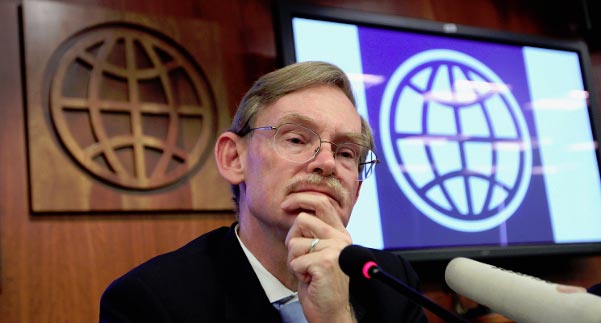
As the Obama administration begins the search for a new president of the World Bank, it risks repeating the same mistakes that all too often in the past have led to the wrong person being appointed.
Source: Financial Times

Every time this process begins, those in charge ponderously – and mendaciously – announce it will be “open, transparent and merit-based”. They know this is not true, as some of the best candidates are automatically disqualified: only US citizens connected to the occupant of the White House at the time are considered and the process is closed, and only tenuously determined by merit.
The reason is, as is well known (and regularly and futilely derided), that leadership selection for the World Bank and the International Monetary Fund is based on a shameful colonial arrangement whereby the bank’s boss is always American and the IMF’s always European. And this will not change until new powers, such as China, India or Brazil agree to join forces to end it – which is not on the cards for now.So how might this flawed process be reformed? In the past, it has led to the appointment of candidates who knew little about the bank. The consequences were confusion over its mission and obstacles in the way of providing assistance to countries in need. This is partly the result of the fact that those in charge of making – or influencing – the decision often base it on wrong notions about the ideal background of the Bank’s president. For example:
So, does all this means that only a superhuman can be successful? No. It means that Mr Obama should look for a professional who already knows this field, its ideas, players and traps, who has a vision for the World Bank rooted in practical experience with development and who has already run successfully a global organisation. This is not the time nor the place for “on-the-job-training”. Nor for paying back political favours.

Distinguished Fellow
Moisés Naím is a distinguished fellow at the Carnegie Endowment for International Peace, a best-selling author, and an internationally syndicated columnist.
Recent Work



Rosa Balfour, Frances Z. Brown, Yasmine Farouk, …
Moisés Naím
Carnegie does not take institutional positions on public policy issues; the views represented herein are those of the author(s) and do not necessarily reflect the views of Carnegie, its staff, or its trustees.

China has showcased its engineering prowess with small modular reactor demonstration projects. But turning these technological achievements into commercial success will be a greater challenge.

Tong Zhao

The Plaza Accord was not an externally imposed punishment of Japan but part of a broader restructuring that Japanese economists and policymakers themselves recognized was necessary. Its effects were undermined, however, when Tokyo responded to the resulting slowdown with policies that exacerbated investment, credit expansion, and the very imbalances the adjustment was intended to resolve.

Michael Pettis

The nuclear relationship between China and the United States is increasingly shaped by widening perception gaps rather than deliberate strategic design.
Tong Zhao
China’s banking crisis in the 2000s was resolved by transferring the costs to households through financial repression—a decision that recapitalized the banks while exacerbating the structural imbalances that continue to shape the Chinese economy today.
Michael Pettis

But their "principal to principal" model will only be as effective as the political strength of each leader back home.

Damien Ma