

Paper
David Burwell
{
  "authors": [
    "David Burwell"
  ],
  "type": "legacyinthemedia",
  "centerAffiliationAll": "dc",
  "centers": [
    "Carnegie Endowment for International Peace"
  ],
  "collections": [],
  "englishNewsletterAll": "ctw",
  "nonEnglishNewsletterAll": "",
  "primaryCenter": "Carnegie Endowment for International Peace",
  "programAffiliation": "SCP",
  "programs": [
    "Sustainability, Climate, and Geopolitics"
  ],
  "projects": [
    "Carnegie Oil Initiative"
  ],
  "regions": [
    "North America",
    "United States"
  ],
  "topics": [
    "Climate Change"
  ]
}
Source: Getty
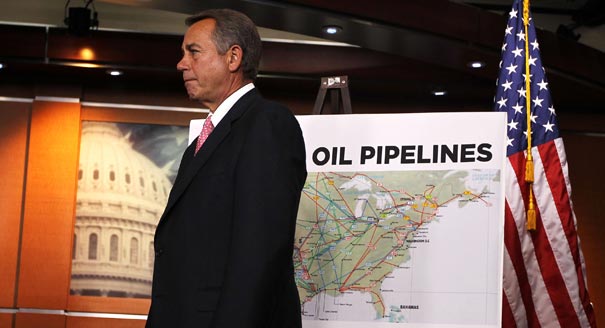
The battle over the Keystone XL Pipeline has become so heated it's easy to lose sight of whether the project is in America's national interest and what are the measurable benefits and costs.
Source: CNN

The battle has become so heated it's easy to lose sight of the main question on which the fate of the pipeline should rest -- whether the project is in America's national interest and what are the measurable benefits and costs.
The pipeline, as originally proposed, would bring crude oil from the tar sands of northern Canada through the Great Plains to the oil refineries in Texas and Louisiana, primarily for export. Supporters tout that the project would bring much needed jobs. Opponents warn of environmental risks.Unfortunately, the fight over whether to greenlight Keystone XL is creating collateral damage that vastly outweighs the marginal benefit either side will gain from sticking to its current position. Three victims among many deserve special mention: the U.S. transportation bill, U.S.-Canadian relations and America's strategic interests.
The transportation bill, now in its ninth extension, is a critical piece of infrastructure legislation that consolidates more than 100 separate programs into just five major investment categories (for efficiency) and establishes performance standards for these investments (no more "Bridges to Nowhere"). It is finally in the last stage of negotiations between the House of Representatives and Senate. While the Senate passed a bill in March in a bipartisan 72-24 vote, the House has only a shell bill to offer, plus its "non-negotiable" insistence on mandatory approval of Keystone XL. The Senate majority has its own bazooka: a presidential veto if Keystone XL is in the bill.
There is a good possibility that a sound, bipartisan bill authorizing a program so important to our future economic growth -- infrastructure -- will be tossed aside for a 10th extension and kicked into a new Congress to start all over from scratch. If this happens, both parties must stand to account in November for the damage done to our economy. America, which in 10 years has fallen from fifth to 23rd place in the quality of its infrastructure compared with its global competitors, will be the loser if the transportation bill becomes a victim of Keystone XL.
If the project can't be resolved soon, U.S.-Canadian relations could also be compromised. Canada is not only our largest trading partner but also a great friend. Today, Canada supplies the largest share of U.S. oil imports and buys our products with the money we pay them for it. Yet the Canadian government risks becoming a pawn in our domestic political catfight.
Keystone XL is being egged on by the fossil fuel lobbyists on both sides of the border who have urged Canada to double down against the initial permit denial and "turn up the political heat." In a recent meeting with representatives of the Canadian government, a U.S. oil industry representative argued that Canada should have pulled its ambassador when the Keystone XL permit was initially denied. That's crazy talk. Yet the Canadians have pushed hard for Keystone approval, bringing in both Prime Minister Stephen Harper and Alberta Premier Alison Redford to praise the pipeline and hosting the Canadian Association of Petroleum Producers while in town to brief Congress on the merits of the pipeline.
All the pressures aside, the United States needs to pause and think carefully about its national interest. Our future energy balance and supply chain should not be short-stopped by attaching Keystone XL as a nongermane rider to a transportation bill for temporary political gain. Politicians come and go; nations generally do not.
The long-term strategic interests of both Canada and the United States are better served if all parties involved heed the analysis under way in the State Department rather than resort to legislative fiat or a presidential veto. Calmer heads are already working on the details of a better proposal: a new route, improved technology and perhaps cleaner oil.
The Canadian government should vigorously and publicly embrace the existing State Department analysis and strongly oppose attaching Keystone XL as a rider to the transportation bill. Canada should not be complicit in rushed, political decisions -- it should play by the rules.
Congress should resist the temptation to use Keystone XL as an opportunity for political brinkmanship. Both Democrats and Republicans need to make sure that the real issues aren't lost in the partisan noise of Washington and that we do our best to avoid all the collateral damage.
Former Nonresident Senior Fellow, Energy and Climate Program
Burwell focused on the intersection between energy, transportation, and climate issues, as well as policies and practice reforms to reduce global dependence on fossil fuels.
Recent Work
David Burwell
David Burwell
Carnegie does not take institutional positions on public policy issues; the views represented herein are those of the author(s) and do not necessarily reflect the views of Carnegie, its staff, or its trustees.

The nuclear relationship between China and the United States is increasingly shaped by widening perception gaps rather than deliberate strategic design.

Tong Zhao

But their "principal to principal" model will only be as effective as the political strength of each leader back home.

Damien Ma

U.S. unpredictability has allowed China to capitalize on its positioning as the “responsible great power”. Paradoxically, the more China wins the perception game, the more likely expectations will rise for Beijing to deliver not just words but to demonstrate with its deeds.

Chong Ja Ian

For Malaysia, the conjunction that works is “and” not “or” when it comes to the United States and China.

Elina Noor
Regulation, not embargo, allows Beijing to shape how other countries and firms adapt to its terms.

Alvin Camba