

In The Media
Kevin Jianjun Tu
{
  "authors": [
    "Kevin Jianjun Tu"
  ],
  "type": "legacyinthemedia",
  "centerAffiliationAll": "dc",
  "centers": [
    "Carnegie Endowment for International Peace"
  ],
  "collections": [],
  "englishNewsletterAll": "ctw",
  "nonEnglishNewsletterAll": "",
  "primaryCenter": "Carnegie Endowment for International Peace",
  "programAffiliation": "SCP",
  "programs": [
    "Sustainability, Climate, and Geopolitics"
  ],
  "projects": [],
  "regions": [
    "East Asia",
    "China",
    "North America"
  ],
  "topics": [
    "Climate Change"
  ]
}
Source: Getty
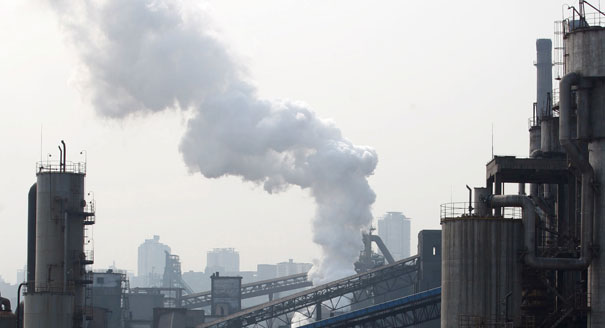
Chinese coal emissions are a major contributor to climate change. Although the Chinese government has pledged to cap coal production and consumption by 2015, more effective policies are needed to reduce the use of coal in the country.
Source: East Asia Forum

Coal accounts for 70 per cent of the country’s primary energy consumption, and coal-fired carbon emissions in China were 17 per cent higher than national carbon dioxide emissions in the United States in 2010, according to the International Energy Agency. If the world is to effectively curb the rise in global temperature at 2° Celsius or less (the international goal to avert calamitous damage), cleaning the production and use of Chinese coal will have to be an indispensable part of the solution.
Facing both international pressure to slow its spiking carbon emissions and domestic demand to improve deteriorating local environments, Beijing understands the importance of limiting its national coal consumption. The government aims to cap national coal production and consumption at around 3.9 billion tonnes by 2015.The problem is that this type of command-and-control policy does not bode well for an increasingly market-oriented Chinese economy. In 2005 Beijing set a coal-production control target of 2.6 billion tonnes for 2010 — but China’s actual coal output reached 3.24 billion tonnes in order to meet national coal demand at 3.35 billion tonnes in the same year.
And in 2011, China consumed 3.68 billion tonnes of coal, almost half of the global total. To meet this record high demand, China not only produced 3.52 billion tonnes of coal, but also imported 182 million tonnes, passing Japan as the world’s largest coal importer in 2011. Considering that China’s coal production grew by 177 million tonnes annually between 2006 and 2010, it is safe to assume that China cannot simultaneously suppress national coal production and consumption to 3.9 billion tonnes by 2015.
But China needs to act. To lower mining-related environmental degradation, and to avoid an overly sizeable coal industry once national coal consumption peaks, Beijing needs to be serious about meeting its national coal-production cap. And coal imports should be utilised to suppress domestic coal-mining activities in the years to come.
Transportation, especially railways, has long been the weakest link of the Chinese coal value chain. While China’s highly monopolised railway sector will eventually need to be deregulated to improve efficiency, it still makes sense for Beijing to keep restricting the construction of dedicated coal rail lines to ensure the price of coal doesn’t drop too low. By doing so, retail coal prices in coastal provinces can be sustained to attract coal imports and encourage energy conservation and fuel substitution. In addition, the incentives for developing long-distance transmission of power will be higher and this will help alleviate deteriorating local environments.
Currently, about half of Chinese coal is burnt for power generation — and this ratio is expected to rise over time. This means that decarbonising electricity in China is critical to a global climate solution.
Pricing carbon is recognised as one of the most effective ways of driving down carbon emissions. But China’s carbon-trade pilot programs, launched in five cities and two provinces, are likely to stumble from the beginning, as the country’s collection of energy statistics — especially on coal — is widely regarded as not transparent or accurate enough. Sooner or later, Beijing may be forced to reconsider the possibility of levying a straightforward carbon tax.
But even if the above policy package is implemented, emissions reductions are not expected to be sufficient to support a global climate solution. So it is important for China to collaborate with the rest of the world, especially the United States, Russia and the European Union, on low-carbon initiatives. These could include technological innovation, environmental legislation, energy conservation and tackling the climate implications of China’s rising coal imports.
Coal is the backbone of China’s energy sector, but it has also contributed to an unprecedented global climate challenge. To clean the production and use of Chinese coal, Beijing should take an integrated approach that addresses all aspects of the issue — including mining activities, transport and end use. In addition, innovative policy instruments should be adopted to ensure China’s national coal consumption soon peaks. And this should all be supported by international collaboration.
The world urgently needs a solution to climate change. And reducing the emissions from coal in China is an essential element of any solution.
The article was originally published in the East Asia Forum.

Former Senior Associate , Energy and Climate Program
Tu was a senior associate in Carnegie’s Energy and Climate Program, where he led the organization’s work on China’s energy and climate policies.
Recent Work
Kevin Jianjun Tu
Kevin Jianjun Tu
Carnegie does not take institutional positions on public policy issues; the views represented herein are those of the author(s) and do not necessarily reflect the views of Carnegie, its staff, or its trustees.

But their "principal to principal" model will only be as effective as the political strength of each leader back home.

Damien Ma

U.S. unpredictability has allowed China to capitalize on its positioning as the “responsible great power”. Paradoxically, the more China wins the perception game, the more likely expectations will rise for Beijing to deliver not just words but to demonstrate with its deeds.

Chong Ja Ian

Hanoi and Beijing have long treated each other as distant cousins rather than comrades in arms. That might be changing as both sides draw closer to hedge against uncertainty and America’s erratic behavior.

Nguyễn Khắc Giang

Across Asia, China is better positioned to withstand energy shocks from the fallout of the Iran war. Its abundant coal capacity can ensure stability in the near term. Yet at the same time, the country’s energy transition away from coal will make it even less vulnerable during the next shock.
Damien Ma

In the latest Five-Year Plan, the Chinese president cements the shift to an innovation-driven economy over a consumption-driven one.
Damien Ma