

Paper
James M. Acton, Ankit Panda
{
  "authors": [
    "James M. Acton"
  ],
  "type": "legacyinthemedia",
  "centerAffiliationAll": "dc",
  "centers": [
    "Carnegie Endowment for International Peace"
  ],
  "collections": [
    "U.S. Nuclear Policy",
    "Korean Peninsula"
  ],
  "englishNewsletterAll": "ctw",
  "nonEnglishNewsletterAll": "",
  "primaryCenter": "Carnegie Endowment for International Peace",
  "programAffiliation": "NPP",
  "programs": [
    "Nuclear Policy"
  ],
  "projects": [],
  "regions": [
    "North America",
    "United States",
    "East Asia",
    "South Korea",
    "North Korea"
  ],
  "topics": [
    "Security",
    "Nuclear Policy"
  ]
}
Source: Getty
Tensions with North Korea are rising as the United States strengthens its missile defense in response to threats.
Source: CTV News
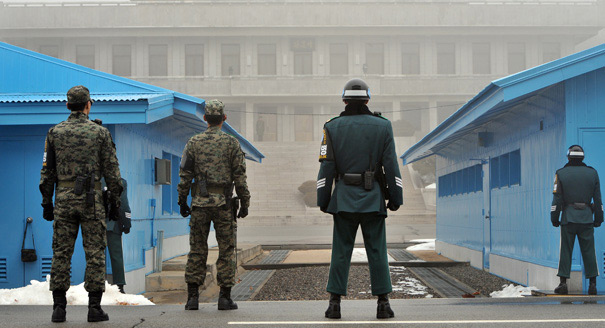
Tensions with North Korea are rising as the United States strengthens its missile defense in response to threats. Carnegie's James Acton talked to CTV News about the situation. He explained that what worries him is not that North Korea will launch a nuclear attack on the United States, but that the North Korean leader, Kim Jong-un, is going to do what his father, Kim Jong-il, did in 2010, which was to commit a provocation against South Korea when he ordered the sinking of a South Korean warship.
Acton pointed out that South Korea has said that if North Korea does something similar again it will retaliate, at which point North Korea is likely to strike back, and the United States will become involved because it has made defense commitments to South Korea. "The result of all of that could a dangerous, escalating conflict on the Korean Peninsula," said Acton, "and the use of nuclear weapons cannot be excluded."
"We don't know for certain whether North Korea has the capability to put warheads onto missiles. North Korea has certainly been claiming that it has, and it is plausible that it has, but we do not actually know," added Acton. " I wish that cooler heads will prevail over the next couple of weeks," Acton concluded, "but there's a possibility that we will be in for a very rough April."

Jessica T. Mathews Chair, Co-director, Nuclear Policy Program
Acton holds the Jessica T. Mathews Chair and is co-director of the Nuclear Policy Program at the Carnegie Endowment for International Peace.
Recent Work

James M. Acton, Ankit Panda
James M. Acton
Carnegie does not take institutional positions on public policy issues; the views represented herein are those of the author(s) and do not necessarily reflect the views of Carnegie, its staff, or its trustees.

The nuclear relationship between China and the United States is increasingly shaped by widening perception gaps rather than deliberate strategic design.

Tong Zhao

Chinese biotech companies have been on the receiving end of U.S. economic coercion. Yet their responses have differed significantly because firm and state interests are not uniformly aligned. For Washington, treating all Chinese tech firms the same, irrespective of their actual interests, risks pushing them farther into Beijing’s corner.

Xue Gong

But their "principal to principal" model will only be as effective as the political strength of each leader back home.

Damien Ma

U.S. unpredictability has allowed China to capitalize on its positioning as the “responsible great power”. Paradoxically, the more China wins the perception game, the more likely expectations will rise for Beijing to deliver not just words but to demonstrate with its deeds.

Chong Ja Ian

Across Asia, China is better positioned to withstand energy shocks from the fallout of the Iran war. Its abundant coal capacity can ensure stability in the near term. Yet at the same time, the country’s energy transition away from coal will make it even less vulnerable during the next shock.
Damien Ma